
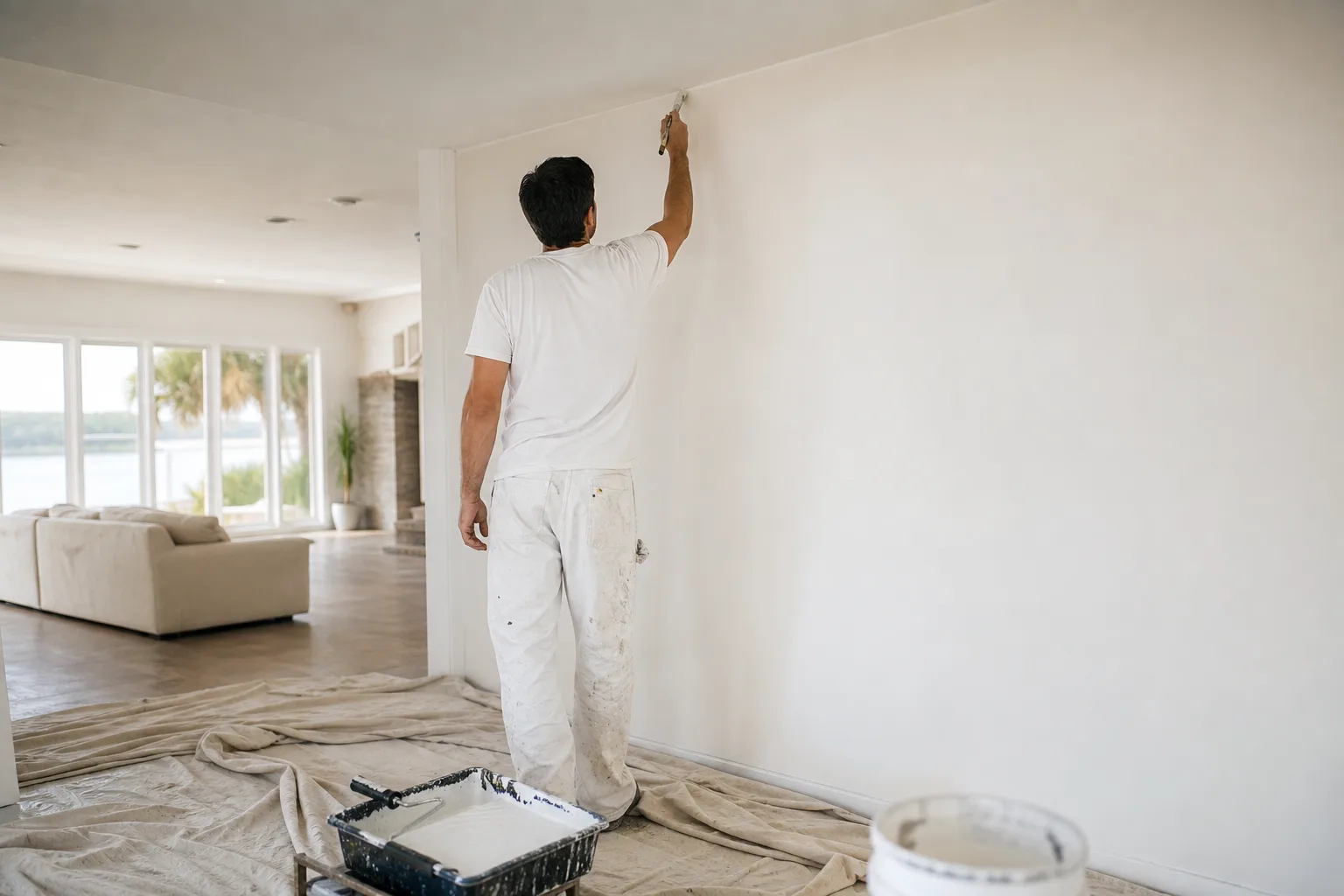
The first thing most homeowners want to know is the one thing no honest painter can answer over the phone: what will it cost to paint the inside of my house? The real interior painting cost depends on what's behind the walls — how big the space is, what shape the surfaces are in, how much prep the job needs, and the grade of paint that goes on. Two homes the same square footage can land hundreds of dollars apart once you account for ceiling height, trim, and condition.
This guide breaks down how interior painting is actually priced on the Gulf Coast, what moves the number up or down, and how to budget a repaint without getting burned by a too-good-to-be-true bid. We won't quote you a figure here — anyone who does, sight unseen, is guessing — but you'll know exactly what drives the price before you call anyone.
How is interior painting cost actually figured?
Pricing tracks the surface a crew coats, not your home's floor plan. That's the key thing to understand. A 1,500-square-foot home with nine-foot ceilings, lots of trim, and a two-story foyer has far more paintable surface — and far more labor — than the floor number suggests. Good painters estimate off the wall and ceiling square footage, the linear feet of trim, and the condition of all of it.
Labor is the largest share of almost any interior quote. Paint and materials are real, but the hours a crew spends prepping, cutting in, rolling, and doing the second coat are what you're mostly paying for. That's why prep-heavy rooms cost more even with identical paint, and why the cheapest bid is usually the one quietly skipping prep.
What drives interior painting cost up or down
Here are the factors that move the number the most, roughly in order of impact on a typical Gulf Coast interior repaint.
| Cost factor | Why it moves the price | What helps |
|---|---|---|
| Surface condition | Cracks, holes, water stains, and old peeling paint all add prep hours before any color goes on | Patch minor dings yourself; flag bigger repairs early |
| Square footage of surface | More wall, ceiling, and trim means more material and far more labor | Paint several rooms at once for efficiency |
| Ceiling height | Nine- and ten-foot walls and two-story foyers need staging and more reach time | Group high-ceiling rooms into one visit |
| Trim, doors, and detail | Crown, baseboards, doors, and windows are slow, brush-heavy work | Decide which trim actually needs repainting |
| Number of coats | Dark-to-light changes or bold colors often need an extra coat for clean coverage | Stay in the same color family when you can |
| Paint grade | Premium washable paint costs more per gallon but lasts in humid rooms | Spend up where it counts — kitchens, baths, halls |
A few of these deserve a closer look. Surface condition is the wild card — a wall that needs skim-coating or stain-blocking can double the prep time of a sound wall, and you can't see that in a floor plan. Ceiling height quietly adds up; a room full of tall walls and a staircase wall costs more than its footprint suggests. And the number of coats is where color choice meets your wallet — going from a deep color to a soft white reliably takes an extra coat, while staying in the same family covers faster.
For the full picture across exterior and cabinets too, our cost to paint a house in Mobile and Baldwin County guide puts interior pricing in context with the rest of the home. If you're only doing one or two spaces, our breakdown of the cost to paint a room gets more specific about single-room pricing.
What a complete interior quote should include
Two quotes for the "same" job can mean very different work, and the gap is almost always in what's bundled in. A complete interior painting quote spells out the surfaces, the prep, the number of coats, and the paint — so you're comparing the same thing across painters. When a number looks low, it's usually because something on this list got left out.
- Surfaces named: walls only, or walls plus ceilings, trim, doors, and closets. Each surface added is real labor.
- Prep described: patching, sanding, caulking, and stain-blocking should be written in, not assumed. Prep is where a cheap bid quietly saves money at your expense.
- Two coats, not one: a single coat rarely covers evenly, especially on a color change. A real quote says two finish coats.
- Paint grade specified: the line should name a paint level, not just "paint." Premium washable lines cost more and last longer in humid rooms.
- Cleanup and protection: furniture moving, floor and fixture protection, and daily cleanup are part of a professional job.
Repaint situations differ, too, and that shifts cost. A simple color refresh in a well-kept home is the most economical — sound walls, light patching, straight to coats. A fixer or older home with cracked plaster, water stains, or layers of old paint carries more prep and lands higher. And a whole-home interior done all at once is more cost-efficient per room than picking rooms off one at a time, because the crew sets up, protects, and works straight through instead of remobilizing for each job. Our full interior painting service covers all three.
How to budget your Gulf Coast interior repaint
Start by deciding scope honestly. Whole-home, or a few key rooms? Walls only, or trim and ceilings too? Scope drives everything else. Painting several rooms in one visit is more cost-efficient than picking them off one a year, because the crew mobilizes once and works straight through. If budget is tight, prioritize the rooms that get seen and used most — living areas, the kitchen, the primary bedroom — and the high-traffic surfaces that take abuse.
Two ways to genuinely save without buying yourself an early repaint: handle your own furniture moving and light patching where you can, and stay in a similar color family so coverage is faster. What you should never trim is the prep. Cutting prep to save a few dollars is the most expensive decision in painting — it just brings the next repaint forward.
One thing that doesn't move interior cost much on the Gulf Coast: the season. Unlike exterior work, which has to wait for the right weather window, interior painting runs year-round because we control the conditions inside. That gives you flexibility on timing — you can book the slower winter stretch when crews have more availability, rather than competing for the busy spring and fall calendar. Humidity still matters indoors during a job, though; we manage airflow so coats cure properly, which is part of why a rushed, under-dried interior job tends to need touch-ups it shouldn't.
It also pays to think a step ahead. If you're planning other work — new flooring, trim carpentry, a kitchen refresh — sequencing the painting at the right point can save you from paying to mask or touch up around finished surfaces twice. Mentioning the bigger plan at your estimate lets us order the work so you're not paying for the same protection job two times.
When you're ready for a real number, get a few written quotes and read what each one includes — prep, number of coats, which surfaces, which paint grade — before you compare bottom lines. The cheapest bid is rarely the cheapest job once you factor in how soon you'll be repainting.
Every Pro 1 interior painting job runs with one accountable crew from your free estimate to the final inspection, a clean job-site daily, and a manager who signs off before final payment — backed by our 3-year workmanship warranty and a 4.8-star rating from Gulf Coast homeowners. When you want a real interior painting cost for your home, get a free in-home estimate and we'll hand you a written quote within 24 hours.