
The first named storm of the year never asks whether your house is ready. On the Gulf Coast it just arrives, drives rain sideways at your siding for a few hours, and finds whatever was already open — a cracked caulk line on the south wall, a soft fascia corner up under the eave, a seam in the lap siding that quietly let go last summer. In Mobile, where a lot of homes have been standing for decades, those open spots are usually already there waiting. Good hurricane prep for a Mobile, AL home is finding and sealing them before the season, not during the watch.
This is a pre-storm exterior checklist built for Mobile specifically — the older housing stock, the flood-zone reality near the bay and the river, and the wet, humid summers that punish anything left open. It's not about storm-proofing a coat of paint. It's about closing the gaps so wind-driven rain can't get behind the finish in the first place. Done in spring, it's a few hours of targeted work. Skipped, it turns one storm into a season of rot and a bigger repaint than you needed.
Why do Mobile homes need their own pre-storm checklist?
Hurricane prep is the same idea everywhere on the coast — seal the envelope, protect the wood — but Mobile turns up the volume in a few specific ways, and the checklist should reflect them.
First, the houses are older. The median home in Mobile was built around 1973, which puts a big share of the city's homes near 50 years old. The older wood-sided districts feel it most — places like Midtown, Oakleigh Garden, and Old Dauphin Way are full of homes whose trim and caulk have cycled through decades of coastal summers — which means more failed joints and more soft spots than a newer subdivision has, exactly the entry points a storm exploits. Second, the water table works against you: much of Mobile falls inside FEMA flood zone AE, a designated special flood hazard area, so storm surge driven up off Mobile Bay and heavy rain can push water high against the lower courses of your walls. And third, the climate is relentless — Mobile averages around 52 inches of rain a year, and summer highs near 94 degrees, so anything you don't seal stays under pressure all season.
The Mobile pre-storm exterior checklist
The most valuable prep is targeted, not cosmetic. Walk the house with these steps in mind — the goal is to close every spot where water could get behind the finish before the first Gulf system forms.
Walk the perimeter and mark the weak spots
Circle the house and note cracked caulk, peeling paint, open siding seams, soft wood at fascia ends and sills, and loose trim or shutters. On an older Mobile home, give the south and east walls — the ones that take the wind-driven rain — an extra look.Firm up soft and rotted wood first
Repair or replace spongy fascia, soffit, sills, and trim before sealing anything. A storm pries hardest at compromised wood, and sealing caulk over rot just hides it. This is the step most often skipped on older homes here.Re-caulk the failed joints
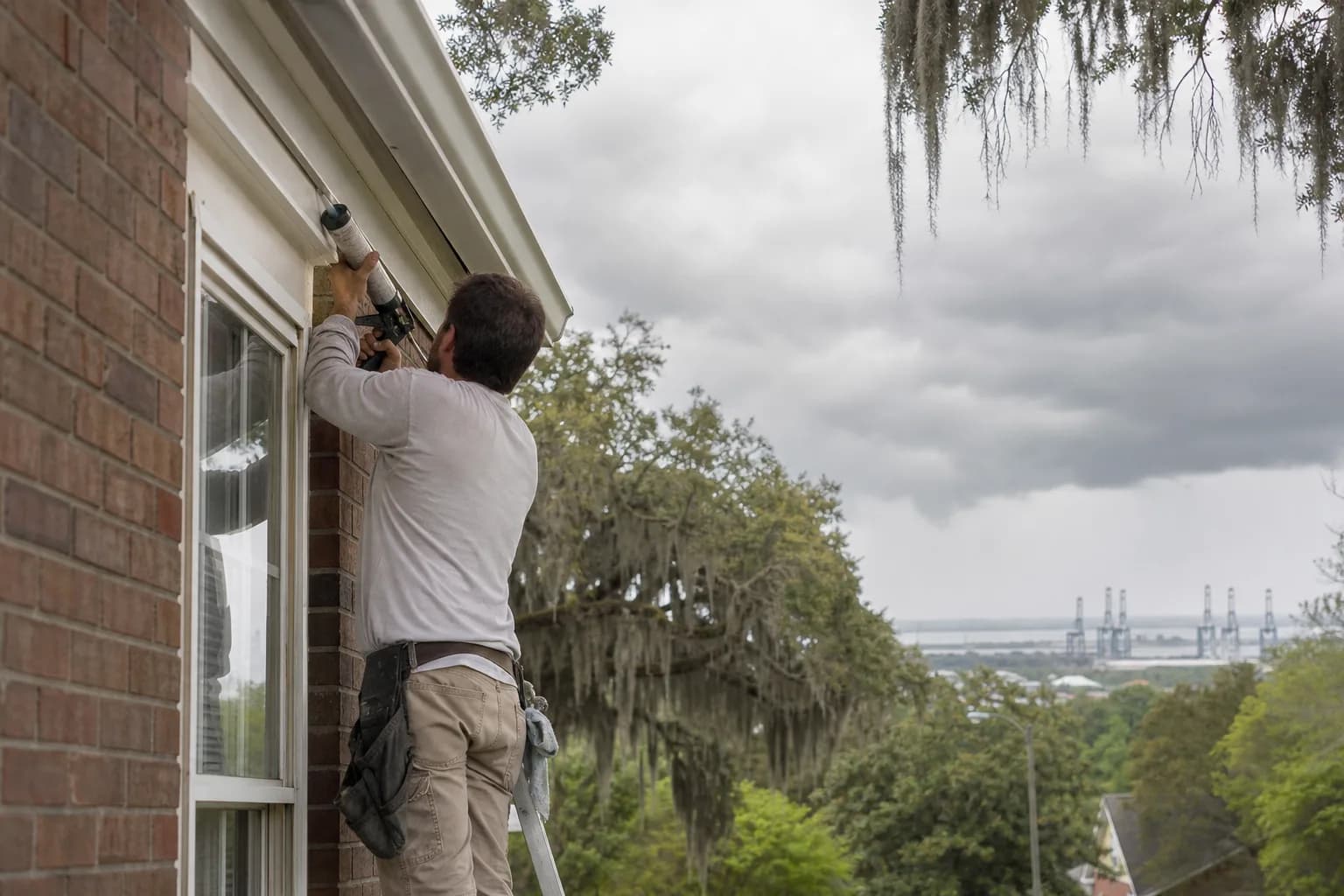
Cut out cracked or missing caulk around windows, doors, and trim and replace it with a quality flexible exterior sealant, so the seams flex with the house and shed water instead of letting it in.Lock down loose paint and bare spots
Scrape peeling or blistered paint to a sound edge and spot-prime any exposed wood while there's dry weather. Even small touch-ups close real entry points — raw wood facing a storm soaks up water fast.Pay special attention near grade
Because much of Mobile sits in flood zone AE, check and seal the bottom foot or two of siding and trim carefully. That's where rising water and surge hit hardest, and where the lowest course of siding wicks moisture first.Clear the gutters and drainage
Clean gutters and downspouts so storm water drains away from the walls instead of sheeting down the siding and pooling at the foundation, where it works into the bottom course of wall.
You can handle a fair amount of this yourself — the walk-around, clearing gutters, and small caulk touch-ups all help if there's a dry stretch. The pieces worth handing off are the soft wood, anything two stories up, and any real repainting, because a coat of paint needs settled, dry weather to cure and a storm season rarely hands you that on demand.
Time the prep for spring, not the storm watch
The single best thing about this checklist is that it works on a calendar you control. Atlantic hurricane season runs June 1 through November 30, and it builds toward a late-summer peak. That makes the months before it — roughly February through May — the right window to do this work. You get drier, settled Mobile weather to seal and spot-prime, and anything you fix has time to cure fully before the first system threatens.
What you don't want to do is rush a full repaint when a storm is already on the forecast. A complete exterior coat needs the right temperature, low humidity, and several dry days to set, and Mobile's 52 inches of annual rain and summer humidity make that window narrow even in good conditions. Paint into humid, unsettled, pre-storm air and the coat stays soft — and soft paint is more vulnerable to a storm, not less. When a system is coming and your finish is already rough, the move is protection now, full exterior painting later, on a calm, dry stretch when the coat can actually cure. If you're mapping a larger project around the calendar, our guide on the best time to paint an exterior in Mobile walks through the windows worth aiming for.
When the wood is the real problem
A lot of pre-storm trouble on older Mobile homes traces to one thing: soft wood that was already there. Rotted fascia, punky sills, and trim gone spongy are weak points a storm exploits — wind tears at them and rain drives straight in. Caulking over a rotted board doesn't protect anything; the rot keeps going and the storm makes it worse.
That's why we treat carpentry as part of protecting an exterior, not a separate job for later. One accountable scope covers finding soft wood, repairing or replacing it, priming it, and sealing it so a storm cannot pry it open. If your last paint job is peeling or blistering in the same spots every year, that's not really a paint problem — it's water getting into wood, and on a 50-year-old Mobile home it's worth addressing before the season rather than after. For the wider Mobile picture — neighborhoods, home styles, and what local homes need — our Mobile, AL painting guide and the Mobile service area page lay it out.
Protect it now, watch the radar later
Hurricane prep for a Mobile home comes down to a simple sequence: walk the perimeter, firm up the wood, seal the joints, lock down loose paint, mind the bottom courses near grade, and clear the drainage. Do it in spring and you've protected the thing that actually matters — the wood under the paint — without gambling a fresh coat against the next storm.
If you'd rather have a crew read your home's exterior before the season, that's exactly what a free in-home estimate is for. We'll walk the perimeter, point out where water can get in, and tell you honestly what needs sealing now versus what can wait for a proper repaint. We've protected Mobile-area homes through a lot of storm seasons since 2013 — one accountable crew from your free estimate through the final inspection, backed by our 3-year workmanship warranty. Get ahead of the weather, and you spend the season watching the radar instead of patching the damage.