
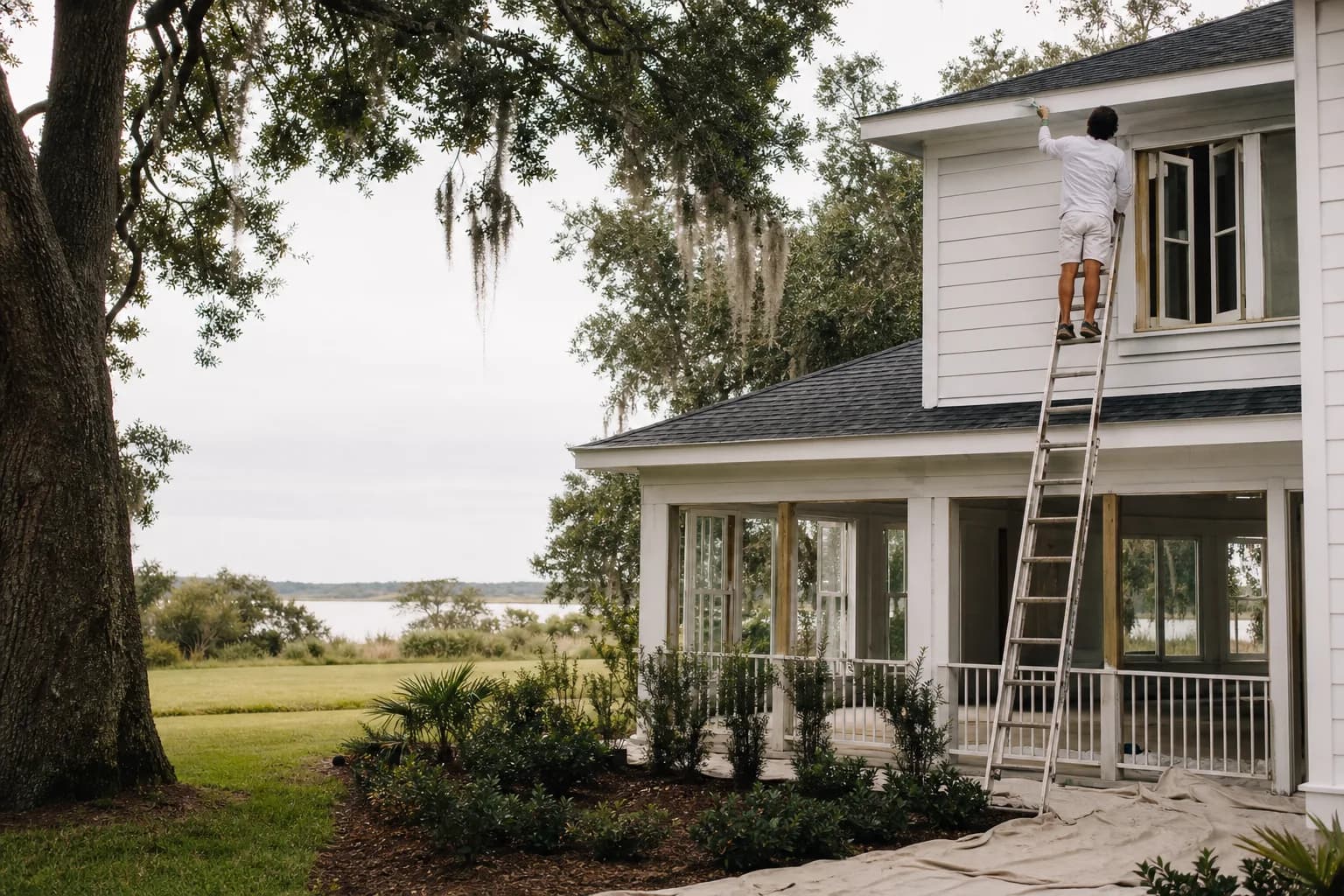
You're already bracing for the disruption — furniture shoved to the middle of rooms, ladders against the house, the smell of fresh paint for a week. So the natural thought is: if we're doing this anyway, should we just knock out the inside and the outside in one go and save some money? It's a good instinct. The answer is usually yes, it's a little cheaper — but the savings come from somewhere most homeowners don't expect, and there are real cases where splitting the work is the smarter move.
Here's the honest cost case for painting interior and exterior together, where the savings actually hide, when phasing wins instead, and how to time a combined repaint on the Gulf Coast.
Where do the savings actually come from?
Let's kill the myth first: bundling does not make the paint cheaper, and it doesn't cut the hours it takes to coat a wall. A gallon costs what it costs, and a room takes the time it takes whether or not the outside gets painted the same month.
The savings are in overhead — the cost of starting and running a job, which you pay once instead of twice:
- One mobilization. Loading the truck, showing up, setting up, and tearing down at the end is real time. Two separate jobs mean paying for that whole cycle twice; one combined project means paying for it once.
- One round of protecting your home. Inside, that's moving furniture, masking floors, and covering fixtures. Outside, it's staging ladders, laying drop cloths over beds and walkways, and prepping the perimeter. Done together, the setup overlaps instead of repeating.
- One estimate and one stretch of project management. A single free in-home estimate covers everything, and the crew runs one continuous project instead of you scheduling, scoping, and supervising two.
- One disruption to your year. Less a line item than a real cost — having painters around once beats clearing your calendar twice.
That's the core of it. If you're going to repaint both halves of your home within the same year anyway, doing them as one project trims the duplicated overhead. We go deeper on the whole-home version of this math in whole-home painting: how bundling interior and exterior saves.
When phasing is the smarter call
Bundling isn't automatically right. Plenty of times, splitting the work into two phases is the better decision even though you give up some of that shared-overhead savings. The deciding factors are usually money, urgency, and season.
| Your situation | Bundle it | Phase it |
|---|---|---|
| Both halves are due within a year | Yes — capture the shared setup | Only if budget forces it |
| Exterior is failing, interior can wait | Optional | Often better — fix the urgent half now |
| Budget is tighter this year | Harder to swing | Yes — split the cost across two years |
| You want minimal disruption overall | Yes — one stretch, not two | No — two interruptions |
| Exterior needs a dry-weather window | Plan around the season | Natural fit — exterior in season, interior later |
The big one is cash flow. The shared-overhead savings are real, but they don't outweigh a budget that's genuinely tight this year. Splitting a whole-home repaint across two years costs a bit more in total setup, but it can be the difference between doing it right and putting it off — and a phased job done well beats a rushed all-at-once job. If you want help mapping that out, how to budget for a whole-house repaint lays out the planning side.
Differing urgency splits the job too. If your siding is peeling and letting Gulf moisture creep in while the interior is just tired, the outside is the priority — handle the failing half now and bring the inside in later. There's no rule that says both halves have to be in the same shape at the same time.
How to time it when you paint interior and exterior together
If you do bundle, sequencing matters, because down here the two halves don't answer to the same conditions. Exterior work is weather-dependent — it wants a dry, mild stretch, free of afternoon storms and brutal humidity. Interior work doesn't care what the sky is doing. That difference is what drives the order:
Start with the exterior, in a weather window
The outside is the half the calendar controls. Grab a dry, mild stretch to wash, scrape, prime, and coat the exterior while conditions allow — that's the part you can't rush or reschedule around rain.Flow inside as drying allows
While exterior coats cure, or if the forecast turns, the crew can move indoors where weather is a non-issue. That overlap is what keeps a combined project moving instead of stalling between phases.Sequence interior room by room around your life
Inside, the work can be staged so you keep usable space — knock out lower-traffic rooms first, keep a path through the home, and minimize how much of your house is offline at once.Close out with one final inspection
Because it's one project, you get one walk to confirm both halves: the exterior coats, the interior cut lines, the cleanup. A manager signs off before final payment.
There's no universal "inside first" or "outside first" — an honest crew sequences it around your home's condition and the forecast, not a script. On the Eastern Shore and around Mobile Bay, that usually means catching the exterior in a good-weather stretch and letting the interior fill in around it. For the full seasonal picture, our cost to paint a house in Mobile & Baldwin County guide covers timing alongside the budget.
The bottom line
So, is it cheaper to paint the interior and exterior together? Usually a little — but the savings come from running one job instead of two, not from a discount on paint or labor. One mobilization, one round of protecting your home, one estimate, one stretch of disruption. If both halves are due within the same year and the budget's there, bundling is the efficient play. If money, urgency, or the season pull the work apart, phasing is no failure — it's just the smarter version of the same project.
The way to know which fits your home is to have both halves looked at together. We give a free in-home estimate covering interior painting, exterior painting, or both, and send a single written quote within 24 hours — itemized so you can see exactly what bundling saves you and decide with real numbers. Pay by cash, check, or credit card. Book your free estimate and we'll lay both options out side by side.