
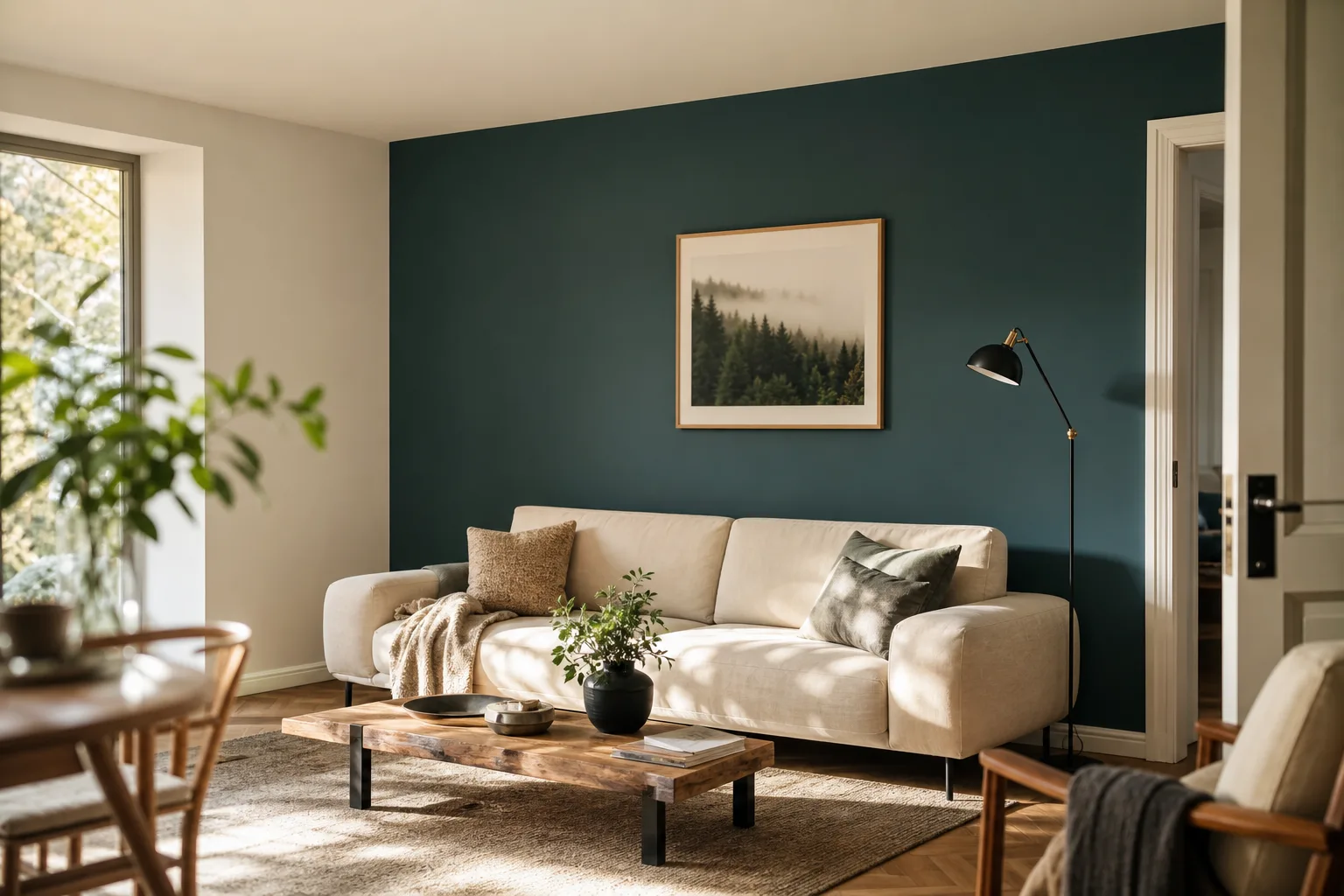
An accent wall is the cheapest way to change a room — and also the easiest way to make one look off. Paint the right wall in the right color and the space feels designed, like you meant it. Paint a random wall in a color that fights the room and you get that "why is that wall like that?" feeling every time you walk in. We've covered up plenty of the second kind.
Done right, though, a single bolder wall adds depth, frames a focal point, and lets you use a color you'd never want on all four walls. These accent wall ideas are really one idea explained well: pick the wall the room already points to, pull a color that belongs, and know the rooms where you should skip it entirely.
What makes an accent wall look intentional
An accent wall works when it agrees with the room instead of arguing with it. Two choices decide that: which wall, and which color. Get both right and almost any accent looks deliberate.
The wall should be the one your eye already lands on — the room's natural focal point. The color should feel connected to the space, not parachuted in. When those line up, the wall reads as "of course," not "interesting choice."
Where accent walls work best
The best accent wall is the wall that's already doing the work of anchoring the room. A handful of spots almost always land:
- Behind the bed. The headboard wall is the focal point of nearly every bedroom. An accent here frames the bed and makes the room feel finished, even with simple bedding and art above it.
- Behind the sofa or the fireplace. In a living room, the eye goes to the seating wall or the fireplace. Accenting it gives the furniture a backdrop and pulls the whole arrangement together instead of leaving it floating.
- A solid, unbroken wall. Walls with no doors or windows give the color a clean, uninterrupted run, which is what makes an accent look like a design move rather than leftover paint.
- A dining or entry wall. A single rich wall in a dining room or entry adds a moment of drama in a space you pass through, without committing the whole room to a bold color you'd tire of.
Notice the pattern: every one of these is a wall the room already emphasizes. You're turning up something that's there, not inventing it. That's also why the best accent walls tend to be the ones people barely register as a "feature" — the room simply looks pulled together, and the color gets the credit without shouting for it.
A second wall worth a look is the one you see straight ahead from the doorway. Even without furniture against it, the wall framed by the doorway as you enter acts like a picture at the end of a hall, and a deeper tone there draws you into the room.
How do you choose an accent color that belongs?
Color is where most accent walls go wrong. The safest, best-looking approach is to keep the accent in the room's family rather than reaching for a contrast that fights everything else.
Two reliable routes:
- Go deeper, not different. A richer, darker version of your main wall color reads as intentional and sophisticated because it's obviously related to the rest of the room. This is the most foolproof accent there is.
- Pull from something already in the room. Take the color from a rug, a painting, a throw pillow, or the upholstery. Because the eye already sees that color in the space, the wall feels tied in instead of pasted on.
Where people get burned is grabbing a saturated color with no relationship to anything else in the room. That's the accent wall that looks dated a year later — not because accent walls are out, but because that one never belonged.
See it before you commit
An accent wall is low-risk because you're only painting one wall — but the color is still a real decision, and a chip in the store won't tell you how a deep shade will feel filling an entire wall in your light. So look before you leap.
Our free AI Color Visualizer lets you upload a photo of the actual room and preview real paint colors right on your wall, so you can see a moody navy or a warm clay on the focal wall before a drop of paint goes up. If you want a second opinion from someone who does this every day, our color consultation helps you land on a shade — and a sheen — you won't second-guess. It's a lot cheaper than repainting a color you talked yourself into.
Where to skip the accent wall
Sometimes the right answer is no accent wall at all, and recognizing that saves you a redo. Skip it when:
| Situation | Why an accent backfires | Better move |
|---|---|---|
| Walls full of windows and doors | The color gets chopped into fragments and never reads as one wall | Paint all walls one color for a clean, calm look |
| A very small or tight room | A dark wall on a side wall crowds the space and closes it in | Light, single color throughout; or test a dark far wall first |
| No clear focal point | There's no natural wall to emphasize, so the accent feels random | One color on all four walls; add interest with art or trim |
| A low-light room | A bold accent can go muddy and heavy without enough light | Lighter tones, or preview the color in that room first |
In those rooms, a single well-chosen color wrapping the whole space looks more intentional than a forced accent — and you can always add personality with art, trim, or a colored ceiling instead.
The takeaway
A great accent wall isn't about being bold for its own sake. It's about finding the wall the room already points to and giving it a color that clearly belongs — a deeper version of your main shade, or a tone pulled from something in the room. Match the wall to the focal point, match the color to the space, and skip it entirely when the room has no natural anchor. For more on color choices across the whole home, our interior house painting guide covers how the pieces fit together.
When you're ready to do it right the first time, the next step is a free in-home estimate with a written quote within 24 hours. We'll help you choose the wall, the color, and the finish — and leave the room looking like you planned it all along.