
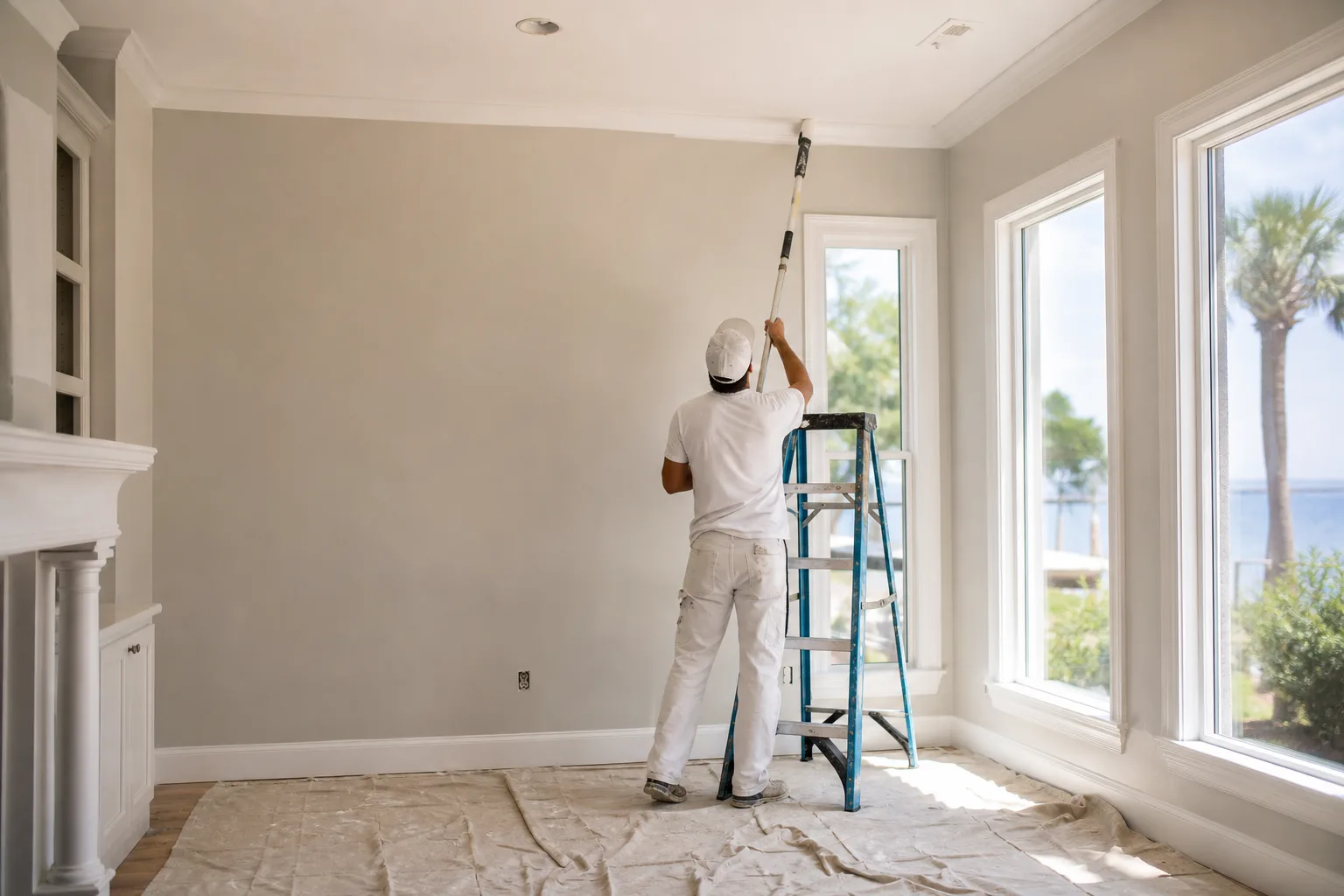
The room you're standing in right now tells the truth about its last paint job. Look at the corner where the wall meets the ceiling — is the line crisp, or wavy and patched-over? Run a hand across the trim. Is it smooth, or can you feel every brush mark and old drip? A good interior paint job disappears into the background and just makes the room feel clean and finished. A rushed one nags at you every time the light hits it.
Interior house painting in Mobile and Baldwin County looks simple from the outside: pick a color, roll it on, done. The reality on the Gulf Coast has a few more moving parts — humidity that fights your dry times, older homes with lead-suspect trim, the difference between a sheen that wipes clean and one that shows every scuff. This guide walks you through the whole thing, the way we'd explain it standing in your living room: prep, primer, sheen, trim and ceilings, lead safety, timeline, and what it's actually like to live in your house while it's being painted.
Prep is most of the job (and most of why jobs fail)
Around here we have a saying: prep is 80% of a paint job that lasts. It's not a slogan — it's where the result is won or lost. Paint is the easy part. The work that makes paint look good and stay good is everything that happens before the first coat.
Real interior prep means filling nail holes, dents, and hairline cracks; sanding those spots flush; caulking the gaps where trim meets wall so you get one clean line instead of a shadow; spot-priming the patches and any stains so they don't telegraph through; and cleaning grime off kitchen and bathroom walls so the new paint actually bonds. Skip the caulk and your trim lines look sloppy. Skip the patch sanding and every repair shows as a dull halo once the wall is painted. Skip cleaning a greasy kitchen wall and the paint peels in a season.
If you want a head start, our interior paint prep checklist covers exactly what you can do before painters arrive to keep the job moving.
Primer: when you need it, when you don't
You don't need to prime every wall, every time — but skipping primer where it matters is one of the most common DIY regrets. "Paint and primer in one" is real paint with better adhesion built in, and it's genuinely fine over a sound, already-painted wall that's a similar color. Where you still want a dedicated primer:
- Bare drywall and fresh patches — they soak up paint unevenly and "flash" (dull, blotchy spots) without primer.
- Big color changes, especially light over dark — primer saves you a third and fourth coat.
- Stains — water rings, smoke, marker, tannin bleed from wood — need a stain-blocking primer or they ghost back through.
- Raw wood trim and doors — primer is what gives the topcoat a smooth, durable surface to grip.
Get this step right and your color goes on even, covers in fewer coats, and bonds for the long haul. Get it wrong and no amount of expensive finish paint will fix the blotchiness underneath.
Sheen: pick the right one for each room
Sheen is the gloss level of the paint, and it matters as much as color — maybe more, because it changes both how a wall looks and how it holds up. Flatter sheens hide imperfections but are harder to clean; shinier sheens wipe down easily but show every bump in the wall. The trick is matching sheen to how a room actually gets used.
| Room / surface | Best sheen | Why |
|---|---|---|
| Ceilings | Flat / matte | Hides drywall flaws; no glare from overhead light |
| Bedrooms, low-traffic rooms | Matte / eggshell | Soft look, easy on the eyes, minor scuffs forgiven |
| Living rooms, halls, stairways | Eggshell / satin | Wipes clean, stands up to daily traffic and fingerprints |
| Kitchens & bathrooms | Satin / semi-gloss | Resists steam, grease, and frequent scrubbing |
| Trim, doors, cabinets | Semi-gloss | Tough, washable, gives crisp definition against the wall |
That kitchen and bathroom line matters more here than in a dry climate. Gulf Coast humidity means moisture sits on bathroom walls long after a hot shower, and a tougher, more moisture-resistant film holds up where a flat paint would streak or grow mildew. If you want to go deeper, we break this down room by room in our guide to the best interior paint sheen for every room.
Color: get it right before two coats are on the wall
Color is the part everyone agonizes over, and for good reason — it's the most visible, most personal decision in the whole project, and it's the one that's most expensive to undo. The single biggest mistake we see is choosing a color off a tiny chip or a phone screen and committing to a whole room.
Paint reads completely differently at scale and in your actual light. A gray that looks calm on a chip can turn lavender or blue once it's on four walls. North-facing rooms pull colors cooler; our strong Gulf Coast afternoon sun pushes them warmer. Always test real samples on the actual walls, look at them morning and night, and live with them for a day or two before you decide. To narrow the field first, our free AI color visualizer lets you preview real paint colors on a photo of your own room before you commit to a single sample.
This is exactly what a color consultation is for — so you don't repaint a color you regret. A little help up front is far cheaper than redoing a room because the "perfect" beige went peachy at sunset.
Don't forget trim and ceilings
Walls get all the attention, but trim and ceilings are what make a job look professional or amateur.
Ceilings: most people default to flat white and never think about it again, and that's usually the right call — flat hides the imperfections that overhead light loves to expose. But a ceiling that's gone dingy or yellowed will drag down even a beautiful wall color. If you're already painting the room, freshening the ceiling is a small add that makes the whole space read brighter and cleaner.
Trim, doors, and baseboards are where craftsmanship shows. Crisp, straight lines where wall meets trim. A smooth semi-gloss finish with no visible brush marks or drips. Caulked gaps so the trim looks built-in, not tacked on. This is slow, detailed, by-hand work, and it's the difference between a room that looks repainted and one that looks renovated.
Lead-safe work in older homes (built before 1978)
If your home was built before 1978, the existing paint may contain lead — and this is not optional fine print, it's federal law and a genuine health issue, especially for kids and pregnant women.
Mobile and Baldwin County have plenty of homes that pre-date the 1978 ban. The historic neighborhoods around Spring Hill, Old Dauphin Way, and Olde Towne Daphne are full of beautiful older houses with original windows, doors, and trim — exactly the surfaces lead paint was formulated to coat. Sanding or scraping those surfaces without the right precautions spreads lead dust through the home, and that dust is the real hazard.
What the interior painting process actually looks like
When we paint the inside of a home, it follows the same dependable order every time. Knowing the sequence makes it easy to see where corners get cut on a cheaper job — and to know what you're paying for on a good one.
Free in-home estimate
We walk the rooms with you, talk through colors and sheen, measure, and email a written quote within 24 hours. No pressure, and the estimate is free.Protect the space
We move and center furniture, then cover floors, fixtures, and anything left in the room with plastic and drop cloths before any prep begins.Prep every surface
Patch nail holes, dents, and cracks; sand them flush; caulk trim gaps; clean grime off kitchen and bath walls. This is the part that makes the finish last.Prime where it counts
Spot-prime patches, stains, and bare drywall, and fully prime raw wood and big color changes so the topcoat goes on even and bonds.Cut in and roll
Brush crisp lines along ceilings, corners, and trim, then roll the walls in even coats — usually two for full, true color.Trim, doors, and ceilings
The detailed by-hand work: smooth semi-gloss trim, clean door finishes, and a freshened ceiling where needed.Clean up and final inspection
We clean the job-site daily and do a final inspection with you before we call it done. A manager signs off before final payment, all backed by our 3-year workmanship warranty.
How long it takes, and living through a repaint
A single room is usually a one-day job. A whole-house interior repaint typically runs three to seven working days — driven by square footage, how many colors and accent walls you choose, and how much patching, caulking, and trim work the home needs before paint. More prep and more colors mean more time, but that's also what makes the result look custom.
Living in your home during the work is very doable. A few things make it smoother:
- Clear small items, breakables, and wall décor ahead of time so day one goes straight to prep.
- Plan for rooms to be off-limits while wet — we sequence the work so you always have usable space.
- Keep pets in a closed, paint-free room for their safety and ours; open paint and curious animals don't mix.
- Expect a mild paint smell. Modern low-VOC interior paints are far easier on the nose than they used to be, and good ventilation clears it quickly.
A few honest planning notes
Two things worth thinking about before you book:
Budget. Interior painting cost depends on the same things that drive the timeline — square footage, ceiling height, prep condition, number of colors, and how much trim work is involved. Rather than guess at a number, it's worth understanding what moves the price; our cost to paint a house guide breaks down the real drivers. We give you a free written estimate so you're working from your actual home, not an online average.
Who you hire. The painter matters more than the paint. Prep discipline, clean lines, a real warranty, and someone who shows up and cleans up — that's what you're actually buying. If you're getting bids, our guide on how to hire a painter covers the questions that separate a pro from a price.
Ready to refresh the inside of your home?
Whether it's one tired room or your whole house, good interior painting comes down to honest prep, the right sheen for how you live, and a crew that treats your home like it's their own. That's interior painting the way it should be done, and it's what we do for homeowners across Mobile and Baldwin County every week.
When you're ready, schedule a free in-home estimate. We'll walk the rooms with you, help with color and finish, and email a written quote within 24 hours — backed by our 3-year workmanship warranty and a 4.8-star track record on Google.