
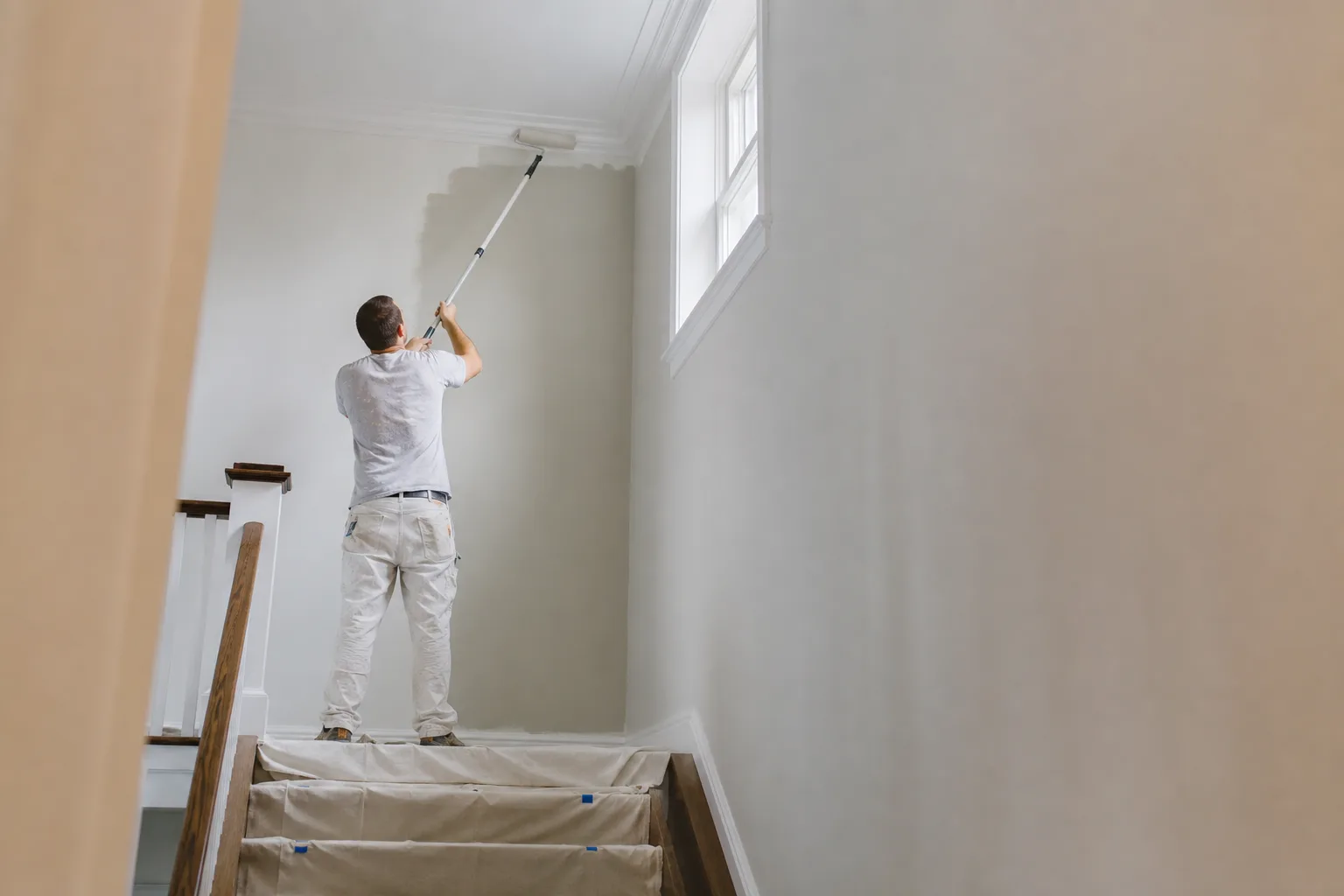
Stairwells and hallways are where most do-it-yourself paint jobs go sideways. The walls are tall, the floor underneath isn't flat, and the one spot you most need to reach is a story-and-a-half up over a staircase. It's not the painting that's hard here — it's standing somewhere safe to do it, and keeping a clean line over a run that's twice as long as any other wall in the house.
So before color, the real question is how to paint interior stairwells and hallways without taking a fall or leaving a patchy mess. That breaks into three problems: reaching the height safely, cutting a long straight line, and keeping a wet edge across a big surface. Solve those three and the rest is ordinary painting. Get the height wrong and nothing else matters.
How do you reach the height safely before you open a can?
The single most common stairwell mistake is leaning a straight ladder against the high wall and working off a rung over the steps. Stair treads are uneven and often carpeted, so a ladder foot can slip sideways the moment you shift your weight. Set a stable, level base first — every time.
For most home stairwells that means a ladder leveler or an adjustable stair platform that bridges the steps and gives you a flat standing surface. For a wide, open two-story shaft, a small rolling scaffold tower is steadier still. Once your feet are planted, an extension pole does the reaching for you, so you roll the high wall without leaning out past the rails. Your hips stay between the rails; the pole stretches, not you.
Reaching height is also exactly where bringing in a crew pays off. Our interior painting teams stage tall stairwells on proper platforms and scaffold every week, so the scary part — the part homeowners get hurt on — is routine. If your hallway is single-story and flat underfoot, it's a very doable weekend; a two-story shaft over a staircase is the job most people are smart to hand off.
Cut a long line and keep it straight
A hallway is one long sightline, which means every wobble in your cut-in line is on display the whole length of the wall. Stairwells add an angled cut where the ceiling line follows the stairs down — a diagonal that has to stay crisp. This is slow, deliberate brush work, not the place to rush.
Cut in the ceiling line, the corners, and around the trim with a quality angled sash brush, working in lengths you can keep wet. Then roll the broad field with your extension pole, feathering each pass into the cut-in band so there's no picture-frame halo around the edges. On the long horizontal run of a hallway, keep your roller passes vertical and slightly overlapped so the sheen lays down even — uneven laps show up as streaks under hall lighting more than anywhere else in the house.
Sheen choice matters as much as technique here, because halls and stairwells are scuff magnets. Shoulders, bags, hands at rail height, the dog, the vacuum — it all lands on these walls. A washable eggshell or satin wipes clean where the builder's flat just streaks and wears, which is why we steer almost every hallway to a scrubbable finish. Our guide to the best scrubbable paint for high-traffic areas digs into that, and the room-by-room best interior paint sheen for every room covers how the walls, ceiling, and trim should differ. We run Sherwin-Williams Emerald or Duration on these walls and an Emerald Urethane Trim Enamel on the rail and baseboards, where the finish takes the hardest hits.
Keep a wet edge on a tall stairwell wall
The third stairwell problem is the one nobody warns you about: the wall is so large that the first section can dry before you reach the last, and where wet paint laps over dry, you get a visible streak called a lap mark. Beating it is all about pace and section size.
Work in vertical sections you can finish top to bottom before the leading edge sets, and don't stop partway across a wall — break only at a corner or a natural edge. Roll from the freshly cut, still-wet area into the dry and back so the laps blend instead of stacking. Two thin coats beat one heavy one on a wall this size, and if you're not sure how many a color will need, our take on how many coats of paint interior walls need lays out when a single pass is asking for trouble.
Here's one Gulf Coast wrinkle in your favor: our humidity slows drying a touch, which buys a little more open time to chase that wet edge than a painter in a bone-dry climate gets. It's a small edge, not a license to dawdle — a big stairwell wall still sets faster than most people expect — but it helps on the longest runs.
The shared mechanics of the job sequence are the same on every stairwell, so here's the order that keeps drips off finished surfaces:
Protect the stairs and landings first
Cover every tread and both landings with drop cloths or rosin paper secured down so nothing slides — a stairwell funnels every drip and footstep through one narrow path. Mask the rail brackets and baseboards.Paint top down
Ceiling first, then walls, then trim and handrail last, so any spatter or drip lands on a surface you haven't finished yet.Cut in, then roll with a pole
Brush the ceiling line, corners, and trim edges in wet-keepable lengths, then roll the broad wall with an extension pole feathered into the cut-in band.Save the rail and balusters for the end
Slow brush work on the handrail, balusters, and baseboards goes last, when nothing above can drip onto fresh trim enamel.Keep a safe path open
Maintain a clear, uncovered route up and down for getting in and out, and never leave loose plastic lying over the treads.
Because a stairwell is the one path between floors, protecting it well is its own skill — secured coverings, taped-down edges, a clear walk route. If you want to see exactly how a crew shields the stairs and everything around them, how painters protect floors and furniture during a job walks through the whole setup. And if you'd like to preview a hallway color on your actual walls before you commit to a full story of it, our free AI Color Visualizer lets you upload a photo of the real space and try colors on it.
Bottom line
Painting a stairwell or a tall hallway is three jobs in one: get to the height on a stable, level rig — never a straight ladder on the steps — cut a long line slow and straight, and keep moving so the wet edge never sets ahead of you. Do those, top-down and on a scrubbable finish, and the hardest-working walls in your home come out clean and stay that way.
If the height is more than you want to take on, that's exactly the call to make — a fall isn't worth a paint job. Our family-owned crew has staged tall Gulf Coast stairwells since 2013, and one accountable team runs your project from the free estimate to the final inspection. Book a free in-home estimate and we'll have a written quote to you within 24 hours, backed by our 3-year workmanship warranty.