
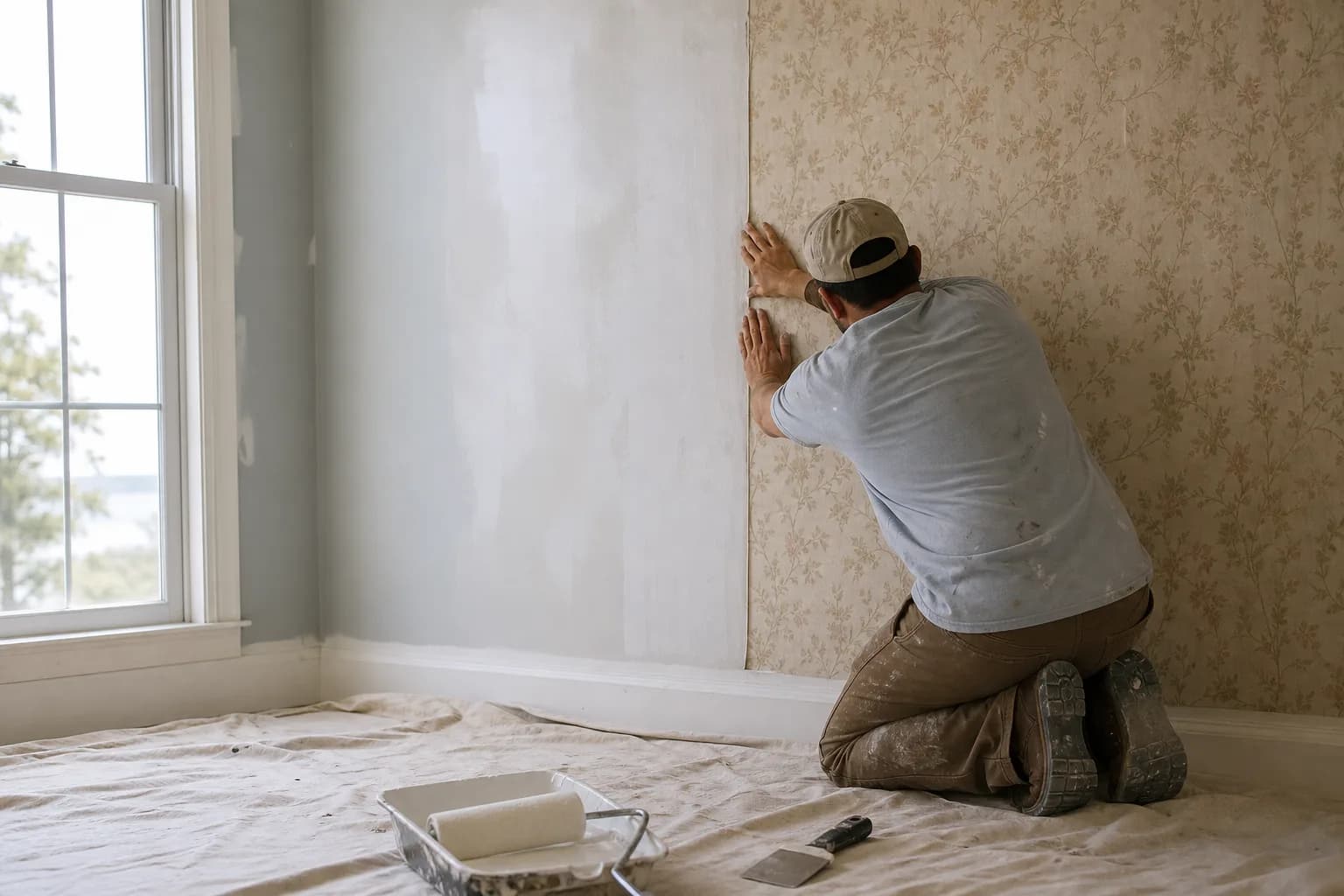
There's a roll of dated wallpaper on your dining-room wall, you'd love it gone, and somebody told you that you can just paint right over it and skip the mess. Maybe. The honest answer is that it depends entirely on the paper and the wall behind it — and getting that call wrong is how a fresh paint job ends up with seams lifting and bubbles forming a few months later.
So let's settle whether you can paint over wallpaper in your specific situation, when it's genuinely fine to do it, and when removing the paper and skim-coating the wall is the path that actually holds up — especially here, where Gulf Coast humidity is constantly working against old glue.
When painting over wallpaper is actually fine
Painting over wallpaper isn't automatically wrong. There's a narrow set of conditions where it's a perfectly reasonable shortcut, and if your wall checks every box, you can save yourself a genuinely miserable removal job.
The candidate has to be a paper that's behaving itself. Run your hand and your eyes over the whole wall and look for four things: every seam lying dead-flat with nothing peeling, paper that's smooth (not textured or embossed) and bonded hard to the wall with no bubbles or hollow spots, a room that stays dry, and no plans to ever strip it later — because once you paint it, removal gets much harder. Press on the seams and corners. If anything lifts, catches a fingernail, or sounds hollow when you tap it, the paper has already told you it's not a candidate.
When the paper passes, the work is mostly about edges. Seal the seams, smooth what you can, prime the whole wall, then paint. Here's the order that gives you the best shot at a finish that doesn't betray the paper underneath.
Clean and re-glue
Wipe the paper down to pull off dust and grease so primer can bond. Re-glue any seam or corner that's the slightest bit loose with seam adhesive and let it cure fully — a lifting edge will only get worse under paint.Skim and sand the seams
Knife a thin layer of joint compound over each seam, feather it wide, let it dry, and sand it flush. This is what keeps the seam lines from telegraphing through your finished color in raking light.Prime with a solvent-based sealer
Roll the whole wall with an oil- or shellac-based stain-blocking primer. This is the step that seals the paper, blocks the old pattern, and stops humidity from reactivating the paste beneath.Apply two finish coats
Paint two coats of a quality wall paint, letting the first dry fully before the second. Two coats is the standard for even color and durability — one almost always dries thin and uneven over a sealed surface.
If you're weighing how many finish coats you'll actually need over a primed wall like this, we break it down in how many coats of paint interior walls need.
When you should remove it and skim-coat instead
Now the other side, because more often than not, removal is the right call. The moment the paper fails any of those candidate checks, painting over it stops being a shortcut and becomes a problem you've sealed inside the wall.
Strip and skim-coat when the seams are lifting or curling, when the paper is textured, embossed, or vinyl, when there are multiple layers stacked up, or when the room sees real moisture — bathrooms, kitchens, laundry rooms, and any exterior-wall room that stays damp. The reasons are simple: a textured pattern reads straight through paint as a pattern you'll see forever, vinyl's slick plastic face won't hold paint or let trapped moisture escape, and a lifting seam painted over today is a peeling seam tomorrow. And on the Coast, humidity is the deciding factor in any close call — it's exactly what creeps under an edge and reactivates old paste. The same damp that drives our paint sheen choices for bathrooms and humid rooms is what makes painted-over paper such a gamble in those rooms.
The payoff for removal is that you end up painting a real wall instead of a layer of paper. No seams to telegraph, no glue to fail, no edges for moisture to find. After the paper and adhesive residue come off, the wall almost always needs a skim-coat to bring it back to smooth and flat, and that's the surface your paint was meant to go on.
How do you tell which path your wall is on?
You don't need to guess. The decision comes down to a short read of the wall in front of you, and the comparison below lines up the two paths side by side so you can see where yours falls.
| Wall condition | Paint over it? | Why |
|---|---|---|
| Smooth paper, all seams tight, dry room | Yes — seal and paint | A stable, bonded surface holds primer and paint reliably |
| Lifting, curling, or hollow seams | No — remove first | A loose edge only gets worse under paint and peels through |
| Textured, embossed, or vinyl paper | No — remove first | Texture shows through; vinyl won't hold paint or breathe |
| Multiple stacked layers | No — remove first | Layers trap moisture and fail unpredictably as one |
| Bathroom, kitchen, or damp exterior-wall room | Usually no — remove first | Humidity reactivates old paste and lifts seams over time |
Two things tend to push the decision toward removal even when a wall looks borderline. First, you only get one honest shot — paint over paper that turns out to be a poor candidate and the fix later means stripping painted wallpaper, which is far worse than stripping plain paper. Second, if you're changing the room's whole feel, a smooth skim-coated wall simply lets a new color read true, and it's the right moment to preview that color before you commit. Our free AI Color Visualizer lets you snap a photo of the room and try real Sherwin-Williams colors on your own walls first. While you're planning the budget side, what drives the cost to paint a room is worth a look, since removal and skim-coating add prep that a straight repaint doesn't.
Bottom line
You can paint over wallpaper only when the paper earns it — smooth, tightly sealed at every seam, in a dry room, sealed first with a solvent-based primer. The second the seams lift, the paper is textured or vinyl, or humidity is in play, removal and a skim-coat is the path that actually lasts, because you're painting a real wall instead of betting on old glue.
If you'd rather not make that call alone, that's what we're here for. Pro 1 Painters will read the wall, tell you straight which path it's on, and handle the removal, skim-coating, priming, and finish as one job — all of it backed across interior painting work throughout Mobile and Baldwin County. Book a free in-home estimate and you'll have a written quote within 24 hours. We're family-owned since 2013 and back the work with a 3-year workmanship warranty. Pay by Cash, Check, or Credit Card.