
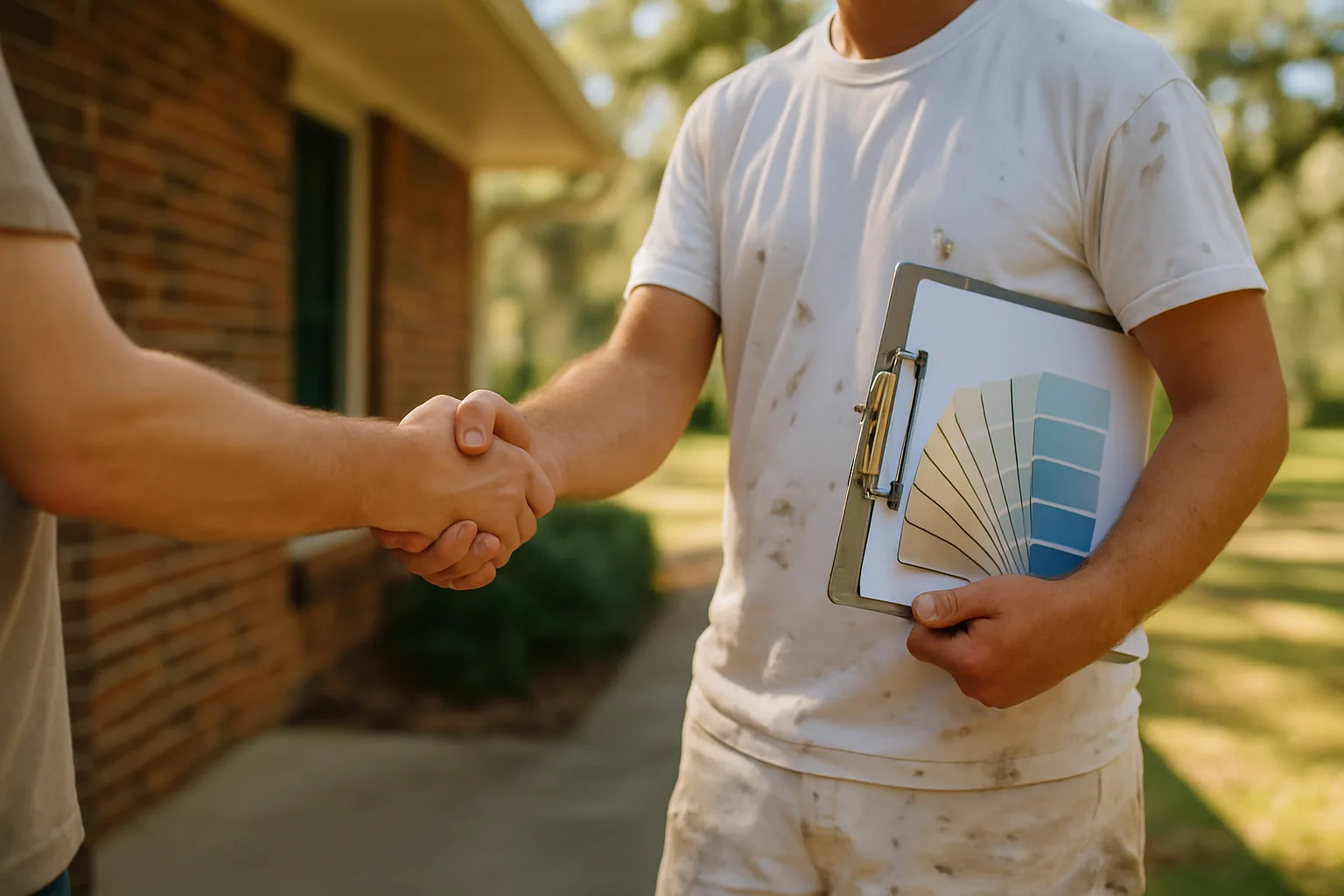
Hiring a painter feels simple until the bids come back and three numbers are hundreds of dollars apart. One painter quoted a long afternoon. Another wants a week. A third gave you a price scribbled on a business card and asked for half down today. Which one's the deal, and which one's the headache?
We've repainted homes all over Mobile and Baldwin County since 2013, and we've also been called in to fix plenty of jobs that started with the wrong hire. The pattern is almost always the same: the homeowner picked on price alone, the prep got skipped, and the paint started failing inside a year or two. This guide is how to pick right the first time — the questions that actually separate a pro from a price, how to check licensing and insurance, how to read an estimate, and the red flags worth walking away from.
How to hire a painter: start with the questions that reveal real pros
Anyone can say they paint houses. The way someone answers a few specific questions tells you whether they run a real operation or work out of a truck between jobs. You're not trying to trip them up — you're listening for confidence and detail.
Here's what to ask, and why each one matters:
Listen for prep talk especially. On the Gulf Coast, salt air, humidity, and hard sun punish a finish that went on over a dirty or peeling surface. A painter who leads with pressure-washing, scraping to a sound edge, treating soft wood, caulking, and priming bare spots is telling you they know our climate. A painter who jumps straight to "two coats and we're done" is telling you something too.
If you want the full list with follow-ups, we go deeper in our companion post on the questions to ask before hiring a painting contractor.
How to verify a painter is licensed, insured, and bonded in Alabama
This is the part most homeowners skip, and it's the part that protects you if something goes wrong. Here's what each term actually means and how to confirm it — for any painter you're considering.
Licensed. Licensing for painters in Alabama depends on the city and the size of the job. Many municipalities require a local business license for anyone doing work inside city limits, and larger projects can fall under state contractor rules. Don't assume — ask each painter directly what licenses they hold, and check with the city where your home sits. The City of Mobile, the City of Daphne, and the City of Spanish Fort all handle their own business licensing, so a painter working across the bay may need more than one.
Insured. This is the one you never skip. A painter should carry two kinds of coverage: general liability (pays if they damage your home — a ladder through a window, overspray on your car) and workers' compensation (covers an injury on your property so the liability doesn't land on you). Ask for a certificate of insurance, and for a big job, call the insurer to confirm the policy is current. A painter with nothing to hide will hand it over without a flinch.
Bonded. A surety bond is a financial guarantee that the work gets finished or you're made whole if it isn't. Not every residential painter carries one, and it's less universal than insurance — but if a painter advertises being bonded, ask what the bond actually covers and who issued it.
Hold any painter you're considering to that standard — ask for the certificate, and call the carrier on a big job. For our part, Pro 1 Painters runs every job with one accountable crew and a manager sign-off before final payment, backed by a 3-year workmanship warranty — and we're glad to talk through how we work at your estimate. We dig into all of this — what to check and how — in our guide on whether your painter is licensed, insured, and bonded in Alabama.
Reading a written estimate (and what a vague one hides)
A real estimate is a document, not a dollar figure. The price on a sticky note tells you nothing about what you're getting, and it gives a painter room to cut corners later and call it "what we agreed to." A proper written estimate is your protection and your apples-to-apples baseline.
A good estimate should spell out:
- Scope — exactly which surfaces, rooms, or sides of the house are included (and what's excluded).
- Prep — pressure-washing, scraping, sanding, caulking, wood repair, priming. This is the line that separates real bids.
- Products — the paint brand, product line, and number of coats. "Paint" is not a spec.
- Labor and timeline — how many days, and who's on site.
- Price and payment terms — the total, the deposit, and when the balance is due.
- Warranty — what's covered and for how long, in writing.
When you have all that on paper, you can finally compare bids fairly. A cheaper number with no prep line isn't actually cheaper — it's a different, smaller job wearing the same word.
Comparing quotes apples-to-apples
Three quotes that look wildly different usually aren't pricing the same work. Before you decide, line them up against each other and look past the bottom number.
| Green flag (hire with confidence) | Red flag (slow down) |
|---|---|
| Detailed written estimate that itemizes prep, products, and coats | A single number with no breakdown, or a verbal-only quote |
| Specific prep steps for our coastal climate | "We'll just two-coat it" with no surface prep |
| Names the paint brand, line, and number of coats | Won't say what paint they'll use, or 'contractor-grade' |
| Modest deposit; balance due on completion | Wants most or all of the money up front |
| Proof of liability and workers' comp insurance on request | Dodges the insurance question or 'doesn't need it' |
| A written warranty with clear terms | No warranty, or 'we stand behind our work' with nothing on paper |
| Real local reviews and reachable references | No reviews, no references, or a brand-new business with no track record |
The lowest bid is tempting, and sometimes the lowest bid is honest. But more often a rock-bottom price is hiding thinner prep, cheaper paint, or a crew that's racing to the next job. The true cost of a paint job is what it looks like in three years. If you want to understand what legitimately drives the number up or down, our cost to paint a house guide breaks down the real cost factors so you can tell a fair bid from a fantasy.
Deposits, payment schedules, and warranty
How a painter handles money tells you a lot. A modest deposit to reserve your spot on the calendar or cover materials is completely normal. What's not normal is a painter who wants the whole job paid before a brush touches your wall — that's the setup for a crew that disappears or loses interest once the cash is in hand.
A healthy payment rhythm is simple: a reasonable deposit up front, the balance when the work is done and you've signed off on it. That last part matters. Your final payment is your leverage to make sure the job is actually finished to the standard you were promised. At Pro 1, a manager inspects the work and signs off before we ask for final payment, and you pay by cash, check, or credit card — no surprises.
On warranty, get the length and the terms in writing. A workmanship warranty means the painter stands behind their labor, not just the can of paint. We back our work with a 3-year workmanship warranty, because prep done right is supposed to last — and we're willing to put that in writing.
Red flags and common painting scams
Most painters in this area are honest. But a few patterns show up again and again on the jobs we get called to rescue, and a few are outright scams. Knowing them up front is the cheapest insurance you'll ever buy.
The door-to-door 'leftover paint' pitch
Someone knocks claiming they have paint left from a job down the street and can do yours cheap today. Real painters don't sell off a truck. This is a classic high-pressure scam.All the money up front
A large deposit or full payment demanded before any work begins is the single most common way homeowners get burned. A modest deposit is fine; the rest follows the work.No written estimate or contract
If a painter won't put the scope, prep, products, and price in writing, you have no agreement and no recourse. Walk away.Pressure to decide right now
'This price is only good today' is a sales tactic, not a real deadline. A reputable painter's estimate holds long enough for you to think it over.No insurance and no proof
If they can't show a certificate of insurance, an injury or accident on your property can become your problem. Don't risk it.No reviews, no references, no trail
No online reviews, no recent jobs they'll let you see, and a name you can't find anywhere should give you pause — especially paired with any of the above.
Any one of these on its own might just be a sloppy operator. Two or three together is your cue to keep looking. We cover the cons and warning signs in more detail in our post on painting contractor scams and red flags.
What are you really hiring a painter for?
Strip it all down and you're not buying paint — you're buying prep discipline, clean lines, a real warranty, and a crew that shows up, does what the estimate says, and cleans up after itself. The brand on the can matters far less than the people holding the brush.
We've earned our 4.8-star track record on Google the slow way: honest estimates, obsessive prep, and standing behind the work. We're a family-owned crew that's been painting Mobile and Baldwin County homes since 2013, and we're happy to be one of the bids you compare — line by line, against everything above.
When you're ready, schedule a free in-home estimate. We'll walk your project with you, talk through prep, color, and finish, and email a written quote within 24 hours. Whether it's house painting for your home or a larger commercial project, the right hire starts with the right questions — and now you know which ones to ask.