
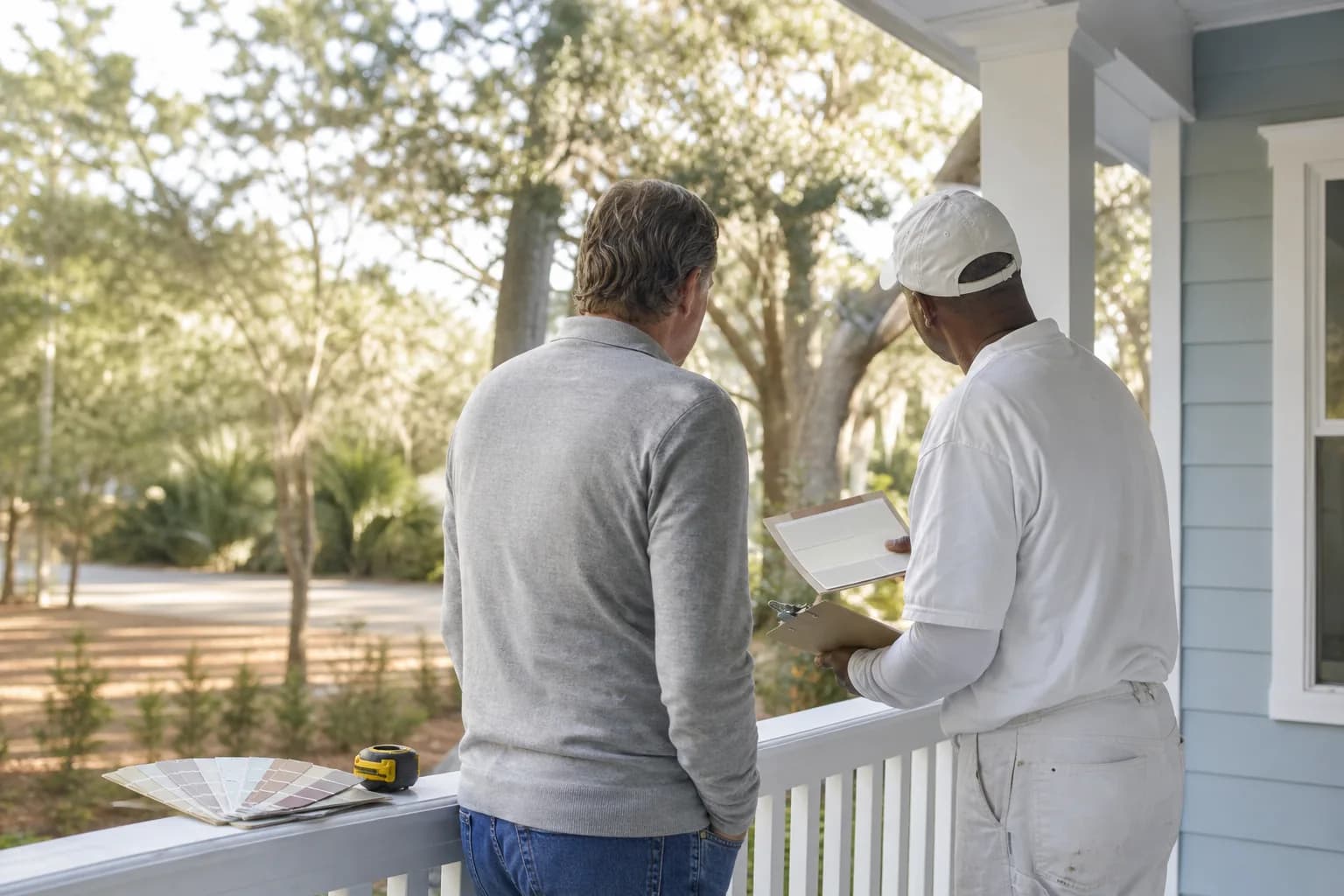
There's a moment, right after a painter finishes walking your house, when they look up and ask if you have any questions — and most homeowners freeze, say "I think that's it," and end up choosing between bids on price alone. That's the moment that decides a lot. The right few questions, asked plainly, separate a crew that does lasting work from one that's racing to the next job, long before a brush ever touches your wall.
So here are the questions to ask a painting contractor before you hire — a fuller set than the usual two or three, covering insurance, prep, products, the crew, the warranty, the timeline, and payment, with a note on what a good answer actually sounds like for each. You're not trying to trip anyone up. You're listening for specifics and confidence. For a shorter starter version, our quick post on the four questions to ask a house painter covers the essentials; this one goes the whole way, and our full guide to hiring a painter in Mobile and Baldwin County ties it all together.
What questions should you ask a painting contractor?
Answer first: the questions that matter most are about insurance, prep, products, accountability, warranty, timeline, and money — in roughly that order. Run any painter through the list below and the right choice tends to get obvious. Here's the full set, each paired with what a strong answer sounds like.
Are you insured — and will you show proof?
Ask for general liability and workers' comp, and ask to see the certificate. A good answer is a painter who hands it over without hesitation. A vague 'we're covered' with nothing to show is the answer.Walk me through your prep on a job like mine
Prep is where a lasting job is won or lost. A strong answer names specific steps — washing, scraping to a sound edge, treating soft wood, caulking, priming bare spots. 'We'll just two-coat it' is a red flag.What paint, and how many coats?
You want the brand, the product line, the sheen per surface, and two coats over a color change. A painter who says only 'quality paint' and won't commit to coats is leaving room to cut.Who runs the job, and who signs off at the end?
You want one accountable crew and a single person who inspects the work before final payment. A good answer names how the job is supervised, not just 'my guys.'What does your warranty cover, and for how long?
Ask for the length and the terms in writing. 'We stand behind our work' with nothing on paper isn't a warranty. A confident painter puts the workmanship warranty next to the price.What's the timeline, and what could delay it?
A realistic window plus an honest note about weather and drying days beats a too-good 'we'll knock it out in a day.' Speed that skips prep shows up within a couple of seasons.How's the deposit and payment structured?
A modest deposit to book and buy materials, with the balance tied to a finished, inspected job, is healthy. Most or all of the money up front is the single most common warning sign.Can I see recent reviews and reachable references?
Recent, detailed reviews and a recent local job they'll let you ask about beat a thin cluster of old five-star blurbs. No trail at all, paired with any of the above, is your cue to keep looking.
That's the spine of the conversation. The four questions below are the ones worth pressing hardest, because they're where good painters and cheap ones diverge the most.
Insurance: the question you never let slide
Start here, because it's the one that protects your home and your bank account. A legitimate painting contractor carries general liability (pays if they damage your home — a ladder through a window, overspray on the car) and workers' compensation (covers an injury on your property so it doesn't become your problem). The question is simple: "Are you insured, and can I see the certificate?"
The answer tells you almost everything. A real company hands over a certificate of insurance without flinching, and on a large job won't blink if you call the carrier to confirm it's active. A painter who gets defensive, changes the subject, or keeps "meaning to send it over" has just answered for you. "Licensed, bonded, and insured" is easy to print on a flyer — the homeowner who actually asks to see proof is the one who's covered. We dig into how to verify all of it in our post on whether your painter is licensed, insured, and bonded in Alabama.
Prep and products: the questions that predict how long it lasts
If you only press hard on one thing, press on prep. Ask the painter to walk you through how they'd prep a job like yours, and listen for specifics. On the Gulf Coast, salt air, humidity, and hard sun punish a finish that went on over a dirty, glossy, or peeling surface. A painter who leads with pressure-washing, scraping to a sound edge, treating soft or rotted wood, caulking gaps, and priming bare spots is telling you they know our climate. A painter who jumps straight to "two coats and we're done" is telling you what they'll skip.
The product and coats questions work the same way. You want the brand, the exact product line, the sheen for each surface, and two coats over a color change — not just "quality paint," which means different things to different crews. None of this is about being difficult; it's about getting the painter to commit, on paper, to the things that determine whether your color still looks crisp in three years. If you're weighing an exterior painting project specifically, prep and product matter even more, because that's the surface our weather hits hardest. And our post on whether prep work costs more than the paint explains why the prep line, not the paint line, is usually where the real value sits.
Accountability, warranty, and how a good painter answers
The last cluster is about who's responsible and how they back it up. Ask who actually runs the job and who signs off at the end. The best protection on a paint job isn't a clever contract clause — it's continuity. You want one accountable crew running your project from the free estimate through the final inspection, and a manager who inspects the work before you make final payment, so the people who started your home are the ones who finish it. When you have to re-explain your house to a new face halfway through, details get lost.
Then ask about the warranty — the length and the terms, in writing. A workmanship warranty means the painter stands behind their labor, not just the can of paint, and a confident crew is happy to put it next to the price. "We stand behind our work" with nothing on paper isn't a warranty; it's a phrase. Our breakdown of what a painting warranty actually covers shows you what to look for in the terms.
Across every one of these questions, the tell is the same: a good answer is specific, offered without hesitation, and backed by paper. "Here's our prep, here's the paint and the coats, here's the certificate of insurance, here's the warranty" is the sound of a real operation. Vague reassurance with nothing to show is the opposite. If a question makes a contractor cagey, that's information too.
Put the questions to work
You don't need to interrogate anyone. You need a short, plain list and the patience to listen for specifics over reassurance. Insurance with proof. Prep you can picture. A named paint and two coats. One accountable crew and a sign-off. A written warranty. A realistic timeline. A reasonable deposit. Recent reviews and a reachable reference. Run two or three painters through the same questions and the right one usually stands out — not as the cheapest bid, but as the one whose answers you could actually hold them to.
We've earned a 4.8-star Google rating across Mobile and Baldwin County the slow way — honest answers, obsessive prep, and standing behind the work, family-owned since 2013. We'd be glad to be one of the painters you put these questions to. When you're ready, schedule a free in-home estimate and we'll give you straight answers and a written quote within 24 hours. Whatever your project, our house painting services start with the right questions — and now you know which ones to ask.