
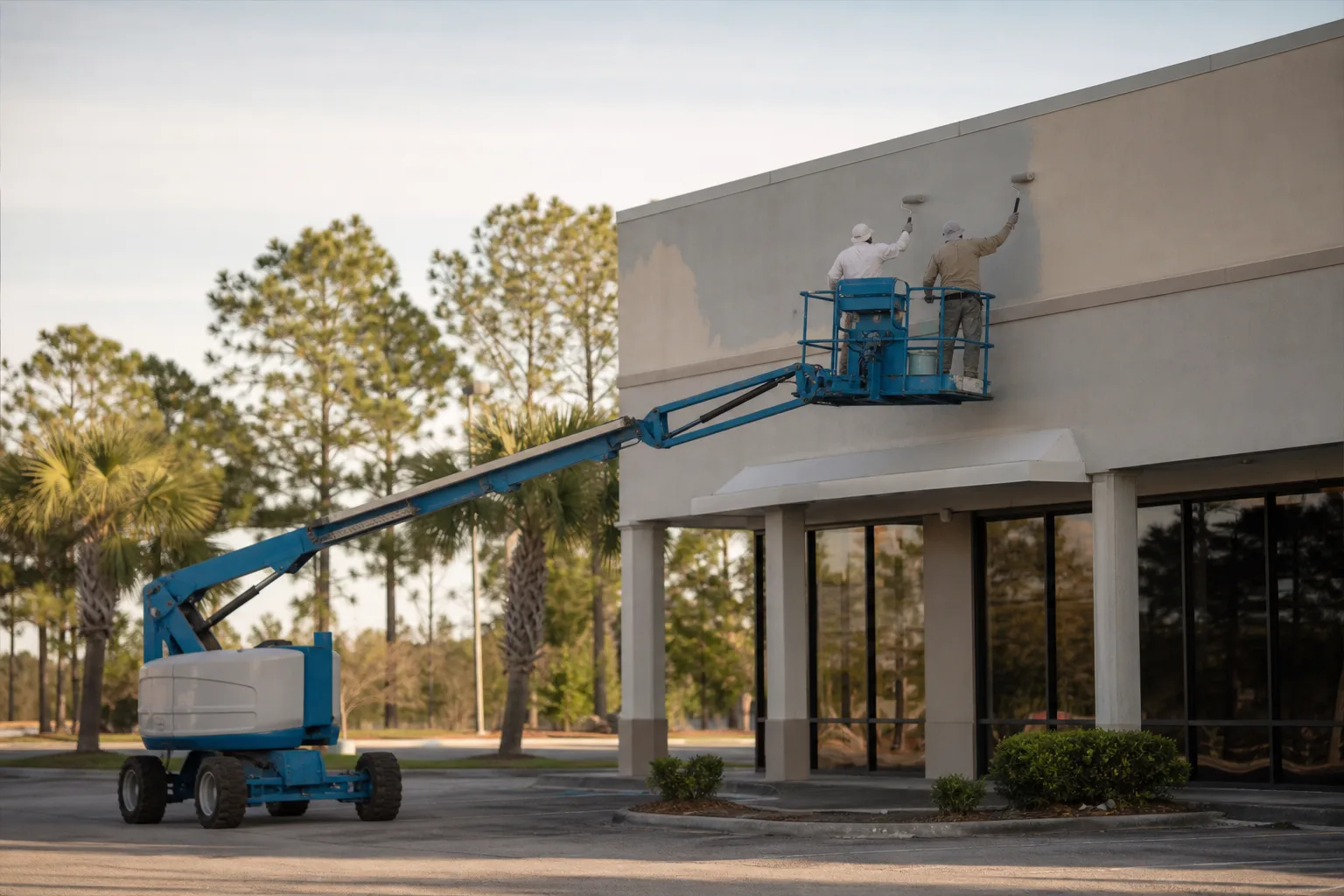
A property manager called us last spring with one question: "What's it going to cost to paint our building?" Fair question. The honest answer is that "our building" covers everything from a 1,500-square-foot office suite to a weathered two-story storefront on a busy highway — and those don't price anywhere near the same.
So instead of a single number that won't fit your property, here's the real version: what commercial painting cost looks like around the Gulf Coast in 2026, how interior and exterior jobs get priced differently, and the building factors that actually move your estimate up or down. When you're ready for a real figure, we'll walk the property and put a written quote in your hands within 24 hours.
What drives commercial painting cost
The biggest mistake owners make is comparing buildings by square footage alone. Square footage matters, but on a commercial job it's only one input. Two buildings with identical wall area can land thousands of dollars apart once you account for what the crew actually has to do to reach, prep, and paint those walls. A flat, single-story warehouse face and a three-story storefront with detailed cornices might measure the same on paper and price nothing alike in practice.
Square footage and ceiling height set the baseline. Total paintable area drives the labor hours and the amount of paint, and tall warehouse or lobby ceilings add equipment and time that a standard eight-foot wall never does. From there, three factors swing the number hardest. Access and height come first: upper stories, atriums, and tall exteriors need lifts or scaffolding, and that equipment rental plus the slower, safer pace it forces raises the price well beyond the cost of the paint itself.
Surface condition and prep come next, and on a commercial building this is the single biggest swing factor. Peeling, chalking, mildew, rust, or failed caulk all mean more hours before a finish coat goes on, and it's exactly the line cheap bids quietly skip. Substrate matters alongside it: block, stucco, metal, EIFS, and wood each take different products, and commercial-grade paint built to survive humidity and UV costs more than builder-grade — but it lasts, which is the whole point on the Gulf Coast.
The last factor is scheduling, and it matters more here than owners expect. A restaurant or retailer that closes for a paint job loses revenue every day the doors are shut. Off-hours, weekend, or phased work so you can stay open affects labor timing and nudges the estimate up a little — but it's almost always far cheaper than closing. We'd rather paint your lobby at 9 p.m. than cost you a day of business.
Interior vs. exterior commercial painting prices
The clearest way to think about commercial painting cost is to split it the way the work actually splits: inside and outside. They use different products, different equipment, and different prep, so they price on different curves.
| Project type | Typical market range | What pushes it higher |
|---|---|---|
| Interior — small suite or office | $2 – $5 per sq ft | High ceilings, heavy patching, trim and door detail, color changes |
| Interior — large facility | $1.50 – $4 per sq ft | Lobbies, atriums, occupied-space scheduling, specialty finishes |
| Exterior — single story | $3 – $7 per sq ft | Surface prep, substrate type, washing, multiple colors |
| Exterior — multi-story | $4 – $10+ per sq ft | Lifts and scaffolding, height, weathered substrates, rust or rot repair |
Notice how wide each band is. That width is the point. The room inside each range is exactly where the building factors above live. A clean, single-story strip center that needs one color and minimal prep lands near the bottom; a three-story office with failing caulk, rust at the railings, and lift access lands near the top — or above it.
Why the cheapest commercial bid is rarely the cheapest job
On a commercial building, a bid that skips prep doesn't just look worse — it fails faster, and you repaint sooner. Gulf Coast buildings take a beating from salt air, humidity, and hard UV. Painting over chalked, mildewed, or peeling paint on an exterior wall is money you'll spend twice when it lets go in a season or two.
The same logic runs through the whole quote. A real commercial estimate spells out the surfaces, the washing and prep, the repairs, how many coats, and the products. A lowball bid often hides what it leaves out, which is why it pays to know how to vet a commercial painting contractor before you sign anything. Before you compare two numbers, compare two scopes — because the lasting job is rarely the cheapest bid, but it's usually the cheapest over the life of the paint. That's the same principle behind our 1-year workmanship warranty: we'd rather do the prep once than chase a callback.
If you're also weighing interior repaints across multiple suites, the drivers overlap with what we cover in our cost to paint a house guide — size, condition, and prep run the price on any job, residential or commercial.
How do you get an accurate commercial estimate?
Because every building is different, an honest commercial quote starts with someone actually looking at yours. When we estimate a commercial job, we walk the property, measure the paintable surfaces, check the substrate and its condition, note the access challenges, and talk through your scheduling so the work fits around your operation rather than the other way around.
From there you get it in writing within 24 hours: the surfaces, the prep, the coats, the products, the timeline, and what's excluded. That written scope is the part that actually protects you. It's what makes two bids comparable line by line, and it's what keeps a job from drifting into change orders halfway through. When everything is spelled out up front, there are no surprises on the final invoice.
It also keeps accountability clear. One crew runs the project from the estimate through the work, and a manager signs off on a final inspection before final payment — so there's a single point of responsibility for the whole job, not a finger-pointing chain if something needs a touch-up. For a property manager juggling tenants or a business owner trying to stay open, that single thread of accountability is often worth as much as the price.
If your project is a storefront, office, or restaurant specifically, the way those spaces get priced and scheduled has its own wrinkles worth reading before you budget — we break them down in what it costs to paint an office, retail, or storefront. It also helps to understand how painters price a job in the first place, so the per-square-foot figures above make sense in context. And whatever the building, the safest next step is the cheapest one: book a free property walk, get the written quote, and compare it line by line against any other bid.
Pro 1 Painters has been a family-owned Gulf Coast painter since 2013, with 4.8 stars across hundreds of Google reviews. When you want a straight answer on what your building will cost to paint, reach out for a free commercial estimate — we'll give you the real number, in writing, in a day.