
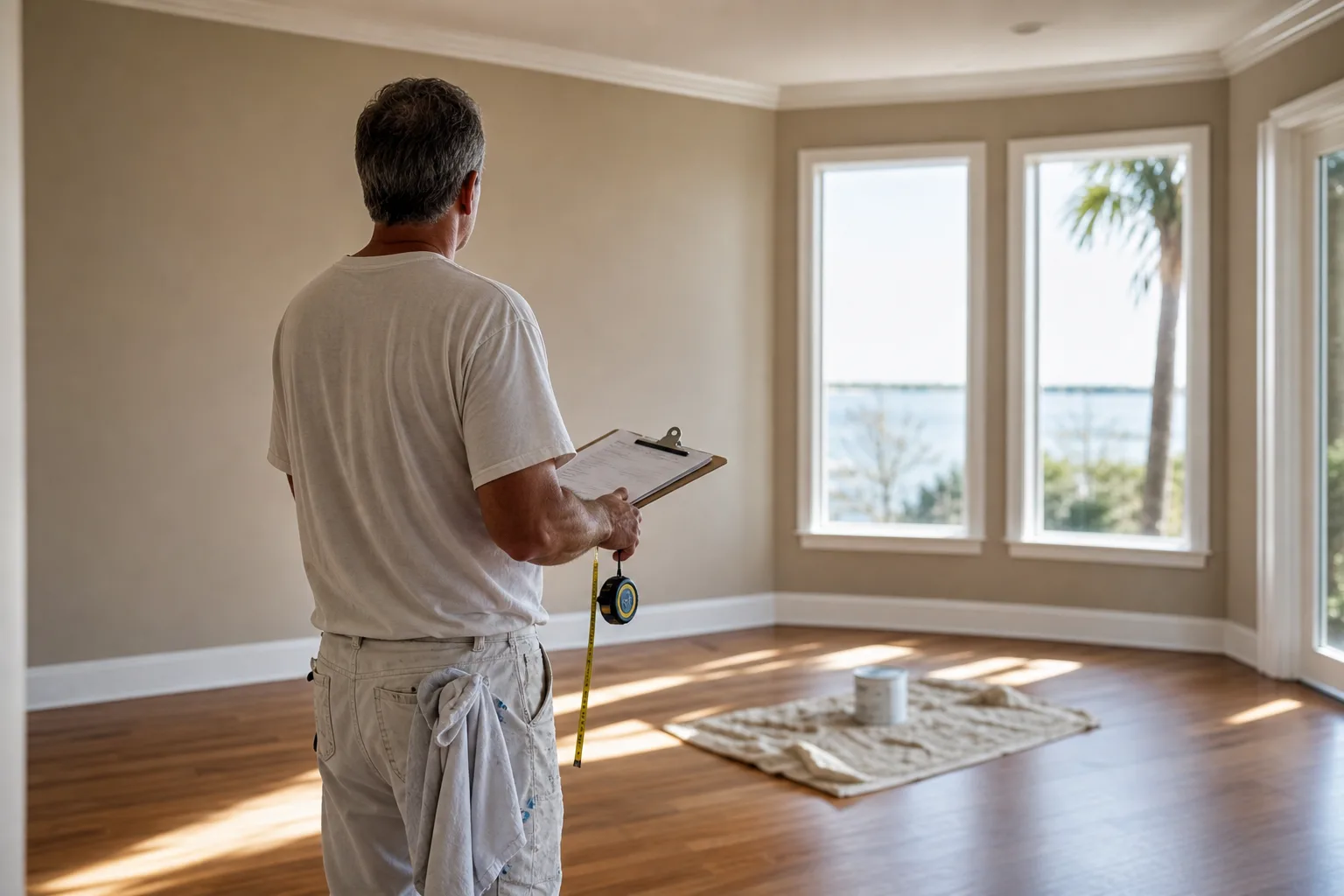
Get three painting bids and you'll often get three numbers that look like they're for three different houses. One painter quotes a rate per square foot, the next gives you a price per room, the third hands over a single flat number for the whole job. None of them is wrong. They're just three different ways painters price a job — and once you know how each method is built, the bids stop looking random and start telling you something useful.
So here's how painters price a job using the three common methods, what each one is good at, where it misleads, and how to read a quote no matter which one a painter hands you.
The three ways painters price a job
Almost every residential painting quote is built one of three ways. The method isn't about honesty — a careful painter and a sloppy one can both quote per square foot — it's about how the price gets assembled and what it can or can't account for.
| Pricing method | How the number is built | Best for |
|---|---|---|
| Per square foot | A rate multiplied by the paintable surface area | Quick estimates, large uniform spaces, sanity checks |
| Per room | A price assigned to each individual room | Painting only part of a home, room-by-room work |
| Flat per project | One bundled number after a walk of the home | Whole-house jobs, anything with prep or repairs |
The big thing to understand up front: these three numbers are not directly comparable. A per-room quote and a per-square-foot quote for the same house can land far apart simply because they're measuring different things and bundling different work. Comparing the bottom-line numbers without knowing the method behind each is how homeowners end up confused — or burned.
Per square foot: fast, but it hides a lot
Per-square-foot is the method people search for because it feels like math you can do yourself. A painter takes a rate and multiplies it by the surface area being painted, and out pops a number.
It works fine as a gut-check and for big, uniform jobs — long stretches of similar wall with little detail. But for a typical home it hides the things that actually move the price. The biggest catch is which square footage: interior wall area and your home's listed floor area are very different numbers, and a real interior quote is built on the walls and ceilings being coated, not the square footage on your tax record. Prep, ceiling height, trim, doors, and repairs all disappear inside a single rate, too.
For exterior work the per-foot method has its own quirks — height, siding type, and stories all bend the rate — and we break that down in detail in our guide to exterior painting cost per square foot. The short version: treat any per-square-foot number as a starting question, not the answer.
Per room: useful when you're not doing the whole house
Per-room pricing assigns a price to each space, which makes it intuitive when you're only painting part of the home — say, three bedrooms and a hallway, leaving the rest for later.
The trap is assuming every room costs the same. A powder bath and a two-story entry foyer are wildly different jobs even if their floor footprint is close, because a good per-room price accounts for ceiling height, trim, doors, closets, and how much cutting-in the space demands. So a real per-room quote isn't one flat figure times the number of rooms — it's priced room by room, with the tall, trim-heavy, detail-heavy spaces costing more than a plain square bedroom.
Per-room shines for staged interior work, where you want to knock out the rooms that bug you most now and budget for the rest later. If that's your plan, our guide on how to budget for a whole-house repaint shows how to phase it without paying twice for setup.
Flat per project: the number most real bids land on
For a whole-house job, the flat per-project price is the method most reputable painters actually use — and the one you can most reliably budget against. Instead of a rate, you get one bundled number built after someone walks your home and writes down the scope.
That's its whole advantage: a flat quote can see what a rate can't. It folds in your real wall area, ceiling heights, the prep your walls need, any patching or carpentry and wood repair, the number of coats, and the grade of paint — then bundles it into a single figure with the work spelled out. The rate methods estimate from the outside; the flat method prices from the actual house.
The catch is that a flat number is only as good as the scope behind it. "Paint the interior — $X" tells you nothing. A real flat quote itemizes the rooms or surfaces, the prep, the coats, and the exclusions, so you can see exactly what the one number is buying. When it's written that way, it's the easiest method to trust and the easiest to compare against another itemized bid.
How do you read any painting quote?
Because painters mix these methods, the move isn't to find the "right" method — it's to make every bid show its work so you can compare them on the same footing.
Ask which method each bid uses
Per square foot, per room, or flat project. A per-room number and a per-square-foot rate for the same house aren't directly comparable, so know what you're holding before you line two bids up.Get the scope in writing
Surfaces or rooms, prep (patching, sanding, caulking, priming), number of coats, and paint grade. The scope is what actually sets the price — the method is just how it's packaged.Confirm what prep is included
Prep is most of what makes paint last. A number that looks low almost always means prep got trimmed. Ask each painter to spell out the prep so a cheap bid can't hide a skipped step.Compare value, not just the bottom line
Two coats of a quality paint with full prep beats one thin coat every time, even at a higher number. Line up what's included side by side, then look at price.
Do that and the method barely matters — you're comparing real scopes instead of mismatched numbers. If you want the bigger picture on why bids swing so much in the first place, our breakdown of what drives the cost of a house painting project and our full cost-to-paint-a-house guide for Mobile and Baldwin County lay out every factor that feeds into the final figure.
Get a number you can actually plan around
A per-square-foot rate is a fine sanity check, and per-room pricing is handy when you're doing part of the house. But the number you can truly budget against comes from someone looking at your actual rooms, walls, and surfaces — because that's the only way to capture your home's prep, heights, and condition.
That's what we do. Pro 1 Painters is family-owned, in business since 2013, with offices in Mobile and Spanish Fort. We come out, look at the real spaces, talk through color and finish, and email a written quote within 24 hours — surfaces, prep, coats, and products itemized so you can see exactly how the price was built. One accountable crew runs the job from the free estimate to the final inspection, a manager signs off before final payment, and the work is backed by our 3-year workmanship warranty and a 4.8-star Google rating. Ready for a real figure on your home? Get a free in-home painting estimate. You pay by Cash, Check, or Credit Card.