
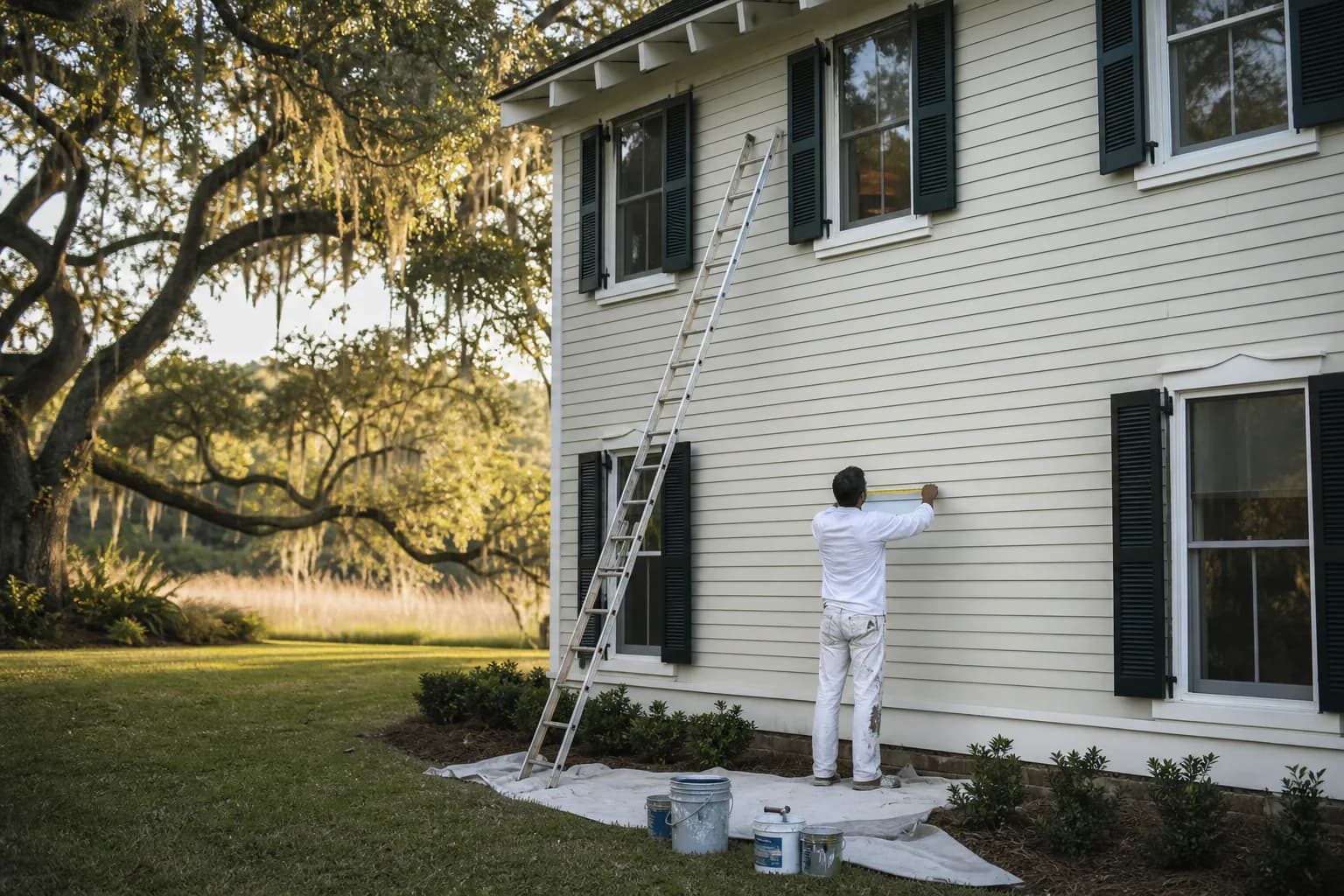
Search "exterior painting cost per square foot" and you'll get a tidy little number, like the whole thing is a math problem you can solve from your couch. Multiply your house size by the rate, done. Except the number you'll find almost never matches what you'll actually pay — and not because anyone's lying. It's because "per square foot" quietly means different things depending on which square footage you're measuring and what's bundled into the rate.
So before you anchor on a figure, here's how exterior painting cost per square foot is really calculated, why a one-story and a two-story home with the same size price differently, and how to use the rate as a sanity check instead of a quote that fits the wrong house.
What "per square foot" actually measures
Start with the honest version: per square foot is just the total job price divided by a square-footage number. The whole question is which square footage — and that's where homeowners get tripped up.
There are two very different numbers in play:
- Interior floor area — the "2,000 sq ft" on your listing. It describes the inside of your home and has almost nothing to do with how much outside there is to paint.
- Exterior surface area — the actual paintable skin: siding, trim, soffits, fascia, gables, and detail. This is what a coat of paint covers, and it's the number a real exterior estimate is built on.
Those two are not close. A compact two-story can have far more exterior surface than a sprawling one-story of the same floor area, because going up adds wall without adding footprint. When a painter quotes you a per-foot rate, the first thing to know is whether it's built on the surface you're paying to coat — or on a floor number that doesn't reflect the job.
Why stories change the rate
Here's the part a flat square-foot figure can't capture: reaching the surface costs money, not just covering it.
A one-story home is mostly ground-level work — ladders for the eaves, but quick, safe movement. A two- or three-story home means taller ladders, staging or scaffolding, more setup, and slower work up high where safety can't be rushed. That's real labor layered on top of the paint, so the same amount of surface costs more to coat at the top of a tall wall than at arm's reach. It's why per-foot rates tend to climb with height, and why two homes with identical surface area can land at different rates if one is taller.
This is also why a single national "per square foot" number is shaky. It's averaging one-story ranches and three-story homes, smooth siding and rough cedar, light prep and heavy restoration — into one figure that fits none of them exactly.
How a per-foot number gets built — a worked example
To make it concrete, here's the logic an honest estimate follows. The dollars below are illustrative of the method, not a price for your home — your siding, stories, and condition set the real figure.
| Step in the math | What it represents | Why it matters |
|---|---|---|
| Measure wall + trim area | Actual paintable surface, not floor area | This is the denominator everything rides on |
| Add for stories / access | Ladder and staging time up high | Two-story surface costs more to reach |
| Add prep + repair labor | Wash, scrape, caulk, prime, wood repair | Often the biggest swing on older homes |
| Add paint + coats | Grade of paint × one coat or two | Premium paint and a second coat cost more, last longer |
| Divide total by surface area | The per-square-foot rate you're quoted | Same rate can hide very different scopes |
Read that bottom row again, because it's the whole point: the per-foot rate is the last thing calculated, not the first. It's an output of the real work, which means two painters can land on the same rate while describing completely different jobs. The factors feeding that math are the same ones in our breakdown of what drives exterior painting cost in our area.
Why can the same per-foot rate hide two different jobs?
This is the trap. Per square foot feels like an apples-to-apples comparison, and it's anything but.
Picture two quotes at the identical per-foot rate. One includes pressure washing, scraping, caulking, priming bare wood, and two coats of a premium exterior paint built for Gulf humidity. The other is a single coat rolled over dirty, chalky siding with no real prep. Same rate, wildly different value — and in our climate, the second one starts failing within a season or two while the first holds for years. The rate told you nothing about that. Only the scope did.
What a per-foot quote should include
A per-foot number is only useful if you know what it covers. Before you compare two of them, confirm each rate includes the scope below — or get it itemized so you can see what's in and what's out.
- The surfaces being painted: siding, trim, soffits, fascia, gables, shutters, doors.
- The prep: pressure washing, scraping, sanding, caulking, and priming bare areas.
- Any carpentry or wood repair for soft or rotted boards — common on Gulf Coast fascia and trim — flagged before the job, not mid-stream.
- The paint grade and number of coats (one vs two changes both price and lifespan).
- Clear exclusions, so nothing's a surprise later.
When all of that is on paper, the per-foot rate finally means something — because now you know exactly what it's buying.
Use the rate as a check, not a quote
Cost per square foot isn't useless. It's a fine gut-check: if one bid's rate is wildly off from the others, that's a flag worth asking about. But it's a starting question, never the answer. The number that fits your house comes from your wall area, your stories, your siding, and your home's condition — and the only way to capture those is to look at the actual surfaces.
Siding type is one of the biggest reasons a flat rate misleads. Smooth fiber cement, rough cedar, brick, and stucco all coat at different speeds and drink different amounts of paint, so the same "rate" buys very different jobs depending on your material — our breakdown of exterior painting cost by siding type shows exactly how much. For how every piece adds up across a whole exterior, our full cost-to-paint-a-house guide for Mobile and Baldwin County lays out the picture, and our regional exterior cost overview puts a per-foot rate in context.
When you're ready for a real figure, we give a free in-home exterior painting estimate: we measure your actual surfaces, talk through color and finish, and email a written quote within 24 hours — surfaces, prep, coats, and products itemized so you can see exactly what any per-foot rate is really buying. You pay by cash, check, or credit card, and one accountable crew runs the job from the estimate through the final inspection, backed by our 3-year workmanship warranty.