
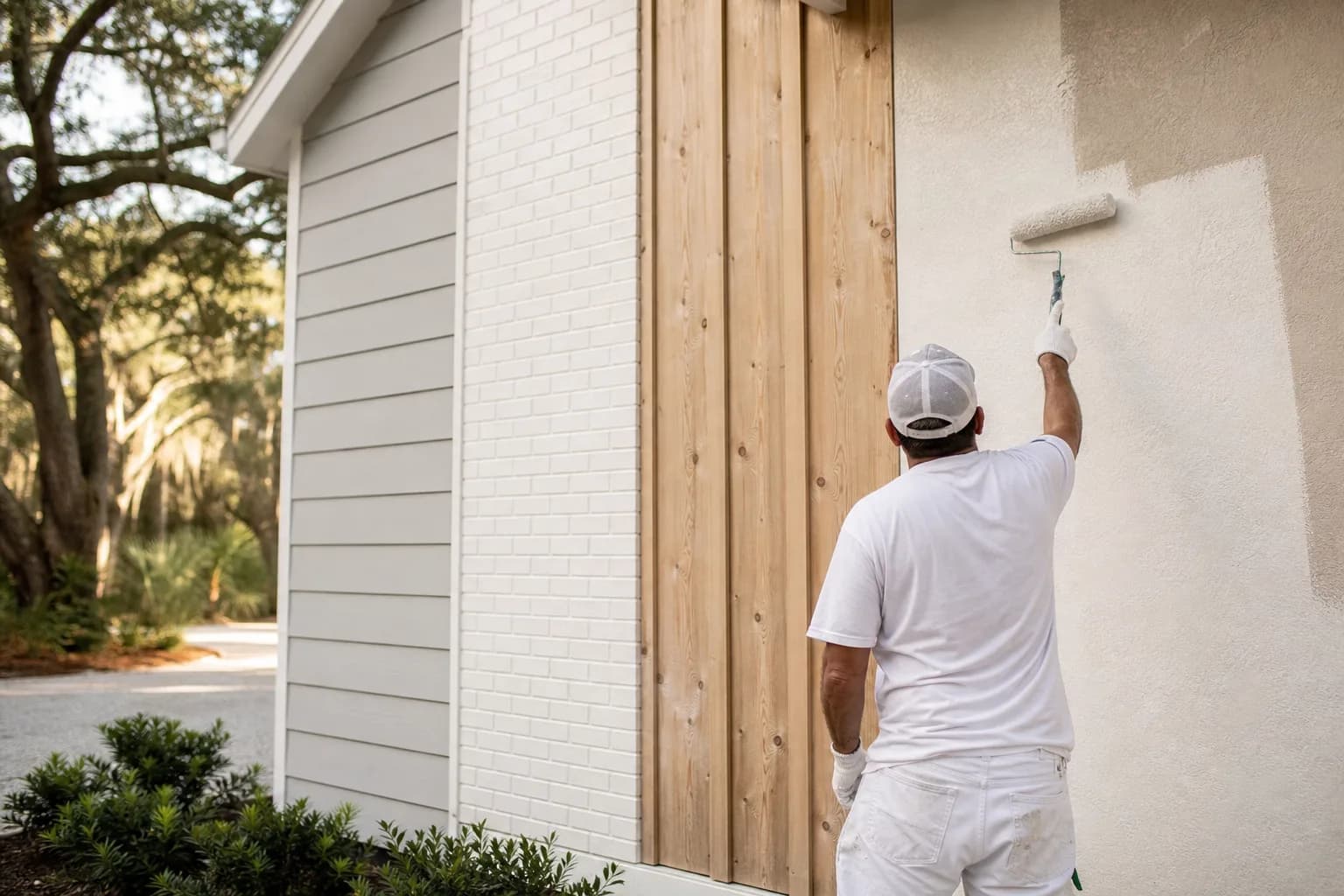
Two houses on the same street, both around 2,000 square feet, both getting their outside repainted — and the quotes come back hundreds of dollars apart. One is clad in smooth fiber cement. The other is rough cedar with a brick wainscot. Same size, very different jobs. The reason is the thing most cost articles skip: what your house is made of changes the price as much as how big it is.
Exterior painting cost by siding type comes down to two things every material handles differently — how much paint it drinks, and how much prep it needs before that paint goes on. Smooth and sound coats fast and sips material. Rough, porous, or neglected surfaces take more of both. Here's how the common Gulf Coast sidings stack up, and why, so you can read a quote knowing what's driving the number.
Why does exterior painting cost change by siding type?
Start with the honest answer up front: siding type changes exterior painting cost because it changes material and labor, and labor is the bigger half of any exterior bill.
Texture is the first lever. A smooth surface has less actual area to cover than a rough one of the same dimensions — every groove in board-and-batten, every dimple in stucco, every face of a brick adds real square inches of paint. Porosity is the second. Bare wood and masonry pull paint into themselves, so the first coat partly disappears and you need more product to build a sound film. The third is prep, and it's where quotes diverge the most: a chalky, peeling, or rotted surface needs hours of washing, scraping, sanding, and priming before a finish coat earns its keep in our climate.
None of that is a hidden fee. It's the work the material actually requires. The siding types below cost what they cost for these three reasons in different combinations.
Fiber cement and Hardie board: the efficient middle
Fiber cement — Hardie board and similar — lands in the middle of the exterior cost range, and it's one of the better-behaved surfaces to paint on the Gulf Coast.
Factory-primed fiber cement takes a quality acrylic evenly and holds it well against our humidity and UV. The variables that move its price are texture (smooth panels coat faster than the wood-grain finish), the number of stories, and condition. The two prep items we watch for: caulk failing at the butt joints and around trim, and a chalky film on older paint that has to be washed off so the new coat bonds. Repainting fiber cement you already have is dramatically cheaper than the original installed cost — you're buying paint and labor, not new siding. For how those factors layer together on a whole house, our exterior painting cost guide for Mobile and Baldwin County walks through a full-home job.
Vinyl siding: cheap to coat, with one rule
Vinyl is usually one of the more affordable sidings to repaint — if it's in good shape and you use the right paint.
Sound vinyl mostly needs a thorough pressure-wash to clear mildew and grime, then a coat of paint formulated to flex and bond with vinyl. There's little scraping or priming, so the labor is low. The one rule that protects the whole job: vinyl expands and contracts in heat, and it can't be painted a color darker than the original without risking warping, because dark colors absorb more heat. A vinyl-safe paint engineered for that movement is non-negotiable here, where summer sun bakes a west-facing wall all afternoon. Get the product right and vinyl is genuinely one of the cheaper exteriors to refresh.
Brick and masonry: more paint, and a one-way door
Brick, block, and stucco sit at the higher end of exterior painting cost, for two reasons worth understanding before you commit.
First, the material. Masonry is porous and textured, so the first paint job drinks up noticeably more product, and it usually needs a masonry primer or conditioner plus a breathable, masonry-rated paint — more product and more labor than smooth siding of the same size. Stucco behaves similarly: all that texture is extra surface area, and any cracks need patching first. Second, and this is the part homeowners don't always hear: painting brick is close to a one-way door. Once brick is painted, it has to keep being repainted — you can't easily go back to raw brick. That makes it worth pricing as a long-term commitment, not a single transaction. None of this means don't do it; painted brick can transform a home. It just belongs in the budget honestly.
Wood siding: the prep is the price
Wood — cedar, clapboard, board-and-batten, shakes — is where condition, not square footage, usually decides the number.
The paint cost for wood is similar to other sidings. The prep is what climbs. Older wood on the Gulf Coast typically needs scraping of failed paint, sanding to a sound edge, spot-priming every bare area, and re-caulking — and humidity and storm exposure mean some boards, especially fascia, trim, and sills, turn out soft or rotted and need carpentry repair before a brush touches them. That's why two cedar homes the same size can price very differently: one was repainted on schedule and needs light prep, the other waited fifteen years and needs hours of restoration first. On wood, the lasting job is built in the prep, and skipping it is exactly why a cheap exterior bid starts peeling in a season or two here.
A quick side-by-side
Here's how the common sidings compare on the levers that actually drive cost. These are relative tendencies, not a quote — your home's size, stories, and condition still set the final number.
| Siding type | Relative cost to repaint | Paint appetite | Main cost driver |
|---|---|---|---|
| Vinyl (good condition) | Lower | Low | Right vinyl-safe paint; can't go darker |
| Fiber cement / Hardie | Lower–middle | Moderate | Texture, joint caulk, chalk wash |
| Smooth lap / wood (sound) | Middle | Moderate | Condition; light scrape and prime |
| Wood (aged / rough) | Higher | Moderate–high | Heavy prep, spot-prime, wood repair |
| Stucco | Higher | High | Texture area, crack patching, masonry paint |
| Brick / masonry | Higher | High | Porosity, primer, repaint-forever commitment |
How to read a quote with your siding in mind
A good exterior estimate names your siding and the prep that goes with it. If you've got cedar, you should see scraping, sanding, and priming line items — not just "two coats." If it's brick or stucco, look for a masonry primer or conditioner and a masonry-rated paint. If it's vinyl, confirm the paint is vinyl-rated and that nobody's promising a much darker color without flagging the heat risk.
When you compare two bids, you're really comparing two descriptions of the work — and siding is where the gap usually hides. The same lesson runs through everything that drives exterior painting cost in our area: the cheap number often means the prep your material needs got cut. The bid that fits your siding and spells out its prep is the one that actually lasts. Siding is one piece of a bigger picture — for how it fits with size, stories, and labor across a whole home, see our full cost-to-paint-a-house guide for Mobile and Baldwin County, and our breakdown of exterior painting cost per square foot explains why a single per-foot rate can't capture your material.
Want a real number for your house, not a national average? We give a free in-home exterior painting estimate — we look at the actual siding, measure, and email a written quote within 24 hours, with prep, coats, and products laid out so you know exactly what you're paying for. You pay by cash, check, or credit card, and one accountable crew runs the job from the estimate through the final inspection, backed by our 3-year workmanship warranty.