
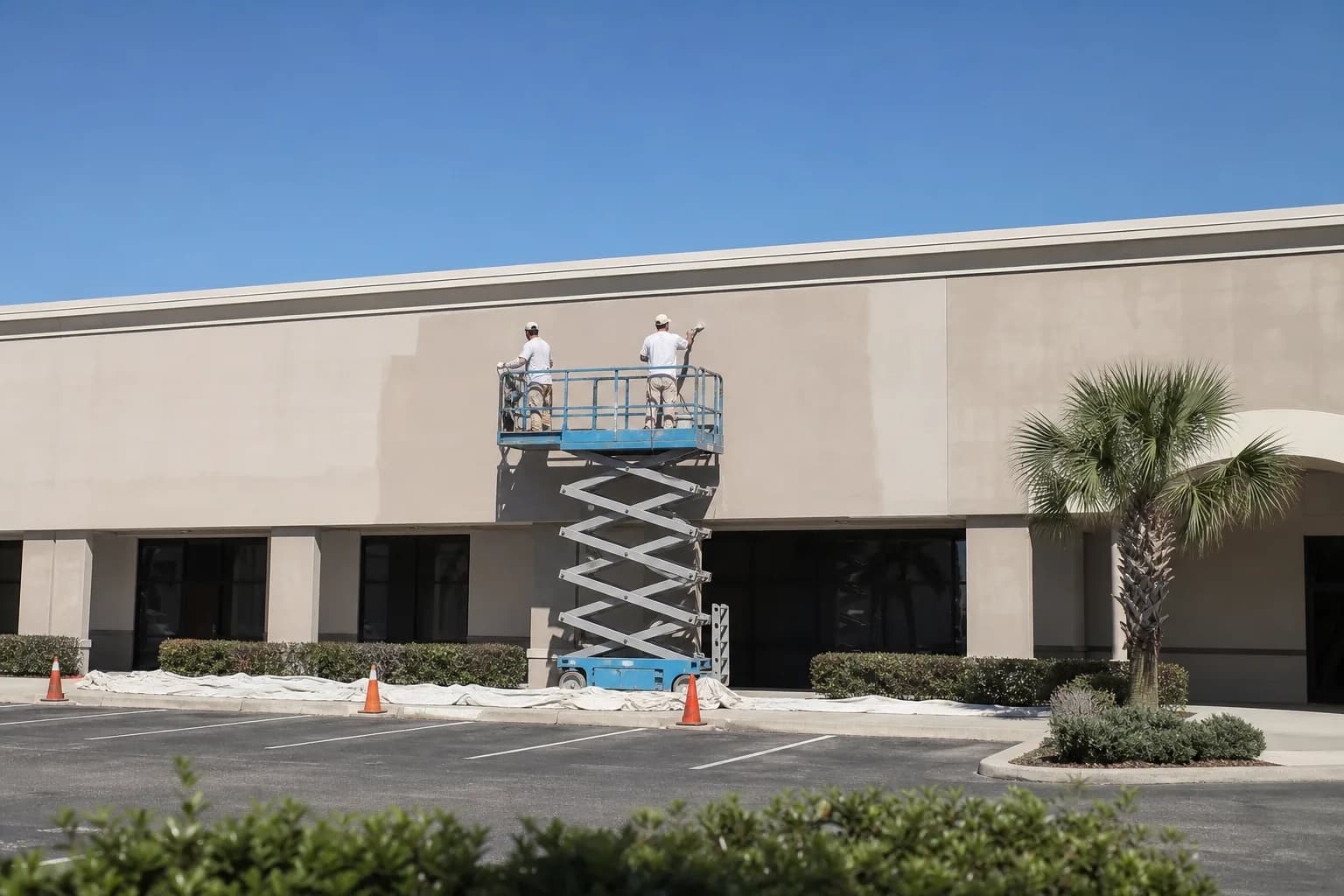
A property manager asks us the same thing almost every week: "What's commercial painting cost per square foot around here?" It's a fair question, and we'll give you real ranges below. But the honest answer is that the square-foot number is the last thing we calculate, not the first. Two buildings with the identical footprint can land a thousand dollars apart once you account for prep, height, the coating the space actually needs, and whether we paint while you're open or after you close. Here's what really moves the price on a Gulf Coast commercial repaint, so you can read a bid and know what you're paying for.
What commercial painting cost per square foot actually runs
Here's the direct answer. On the Gulf Coast, interior commercial painting commonly runs about $1 to $3 per square foot of floor area, and exterior work runs roughly $1 to $4 per square foot of wall area, with specialty coatings and tough access pushing higher. Those are market ranges, not a quote — a clean open office repaint sits near the bottom, and a weathered multi-story facade that needs serious prep sits near the top.
The catch is that "per square foot" means two different things depending on what's being measured. The gap between them is the single biggest reason owners get confused comparing bids.
| How it's measured | Typical use | What to watch |
|---|---|---|
| Per sq ft of floor area | Interior offices, retail, warehouses | A 5,000 sq ft suite with 10-ft walls has far more paintable wall than the floor number suggests |
| Per sq ft of wall area | Exteriors, high-bay walls, facades | Counts actual coated surface, so it tracks the real work more closely |
| Lump sum / per project | Most real commercial bids | Bundles prep, coatings, access, and labor into one firm number |
When you collect bids, the first thing to confirm is which method each painter used. A floor-area number and a wall-area number for the same building aren't comparable, and a lump-sum bid that walks the property is usually the most reliable of the three. For the full picture of how a commercial job is scoped and run, see our commercial painting in Mobile and Baldwin County guide.
The prep is what you're really paying for
The biggest swing in any commercial paint price isn't the paint — it's the prep. Prep is 80% of a job that lasts, and on a commercial building there's a lot of it. Pressure-washing a long exterior, scraping and feathering failed coating, grinding rust off metal, patching block, caulking control joints, and masking off storefronts and signage all take hours, and hours are most of the bill.
A bid that looks cheap per square foot has usually trimmed the prep. That's the bid that peels in two seasons and costs you a full repaint. A bid that runs a little higher per foot but spells out washing, scraping, priming, and repair is the one that holds.
Five factors that move the per-square-foot price
Square footage sets the baseline. These five factors decide where in the range you land — and they're worth understanding before you read a single bid.
Substrate and condition
Smooth drywall coats fast and cheap. Split-face block, stucco, rusted metal, and chalking old paint all drink more product and need more prep, which raises the per-foot cost.Coating system
A standard interior latex is the low end. Direct-to-metal, high-build masonry coatings, epoxy in wet or high-traffic areas, and elastomeric on exteriors cost more per gallon and per labor hour, but they're what certain spaces need to last.Height and access
Work you can reach from the ground is cheapest. Scissor lifts, boom lifts, and scaffolding add rental cost and slow the crew down for safety, so multi-story and high-bay work prices higher.Schedule and downtime
Painting during normal hours is the baseline. After-hours, overnight, weekend, and phased work that keeps you open adds labor and coordination — and it's often still cheaper than closing your doors.Project size
Bigger jobs usually carry a lower rate per square foot because mobilization and setup get spread across more area. A small storefront repaint carries a higher per-foot rate than a full warehouse.
Notice that none of these is the brand of paint on the can. The product matters, but it's a small slice of the total next to prep, access, and labor. That's why a careful on-site measurement beats any per-foot rule of thumb.
Why does the Gulf Coast add its own line to the bill?
Coastal Alabama is harder on a commercial coating than most of the country, and that shows up in the cost — usually as more prep and a better coating rather than a higher rate by itself. Salt-laden air, summer humidity that hangs for months, intense UV, and a long storm season all attack exterior coatings and steel. A building near Mobile Bay or down toward the port takes more abuse than one inland, and the right system to fight that holds up better but costs more up front.
That up-front difference pays for itself. A coating chosen for our climate, over surfaces that were properly washed and primed, simply lasts longer between repaints. Skimp on either and you're back on the schedule years early, paying twice. Our guide on protecting paint from the coastal Alabama climate walks through why prep and product choice matter so much on the Gulf Coast — the same physics applies to a strip center as to a house.
The coast adds a second hidden cost, too: timing. Coatings need dry, lower-humidity weather to cure properly, and our long, wet, humid stretch narrows the windows when exterior work can be done right. A schedule that has to dodge afternoon storms and saturated air can run longer than the same job up north, and time on site is labor. A painter who knows the local weather plans the project around those windows instead of fighting them, which protects both the finish and your budget.
How to get a number you can actually budget against
A per-square-foot range is useful for a rough mental check. It is not something you can sign a contract on, because it can't see your building's condition, height, or coating needs. The only way to get a number you can budget against is to have a commercial painter walk the property, measure the real surfaces, and look at what they're actually coating.
That's exactly what we do. Pro 1 Painters is family-owned, in business since 2013, with offices in Mobile and Spanish Fort. We come out, measure your building, check the substrate and access, and send a written quote within 24 hours — one firm number, with the prep and coatings spelled out. One accountable crew runs the project from the free estimate to the final inspection, a manager signs off before final payment, and the work is backed by our 1-year workmanship warranty and a 4.8-star Google rating.
So when you're comparing commercial painting cost per square foot on the Gulf Coast, use the ranges here to sanity-check a bid — then get a real measurement. If the after-hours and phased-work line above is what's driving your number, our guide to phasing a commercial repaint so you stay open shows how that scheduling actually works. To plan the project itself, see our commercial painting service and our commercial painting guide for Mobile and Baldwin County. Ready for a firm price on your building? Call Pro 1 Painters for a free on-site estimate. Pay by Cash, Check, or Credit Card.