
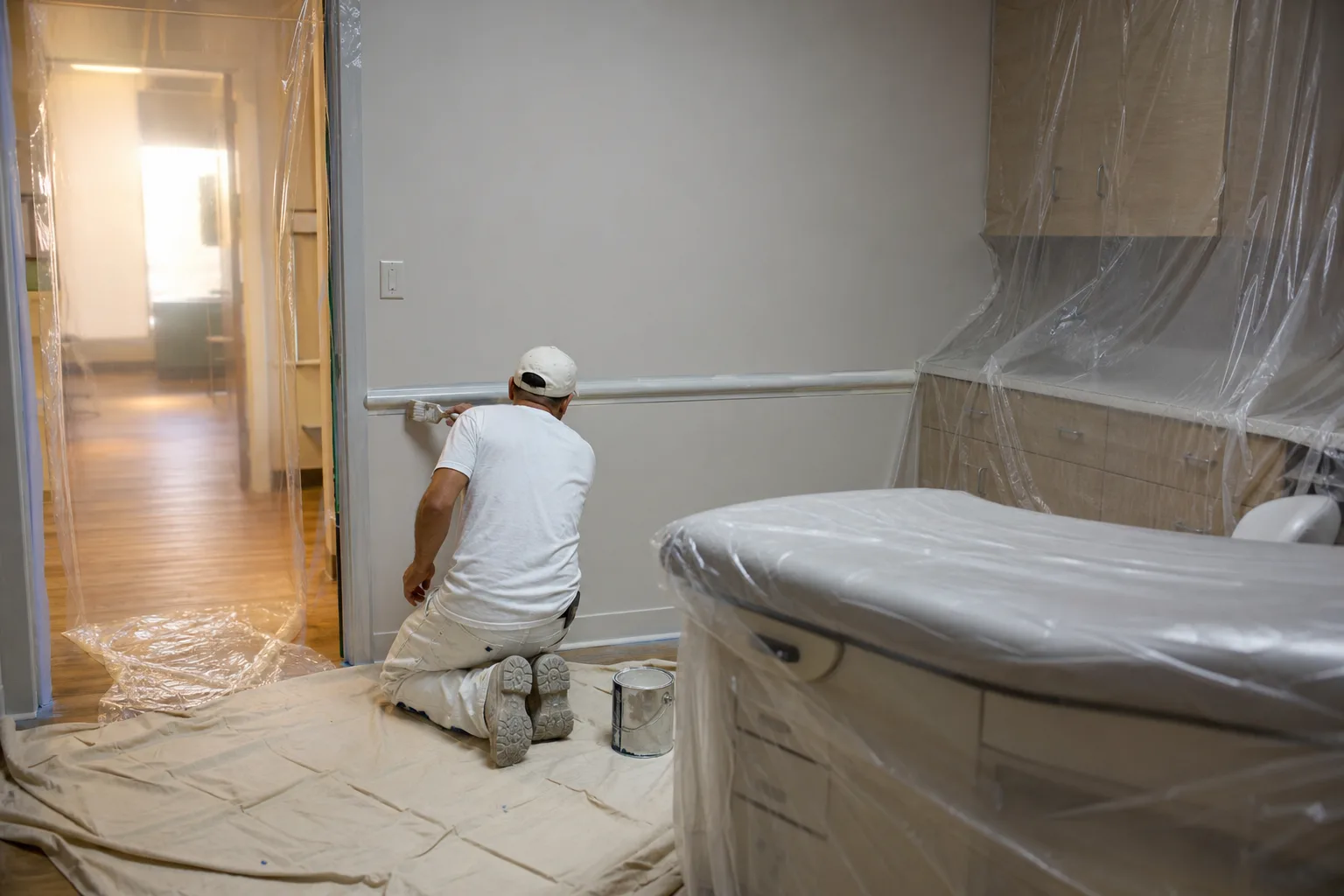
Every practice manager who's gotten a paint quote hits the same wall: the walls genuinely need it, but there's no week on the calendar to lock the doors and send patients away. A clinic that goes dark for a repaint isn't saving on paint — it's bleeding booked appointments, idle staff, and patients who reschedule elsewhere. So the real question was never "what color?" It's whether the place can get repainted while it keeps seeing people.
It can, and it's not a trick. Knowing how to repaint a medical or dental office without closing comes down to four moving parts working together — the right products, the right hours, real containment, and a finish that survives clinic cleaning. Get those aligned and a patient sits down in a freshly painted exam room without ever knowing a paint crew was in the building the night before.
Why can't a clinic just close for paint?
Answer-first: for a working practice, every shut day costs far more than the repaint does. A medical or dental office runs on a booked schedule — providers, hygienists, and front-desk staff all paid against appointments — and an empty chair is revenue that doesn't come back. Closing for paint trades a cosmetic upgrade for canceled care and a waiting room of rescheduled patients.
There's a clinical layer on top of the business one. A working office isn't an empty retail unit you can fill with fumes overnight — it has patients with sensitivities, equipment that can't take dust, and clean areas that have to stay that way while work happens a wall over. That's why painting a live clinic is its own discipline, built around the practice instead of the paint. We've done it on occupied medical jobs along the coast, an urgent care among them, with the clinic open and seeing patients the entire time.
How we repaint a working clinic, zone by zone
The mechanism that keeps you open is simple: we never take the whole suite offline. We split the practice into zones — a couple of exam rooms, the waiting area, a restroom, the back office — and run them one at a time, handing each back chair-ready before touching the next. Here's the rhythm of a single zone.
1. Map your real downtime
At the free estimate we pin down exactly when each part of the suite is empty — closed evenings, a half-day, a weekend, a dark day — and build the zone schedule around your appointment book instead of ours.2. Seal the zone before anything opens
Before a lid comes off, we wall the active room off from the rest of the suite with containment, mask the vents and returns so nothing travels the HVAC, and protect floors and any equipment that stays.3. Prep and paint inside the window
We do the prep and apply low-odor, fast-recoat paint within the off-hours window, sequencing the loudest, dustiest, strongest-smelling steps for when the suite is fully empty.4. Clear the air and detail the room
We run air movers to clear any odor, then clean and detail the space so it's spotless — no tape, no dust, no smell waiting for the first patient of the day.5. Hand the zone back chair-ready
The room goes back into rotation dry, clean, and reset, and a manager checks the work. The next morning's schedule runs in it like nothing happened.
Because every zone comes back finished, a job that spans several nights never reaches your patients as disruption — they just see one fresh room at a time, and eventually a whole practice that looks new. The two levers under that are when the work happens and how the building gets divided; our guides on after-hours and weekend commercial painting and on phasing a commercial job zone by zone go deep on each.
What paint and finish a clinic actually needs
Answer-first: clinical walls want a low-VOC paint in a washable, scrubbable sheen — the low odor keeps patients comfortable in the building, and the wipe-down surface survives the daily disinfecting a practice can't skip. The old trade-off between low smell and durability is gone; modern low-VOC products give you both at once, which is what makes an overnight clinic repaint possible.
Finish matters as much as the paint, because rooms in a clinic don't all take the same wear. We match the product and sheen to how each space gets used — a tougher, washable finish where the wipe-downs are constant, something warmer where patients wait — so the surface holds up under clinical cleaning instead of burnishing out in months. Color does quiet work too: soft, muted neutrals and calm blues and greens settle a nervous patient, while hot, saturated tones read tense and clinical. If you want help landing the palette, that's what a color consultation is for, and you can preview washable colors on your own walls first with our color visualizer.
| Clinic area | Finish priority | Why |
|---|---|---|
| Exam & treatment rooms | Most washable, low-VOC | Wiped and disinfected daily; surface has to take repeated cleaning |
| Waiting & reception | Durable but warm | High-traffic and patient-facing; should look calm, still scrub clean |
| Restrooms | Moisture- and scrub-tough | Constant cleaning and humidity demand the hardest-wearing finish |
| Back office & break room | Standard durable | Staff-only and lower-stakes, so a softer finish is fine |
| Corridors | Scuff-resistant | Carts, chairs, and shoulders mark these walls more than any other |
Containment is what keeps the rest of the suite clean
The reason a zone can be torn up while patients sit twenty feet away is containment, and on a clinic it's non-negotiable. We seal the active room off from the working suite, but the part people forget is the HVAC — mask the supply vents and return air in that room and the system can't carry dust or odor into a space with patients in it. Floors get protected, anything that stays gets wrapped, and the zone is isolated before any prep starts.
That isolation is what lets us run the dusty steps — sanding, patching, scuff-sanding old enamel — without it becoming a clinical problem: the dust stays behind the wall, gets cleaned up inside the sealed zone, and never reaches a clean room or a waiting area. Keeping those finishes looking new in the years after is its own conversation, and a commercial paint maintenance program is how a busy practice does that without closing again.
What to ask before you hire anyone for a clinic
A clinic repaint only pays off if the crew delivers a clean, ready room by the next morning, unsupervised, every time. So a few questions are worth asking before you sign. Can they actually contain a zone and mask the HVAC, or will dust find your waiting room? Will two coats go up in a single off-hours window, or does the job creep across more nights than promised? And will a manager inspect the work before final payment? A crew that answers those plainly has painted around live operations before — our guide on the questions to ask a commercial painting contractor covers the rest of the checklist.
Bottom line
Repainting a medical or dental office without closing isn't a compromise — it's a method. Low-odor, low-VOC paint in a washable finish, work scheduled into your real off-hours, every active room sealed off with HVAC masked, each zone handed back chair-ready before the next. Run that way, a full repaint costs your practice a sharper-looking space and not one canceled patient.
That's how we run every clinic job — family-owned since 2013, one accountable crew from your free estimate through the final inspection, backed by our 1-year workmanship warranty. If your practice needs fresh walls but can't afford to send patients home, see our commercial painting service or reach out for a free estimate and a written quote within 24 hours. Pay by Cash, Check, or Credit Card.