
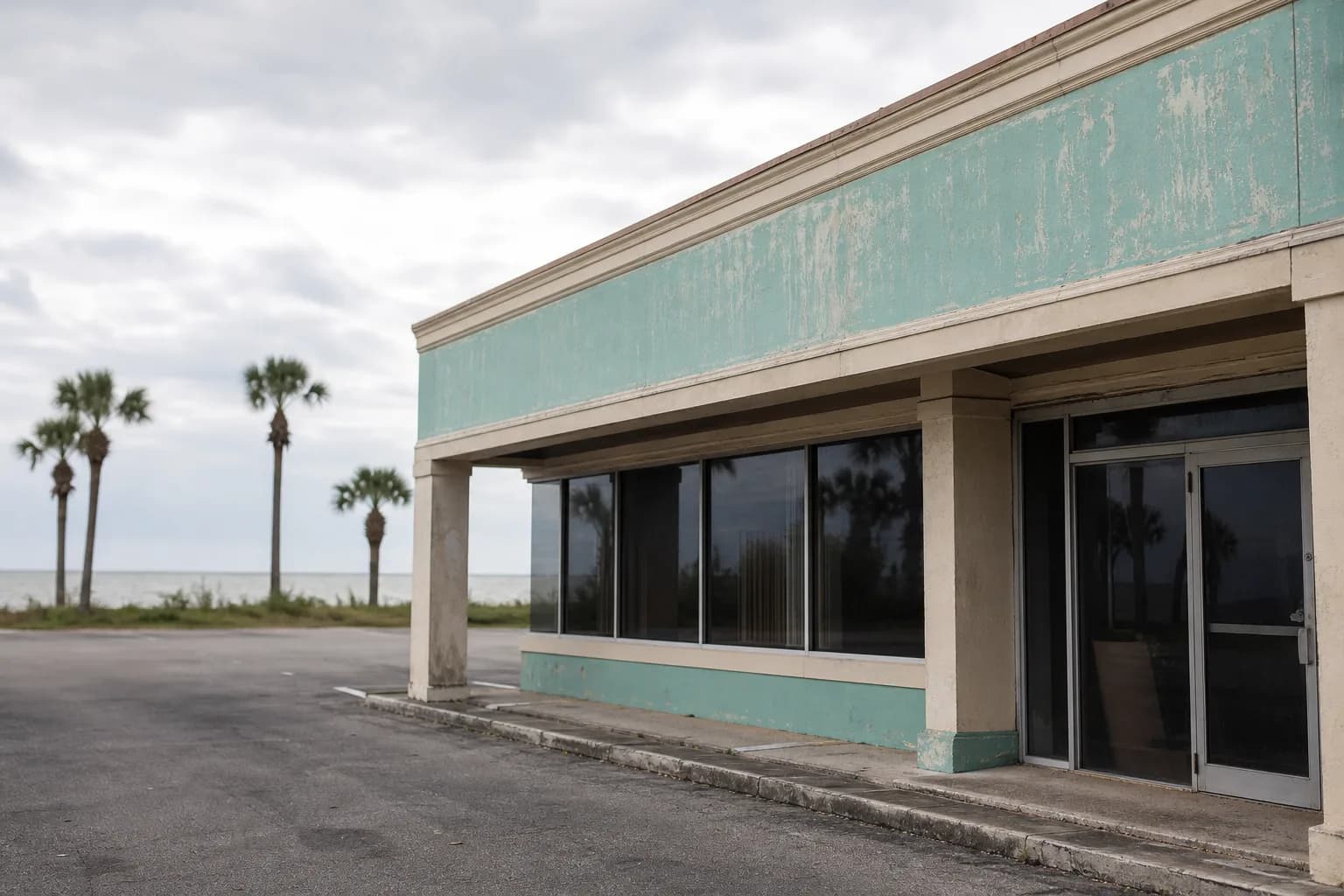
A commercial repaint rarely lands on a schedule. It lands when an owner finally looks up at a chalky, faded storefront and realizes it's been telling customers the wrong story for two years. The building still works — but it looks tired, and on a commercial property, tired reads as "this place is slipping." The frustrating part is that nobody told you when it was actually due, so the decision always feels late.
So let's put a real number on it. How often should you repaint a commercial building on the Gulf Coast, why does our climate move the timeline up, and how do you budget for it instead of reacting to it?
How often should you repaint a commercial building on the Gulf Coast?
Here's the short answer, then the reasoning. On the Gulf Coast, most commercial exteriors run 5 to 7 years between full repaints, and high-traffic commercial interiors want a refresh every 3 to 5 years. Those are shorter cycles than you'd quote for the same building inland, and the reason is the environment, not the paint.
But "5 to 7 years" is an average, and your building isn't average. Substrate, sun exposure, how close you are to open water, traffic, and the quality of the last paint job all push the number around. Here's how the common commercial scenarios actually shake out.
| Surface / situation | Typical Gulf Coast repaint cycle | What drives it |
|---|---|---|
| Exterior — stucco / masonry, inland | 7 to 10 years | Durable substrate, less salt exposure |
| Exterior — wood / trim, inland | 5 to 7 years | Wood movement, sun, caulk failure |
| Exterior — any substrate, bay or Gulf-facing | 4 to 6 years | Salt air plus full UV accelerate breakdown |
| Interior — offices, low traffic | 5 to 7 years | Wear by occupancy, not weather |
| Interior — corridors, retail, breakrooms | 3 to 5 years | Scuffs, handprints, cleaning, heavy traffic |
| Interior — restrooms / kitchens | 3 to 5 years | Humidity, grease, frequent scrubbing |
Read that as a planning starting point, not a guarantee. The honest way to set your building's real number is to have someone walk it and read the actual condition, which is part of every free estimate we do.
Why salt air shortens the cycle
Inland buildings get sun and rain. Coastal buildings get sun, rain, humidity, storms, and salt — and salt is the one that quietly does the most damage. It's hygroscopic, meaning it pulls moisture out of the air and holds it against the surface, so your walls stay damp longer than they look. It's also mildly abrasive and works its way into the smallest cracks in the paint film. Layer relentless Gulf-Coast UV and high humidity on top of that, and a finish simply ages faster here than the same finish would in north Alabama.
That's why a coating that's rated for a decade in a dry climate might give you six or seven good years on a bay-facing wall in Mobile or Baldwin County. The sides of the building facing the water and the afternoon sun always go first — you'll often repaint one or two elevations before the whole envelope is due, the same pattern we break down in how salt air and humidity shorten paint life. We go deeper on the products and prep that hold up to this in our commercial painting guide for Mobile and Baldwin County.
The warning signs your building is due
You don't have to guess. A commercial exterior tells you it's failing in a fairly predictable order, and on the coast you almost always get plenty of warning before paint actually peels.
- Chalking. Rub a hand on the wall and it comes away with a dusty residue. That's the binder breaking down under UV — the earliest sign the finish is spent.
- Fading and uneven color. Sun bleaches the pigment, and the exposed elevations fade faster than the shaded ones, so the building starts to look two-toned.
- Caulk failure. Cracked, shrunken, or pulled-away caulk at joints, windows, and trim. This one matters most — open joints let water behind the finish, and water behind the finish is how small problems become expensive ones.
- Hairline cracks and checking. The film going brittle and losing its flex.
- Bare spots and peeling. The late stage. By the time you see real peeling, water's usually been getting in for a while.
Interiors are simpler: they wear by traffic. When corridors are scuffed, breakroom and restroom walls won't come clean anymore, and the retail floor looks dingy under the lights, you're due — usually right around that 3-to-5-year mark in the busy spaces.
Budgeting: plan the cycle, don't react to it
The most expensive way to handle commercial paint is to wait until a building looks bad and then scramble for a full repaint out of nowhere. The cheapest way is to treat it as a capital cycle you plan for — the same as a roof or an HVAC system. Once you know your exteriors run roughly 5 to 7 years and your high-traffic interiors 3 to 5, you can put the spend on a calendar and budget for it instead of being surprised by it.
Two things make that budget go further. First, maintenance. Second, doing the prep right when you do repaint — because a cheap, rushed job on the coast resets the clock far too soon. For a square-footage starting point, our breakdown of commercial painting cost per square foot on the Gulf Coast gives you real ranges and what moves them.
A maintenance program is the move for owners and facility managers who'd rather not think about it. Instead of waiting for the building to look bad, we keep it on a schedule — wash, inspect, touch up the joints, and repaint elevations as they come due. You can read how we structure that in our commercial paint maintenance program for the Gulf Coast.
What "done right" looks like on a commercial repaint
Hitting the right cycle only pays off if the repaint itself holds up. On the coast, that means real prep — pressure-washing off the salt and chalk, scraping and sanding failing paint, re-caulking every joint, treating soft wood, and priming bare substrate — before any finish coat. It means the right coating for each surface and exposure, two coats where the wear demands it, and scheduling that works around your hours so your doors stay open while we paint.
It also means accountability. One crew runs your project from the free estimate through the final inspection, the job-site gets cleaned daily, a manager signs off before final payment, and the work is backed by our 1-year workmanship warranty. That's how a repaint actually lasts the 5 to 7 years it's supposed to.
If your storefront, office, clinic, or warehouse is chalking, fading, or showing cracked caulk, the next step is simple. Book a free on-site estimate — we'll walk the property, read its real condition, tell you honestly where it stands on the repaint clock, and send you a written quote within 24 hours. See the full scope on our commercial painting page, and let's get your building back to telling the right story.