
The lease is signed, the customers keep coming, and the walls look every one of their years — scuffed corridors, a faded exterior the sun has chalked, a breakroom nobody wants to eat in. The catch with a commercial building is that you can't just close for a week and let painters take over. The work has to happen around the way your business actually runs.
That's the part most owners and property managers worry about, and it's the part we plan around first. This guide walks through how commercial painting works across the property types we see most in Mobile and Baldwin County—from Midtown offices to buildings across the Eastern Shore—how we keep your doors open while we do it, and the practical stuff: insurance, prep, coatings, and how often you should really repaint on the Gulf Coast.
What is the difference between residential and commercial painting?
Residential painting is organized around a household, personal belongings, and room-by-room comfort. Commercial painting is organized around a business's operating hours, public access, larger or specialized surfaces, safety documentation, containment, and coatings chosen for heavier traffic. Both require sound prep and clean application, but commercial work usually adds phasing, facility coordination, and written closeout requirements. Compare our commercial painting and house painting services for the two scopes.
| Factor | Residential painting | Commercial painting |
|---|---|---|
| Primary constraint | Household schedule and occupied rooms | Business uptime, customers, tenants, or patients |
| Scheduling | Room by room during agreed workdays | After-hours, overnight, weekends, or phased zones |
| Coatings | Appearance, washability, and home use | Traffic, cleaning cycles, substrate, and facility use |
| Documentation | Written scope, colors, prep, and warranty | Written scope plus phasing, access, COI requirements, and closeout |
| Site protection | Furniture, floors, fixtures, and family access | Equipment, inventory, public paths, containment, and daily reopening |
Every commercial property paints a little differently
"Commercial" covers a lot of ground, and a paint plan that fits a law office is wrong for a warehouse. Here's how the common property types differ in practice.
- Offices. The priority is downtime and dust. Open-plan floors, conference rooms, and corridors usually get painted after-hours or zone by zone so nobody's working next to a wet wall. Cubicles and electronics get masked; we're as careful with your gear as your finishes.
- Retail. Storefronts live and die on appearance, so the finish has to be clean and the timing has to protect sales. We often work overnight or in the slow hours, and we keep the sales floor shoppable while we move through it.
- Restaurants. Tight turnarounds and odor control rule everything. Health-code surfaces, grease-prone kitchen walls, and dining rooms that reopen the next morning mean low-odor products and overnight scheduling are usually the answer.
- Medical and dental. Cleanability and air quality come first. Exam rooms, waiting areas, and corridors need durable, washable, low-VOC finishes, and the work zone has to stay contained so patient areas aren't disrupted.
- Warehouse and industrial. Here it's about coverage and durability over polish — high ceilings, block and metal walls, safety striping, and coatings that stand up to forklifts, washdowns, and temperature swings.
- Multifamily. Apartments, condos, and HOA buildings are a logistics job: unit turns on a deadline, common areas and breezeways that have to stay open, and exteriors that take the full brunt of Gulf-Coast weather.
Whatever the type, the through-line is the same: figure out how the building is used, then build the paint plan around that. You can see the full scope on our commercial painting page, but the planning is what separates a clean job from a disruptive one.
Keeping your doors open while we paint
The number-one question we get from business owners isn't about color. It's "do we have to close?" The answer is almost always no — and that comes down to three tools.
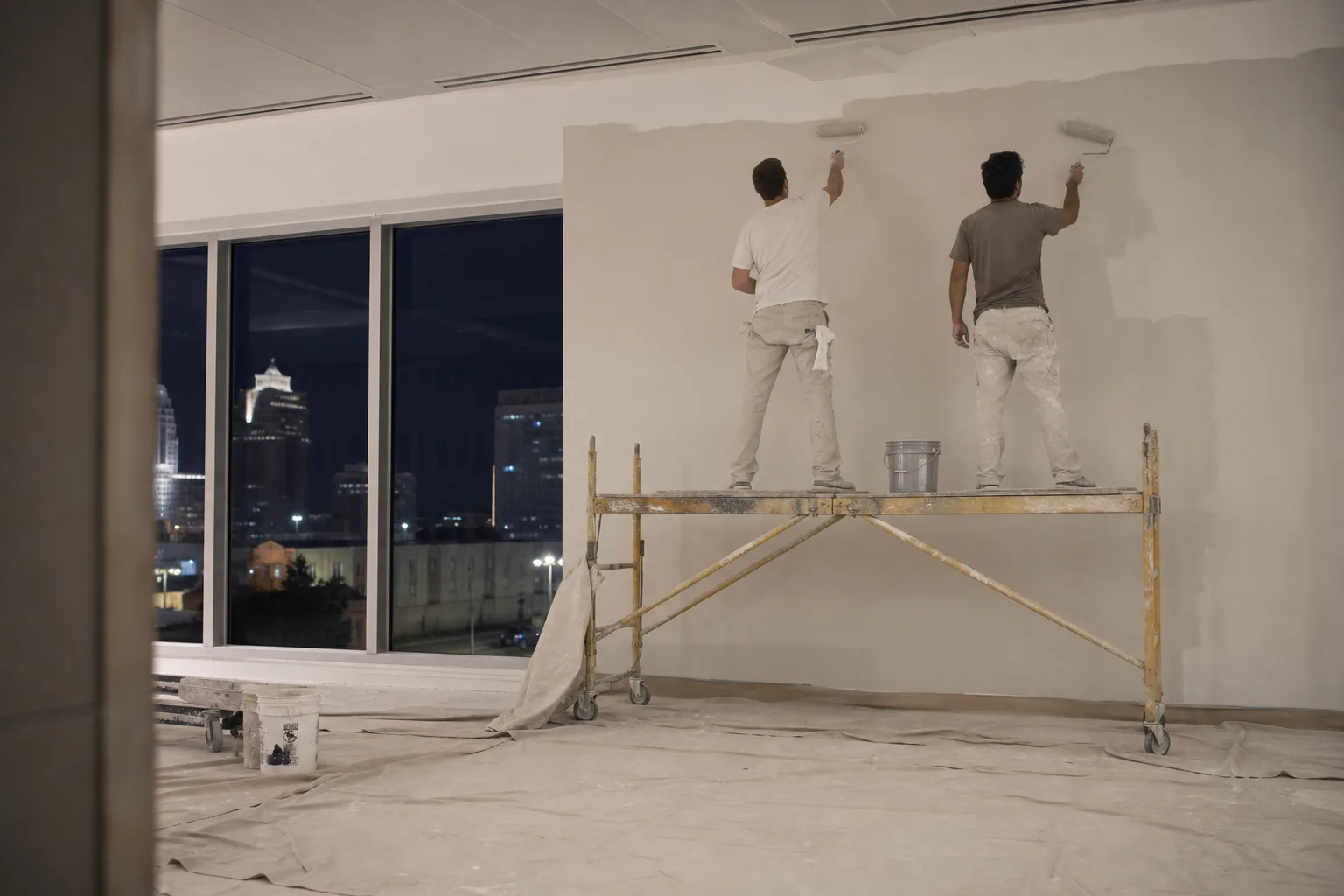
After-hours and overnight work. For retail, restaurants, and busy offices, the simplest fix is to paint when you're closed. We come in after the last customer leaves, work through the evening or overnight, and have the space ready before you open. You lose zero selling hours; your team walks into fresh walls.
Zone containment. When around-the-clock work isn't practical, we wall off one area at a time with plastic and barriers, paint it, and move on. The rest of your building keeps running while we work behind the containment. It's how we repaint an occupied office floor or a clinic without sending anyone home. On a building too big to do all at once, this becomes full project phasing — we sequence floor by floor or zone by zone so the place is never fully offline.
Low-odor, low-VOC products. Paint smell is what makes people think they have to leave. We use low-odor, low-VOC coatings where occupancy matters, ventilate the work zone, and contain it so the smell doesn't drift into your dining room, lobby, or exam rooms. For a deeper look at this, we wrote a whole piece on painting an occupied commercial space without closing.
How a commercial project actually runs
A commercial job is a project, not a drop-by. Here's the sequence we follow from first call to final sign-off.
Free on-site estimate
We walk the property with you — or your facility manager — measure the spaces, note surface conditions and access, talk through colors and coatings, and email a written quote within 24 hours.Schedule and paperwork
We lock the calendar around your hours, set the after-hours or zone plan, and put the scope, schedule, and documentation in writing before any work begins.Protect and contain
We mask fixtures, electronics, displays, and equipment, lay drop cloths, and wall off the active zone so the rest of the building keeps operating cleanly.Prep every surface
Pressure-wash exteriors; scrape and sand failing paint; patch drywall and match texture; caulk gaps; treat soft or rotted wood; spot-prime stains and bare substrate. Prep is 80% of a paint job that lasts.Prime and coat
We prime where it's needed, then apply the right coating system for the surface and the wear it takes — usually two coats — by spray, roll, or brush depending on the space.Final inspection and sign-off
We clean the job-site daily and do a final inspection with you at the end. A manager signs off before final payment, and the work is backed by our 1-year workmanship warranty.
That manager sign-off matters more on a commercial job than almost anywhere else. One accountable crew runs your project from the free estimate through the final inspection, so there's a single point of responsibility instead of a rotating cast you have to re-explain the job to every morning.
Insurance, COI, and the paperwork that protects you
On a commercial property, the paperwork is part of the job — not an afterthought. If a painter can't produce proof of insurance, that's a problem for you, because liability can land on the property owner when an uninsured contractor gets hurt or causes damage on site. So before any crew touches your building, ask for a current certificate of insurance (COI) and verify it directly with the contractor's agent — and run that same check on every bid you're weighing.
For our part, we put the scope, schedule, and our 1-year workmanship warranty in writing before any work begins, and we'll walk through your documentation requirements with you at the estimate. If your landlord, corporate office, or HOA has a specific paperwork checklist — coverage language, formats, sign-off steps — send it over and we'll work through it with you up front so nothing's a surprise on day one.
Coatings: matching the product to the space
Wall paint that's perfect for a conference room is the wrong call for a restroom or a warehouse floor. The coating has to match the wear the surface takes. Here's how the common commercial spaces line up.
| Space | Typical finish | Why it fits |
|---|---|---|
| Office walls + corridors | Eggshell or satin, washable | Hides minor flaws, wipes clean, handles daily traffic |
| Restrooms + kitchens | Satin or semi-gloss, moisture-tolerant | Resists humidity, grease, and frequent scrubbing |
| Retail + lobbies | Satin to semi-gloss | Looks sharp under display lighting, cleans easily |
| Medical + dental | Low-VOC, scrubbable | Cleanable surfaces and better air quality for patients |
| Warehouse block + metal | Durable industrial-grade coatings | Stands up to washdowns, impact, and temperature swings |
| Doors, trim + railings | Semi-gloss enamel | Hardest, most wipeable finish for high-touch surfaces |
We also handle the surfaces that aren't paint-and-go. Drywall that's been patched needs its texture matched so the repair disappears under the finish — that's a craft of its own, and we cover it in our drywall repair and texture-matching guide. Soft trim, fascia, and rotted wood get repaired before we coat them. A finish is only as good as what's under it.
One thing to be clear about: our floor service is floor painting. If your warehouse or shop needs painted concrete or block, that's squarely in our lane — we'll get it clean, primed, and coated with the right paint for the surface. We focus on what we do well rather than overselling a service we don't, and we'll always tell you straight where the line is.
How often should you repaint on the Gulf Coast?
Our climate is hard on paint. Salt air off Mobile Bay and the Gulf, brutal summer sun, high humidity, and storm season all age a finish faster than they would inland up north. That changes the math on repaint timing.
Interiors in commercial spaces wear by traffic more than weather. High-touch areas — corridors, breakrooms, restrooms, retail floors — usually want a refresh every 3 to 5 years. Low-traffic offices can stretch longer.
Exteriors on the coast take the real beating. Most commercial exteriors here run 5 to 7 years between full repaints, sometimes less on the sun-blasted or bay-facing sides of a building. You'll see chalking, fading, and caulk failure before the paint actually peels — those are your early-warning signs.
A smart facilities plan doesn't wait for paint to fail — it budgets for the refresh on a cycle. We put a realistic timeline in your estimate so you can plan capital expenses instead of reacting to a building that suddenly looks tired. (We go deeper on the timing question in our piece on how often to repaint a commercial building on the Gulf Coast.)
Why Mobile & Baldwin County owners choose us for commercial painting
Pro 1 Painters has been family-owned since 2013, working commercial and residential jobs across Mobile and Baldwin County. Our recurring, no-charge work at the Ronald McDonald House of Mobile shows how occupied-building planning works in a real local facility. For a business owner, what matters is that the job gets done around your schedule and treats your space like it is still open for business — because it is.
You get one accountable crew from the free estimate to the final inspection, a clean job-site at the end of every day, a manager who signs off before you pay, the scope and schedule in writing before we start, and a 1-year workmanship warranty behind the finished work. That's how a local crew earns the next building, and the one after that. If you're budgeting before you call, our breakdown of commercial painting cost per square foot on the Gulf Coast explains what actually moves the price.
If your office, storefront, restaurant, clinic, warehouse, or multifamily property is due for paint, the next step is simple: book a free on-site estimate. We'll walk the property, build the schedule around your hours, and send you a written quote within 24 hours. No pressure, no guessing — just a clear plan to get your building looking sharp without closing your doors.