
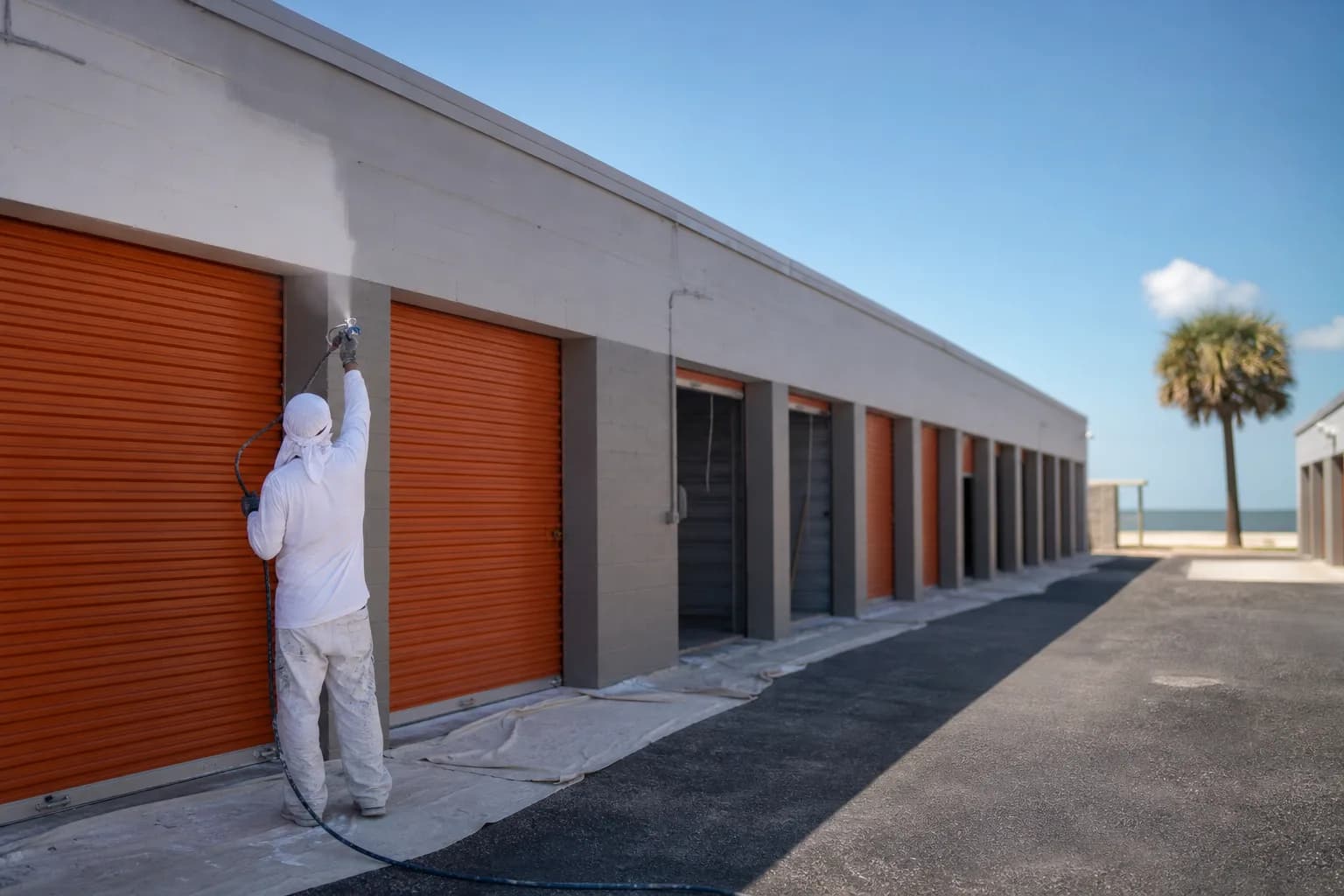
A self-storage facility is one of the strangest buildings to repaint, because it never actually closes. There's no "after hours" to slip the work into — a tenant might pull up to grab a box at 6 a.m. on a Sunday, and the gate code is supposed to let them. So the usual playbook for an occupied commercial space, where you wait for the lights to go off, simply doesn't apply. The whole property is "open" twenty-four hours a day, every day.
That changes how the job has to be run. The challenge in self-storage facility painting isn't the metal or the height or the square footage — it's keeping every renter's access to their own unit intact while you work your way across acres of roll-up doors and corridors. Get the sequencing right and a renter barely notices the repaint happening around them. Get it wrong and you've got a line of frustrated tenants who can't reach their stuff.
Why can't a storage facility be painted the normal way?
Most occupied commercial jobs lean on a closed window — we paint a store overnight, a clinic on its dark day, an office wing while staff relocate. Storage has none of that. The product is round-the-clock access, so there's no moment the building is empty and no group of people you can route somewhere else for a few hours.
The other quirk is that the "occupants" aren't there continuously — they show up at random, for a few minutes, at a specific door, then leave. You're not protecting a working floor full of people all day; you're protecting any single tenant's ability to reach any single unit at any unpredictable moment. That flips the whole approach. Instead of clearing a zone of people, you keep almost the entire property reachable and only ever touch a short, well-announced stretch of doors at a time.
Sequencing the job row by row
On a multi-story office we phase by floor; on a sprawling plant we phase by bay. On storage, the natural unit is the row — a single building or a stretch of doors along one drive aisle. We break the property into those rows and run them one at a time, the same logic behind any well-run commercial paint job's phasing, just sized to storage.
| Facility area | How we sequence it | Why it protects access |
|---|---|---|
| Drive-up exterior rows | One building / aisle face at a time | Every other row stays fully open while one is worked |
| Roll-up doors | A few adjacent doors per short window | Only a handful of units are briefly affected, never a whole row |
| Climate-controlled corridors | Short interior runs, one at a time | A clean, walkable route to every unit stays open |
| Gate, office & signage walls | Low-traffic windows, kept passable | The entrance everyone uses is never closed off |
| Site fencing & light poles | Last, around the buildings | Touched only after the high-traffic areas are done |
The rule that holds it together: only one short section is ever in play, and the rest of the facility operates exactly as it did the day before. Tenants whose units sit on an untouched row never even know the crew is on site that day. We map all of this at the free estimate by walking the property and looking at where the buildings divide and where your traffic actually concentrates.
Handling the roll-up doors
Roll-up doors are the part people worry about, and rightly — that's the one surface a tenant has to physically operate to get in. The rule is simple: we coat a door only when it's down, work a small cluster of adjacent doors in one short window rather than a whole row, and give those few units a fresh-coat dry time before the door rolls again. Which specific doors are affected, and when, goes up at the gate and by the office days ahead, so a renter heading out knows before they drive over.
If someone needs into a unit we're actively coating, we plan around them — that single door waits. It's slower than blasting a whole building face in one pass, but it's the difference between a repaint that annoys your tenants and one they hardly register. The same discipline that makes an apartment turnover go smoothly around move-in dates applies here: you work around the people, not over them.
Finishes that survive coastal metal and constant traffic
Most self-storage on the Gulf Coast is bare steel — corrugated walls, metal roll-up doors, exposed structure — sitting in full sun and salt air year-round. That's a brutal environment for paint: rust creeps from every scratch, color chalks and fades, and a cheap paint job peels inside a couple of seasons. The finish has to be chosen for that, not for looks alone.
1. Prep the metal honestly
We pressure-clean off chalk and grime, knock back rust to sound metal, and address loose or failing old paint. On Gulf Coast steel this prep is most of the job — paint over rust and it bleeds right back through.2. Spot-prime bare and rusted metal
Every bare or rusted spot gets a rust-inhibitive primer before topcoat. That primer is what stops corrosion from restarting under a fresh, good-looking finish six months on.3. Topcoat with a durable exterior metal system
We finish the exterior in a Sherwin-Williams exterior paint rated for metal in coastal exposure — built to hold color and fight rust, fading, and chalking through the sun and salt the buildings live in.4. Use a scrubbable finish on high-traffic interiors
Climate-controlled corridors take a beating from carts and dollies, so interior walls and high-touch surfaces get a tougher, washable finish that wipes clean and stands up to constant traffic.
Corridor and trim colors we match to your brand — we color-match any brand in-house, so your buildings stay on-palette even if the original spec is long gone. For the office, gate area, or a model-corridor refresh where you want to preview a look first, our color visualizer tool lets you test colors on a photo before a drop of paint goes up, and our commercial painting service page covers the rest of what we handle on a property like this.
Keeping tenants and staff in the loop
Because the job runs for a stretch and the affected doors change day to day, communication is part of the method, not a courtesy. You get a posted schedule of which row and which doors are active and what's next, signage at the gate so renters see it on the way in, and a heads-up before anything that might touch a busy area. For facilities that want it, we can help with a quick tenant notice so nobody's surprised. And at the end, a manager walks the finished property with you and signs off before final payment — so the job closes on your confirmation, not the crew packing up. A Certificate of Insurance is available for your records before we start, which most facility owners and their corporate offices want on file.
Bottom line
A self-storage facility gets painted the same way it operates — continuously, around the people using it. Break the property into rows and aisles, run them one at a time, touch only a few doors in any short window, announce every affected unit ahead, and choose finishes built for coastal metal and constant cart traffic. Do that and your buildings come out looking new without a single tenant locked out of their unit.
That's how we'd run yours — family-owned since 2013, with one accountable crew handling the property from your free estimate through the final inspection, all backed by our 1-year workmanship warranty. If you manage a storage facility across Mobile and Baldwin County that's due for a refresh, reach out for a free in-home estimate and a written quote within 24 hours. Pay by Cash, Check, or Credit Card.