
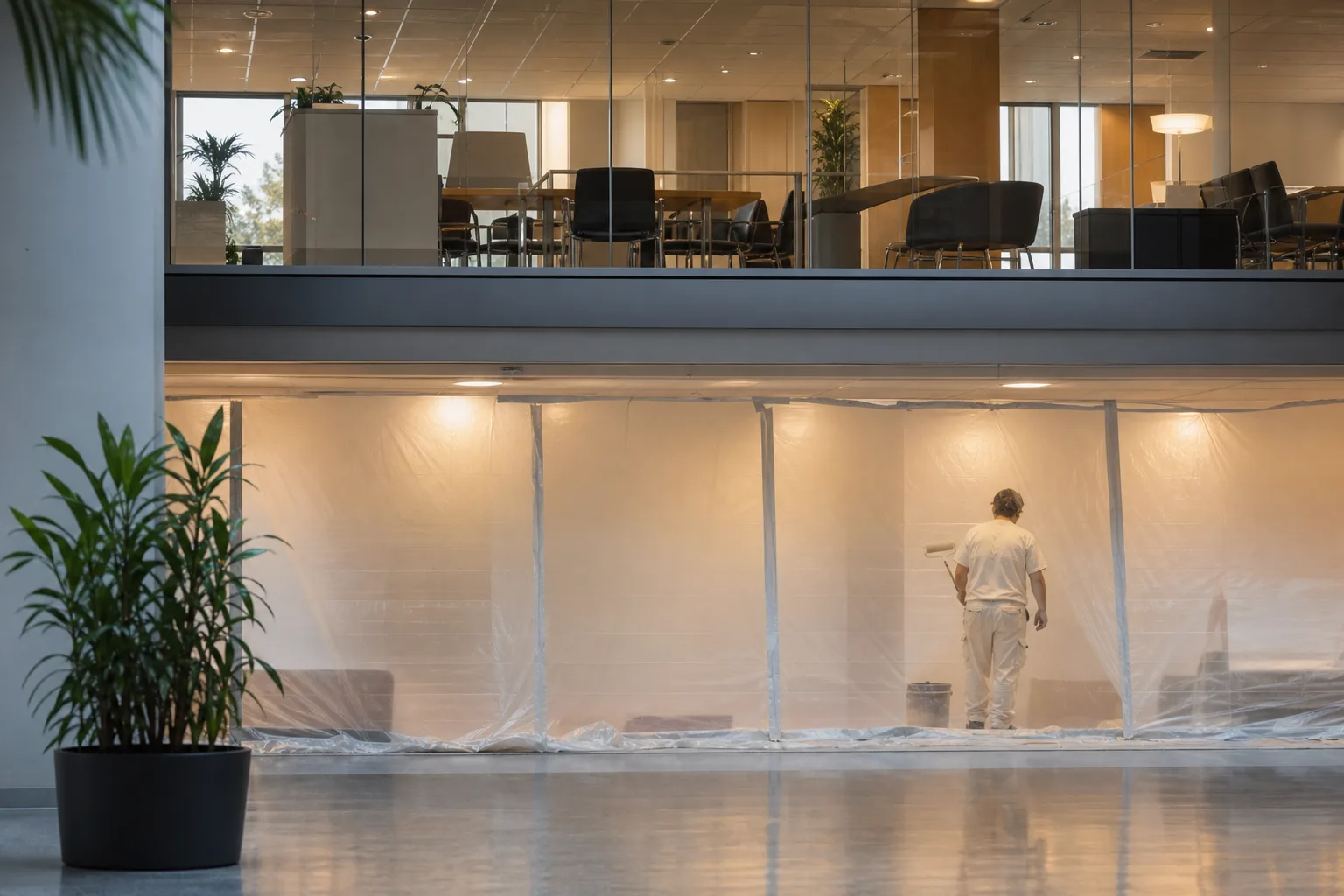
A commercial repaint gets hard the moment the building is too big to close. A single retail unit you can knock out overnight. But a three-story office, a school, a sprawling clinic, a warehouse with a working floor — you can't shut all of it, and you can't paint all of it at once either. The answer is phasing: breaking the project into sections and running them one at a time so the building keeps working while it gets painted. Done right, commercial painting phasing is invisible to most of the people inside the building — they just notice that, a few weeks on, the whole place looks new.
Phasing is the engine underneath painting an occupied space without closing — our full guide to keeping a commercial space open through a repaint covers scheduling, containment, dust control, and protection together. This post zeroes in on one piece of that: how a large job gets divided and sequenced — what becomes a phase, and what order the phases run in. That decision, made at the estimate, is what determines whether a big repaint interrupts your operation or just quietly happens around it.
What "phasing" actually means on a commercial job
Answer-first: phasing means splitting a large building into sections — floors, wings, suites, departments, or zones — and completing them one at a time, handing each one back ready to use before the next begins. The building is never fully offline. At any moment, most of it is running normally and one defined area is in progress behind containment.
The opposite approach — closing the whole building and painting everything in one push — is faster on the calendar and sometimes right for a vacant or between-tenants space. But for a working business, every shutdown day has a cost, and phasing trades a few extra calendar days for zero closed days. For most commercial owners, that's the trade that matters. Those extra after-hours and staged days do show up in the price — our breakdown of what drives commercial painting cost per square foot walks through how scheduling factors into a bid.
How do we break a building into phases?
The first decision is what becomes a phase. We make that call by walking the building at the free estimate and looking at two things together: where the space naturally divides, and how each area gets used.
| Building type | Natural phase unit | Why it fits |
|---|---|---|
| Multi-story office | Floor by floor | Each floor seals off cleanly and can empty on its own schedule |
| Sprawling single-level | Wing or department | Sections are far enough apart to isolate work from working areas |
| Office suite or clinic | Suite or room cluster | Rooms can be cycled out a few at a time without closing the practice |
| Warehouse / industrial | Bay or work area | Production keeps running in the bays that aren't being painted |
| Retail / restaurant | Front-of-house vs back-of-house | Sales floor gets after-hours work; back areas run behind a sealed wall while open |
The split has to satisfy two rules at once: each phase must be a section containment can seal off cleanly, and the area's downtime has to be survivable for that part of your operation. A phase that can't be isolated lets dust and odor leak into working space; a phase that takes a critical area offline at the wrong time costs you more than the paint is worth. Where those two rules point in different directions, the estimate is where we reconcile them with you.
Sequencing: what order the phases run in
Dividing the building is half the decision. The other half — and the part that makes or breaks the experience — is the order. We sequence around your operations, not the floor plan.
1. Lowest-disruption areas first
We start where painting interferes least — a floor that's between tenants, a wing that's lightly used, a department that can relocate easily — so the project gets momentum before it touches anything sensitive.2. Customer-facing zones in the quiet windows
Lobbies, sales floors, and dining rooms get after-hours or slow-day windows so they're never roped off during business and the public never sees the work.3. Never two adjacent in-use areas at once
We keep a finished, clean path through the building by not tearing up two neighboring working areas simultaneously — there's always a clear way through.4. Critical operations scheduled around their calendar
A booked event space, a busy clinic week, a tax-season rush — high-stakes areas get sequenced for when their calendar allows, not when it's convenient for the crew.5. Tie-in and shared spaces last
Stairwells, shared corridors, and connectors that everyone passes through get done once the surrounding phases are complete, so the high-traffic glue of the building is disrupted only briefly at the end.
The thread through all of it: at no point is your operation's lifeline cut. If you're an office, your people always have somewhere to work. If you're a store, customers always have a clean floor to shop. If you're a clinic, patients always have rooms. We figure out that lifeline at the estimate and protect it through every phase.
Run each phase clean, then hand it back
Within a phase, the rule is simple: finish it completely before moving on. We don't half-paint three floors and leave the building living inside a construction zone. We seal off the phase, do the full cycle — prep, repairs, prime, paint, cure — clean the area top to bottom, pull the containment, and return that floor or wing to full use. Only then does the crew move to the next phase.
That's what keeps a long project from feeling long to the people inside it. Because every phase comes back finished and clean, your team and your customers only ever encounter one tidy area at a time, never a building-wide mess. A six-week job experienced one completed zone at a time barely registers as disruption at all.
Communication holds a phased job together
A phased project runs for weeks, often partly after hours, so you can't watch all of it. That makes communication part of the method, not an afterthought. You get a clear schedule of which phase is active and what's next, a daily update on progress, and a heads-up before any decision that needs your call. And at the end, after the last phase, a manager walks the entire finished project with you and signs off before final payment — so the project closes on your confirmation, not on the crew packing up.
The bottom line on phasing a commercial repaint
Phasing is how a building too big to close still gets fully painted. Divide it by floor, wing, suite, or zone along lines containment can seal and operations can spare; sequence the phases around how you actually run — lowest disruption first, customer-facing areas in the quiet hours, never two adjacent working areas down at once; finish and hand back each phase clean before the next; and keep communication tight throughout. Get that right and a major repaint costs you a sharper-looking building and not a single shutdown day.
That's how we run every large commercial job — family-owned since 2013, one accountable crew from your free estimate through the final inspection, all backed by our 1-year workmanship warranty. If you've got an office, school, clinic, or multi-area building that can't close for paint, see our commercial painting service or our commercial painting guide for Mobile and Baldwin County for the full picture, then reach out for a free estimate and a written quote within 24 hours. Pay by Cash, Check, or Credit Card.