
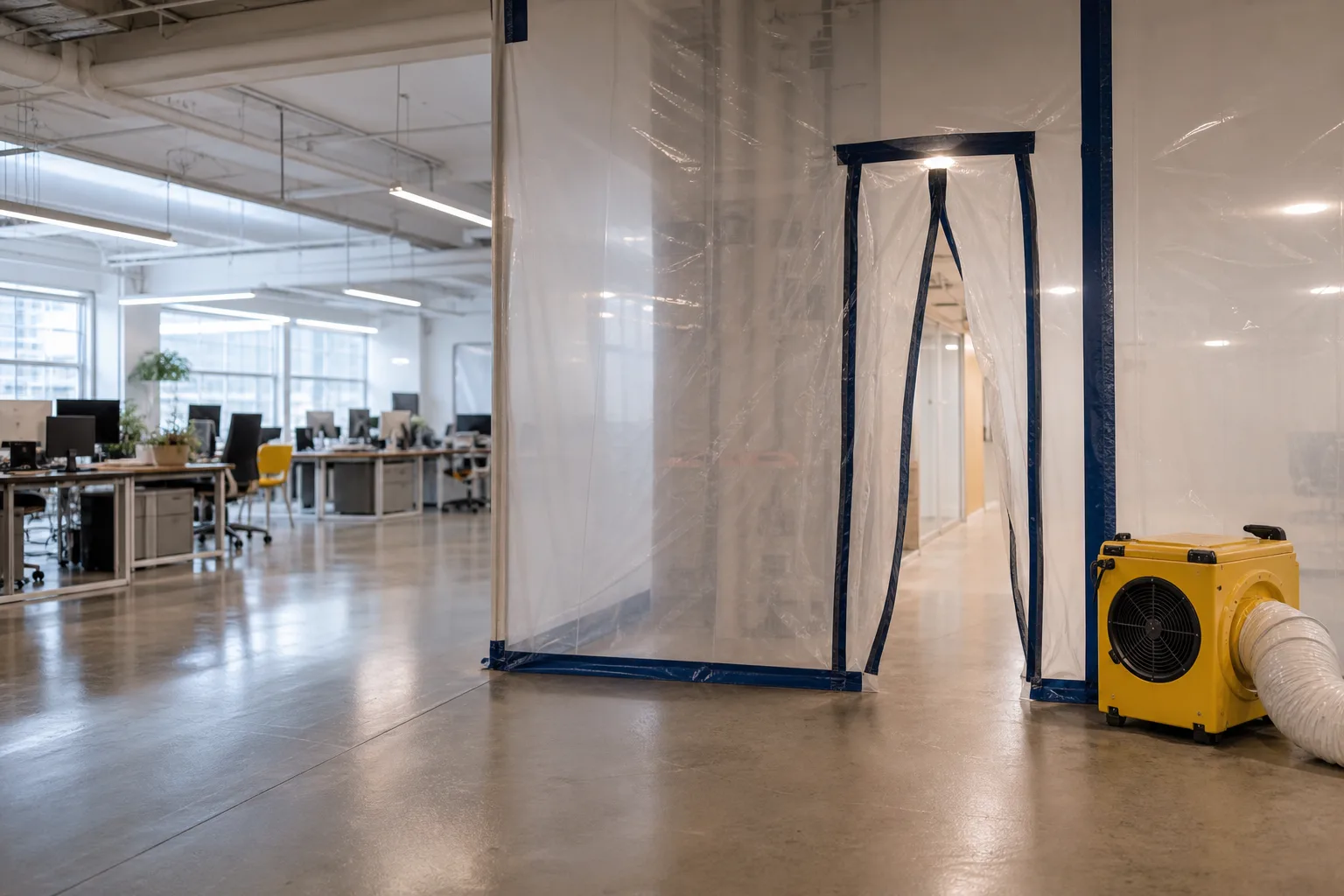
The plastic sheeting taped across the hallway is the part of a commercial paint job your customers actually notice — and the part most painters get wrong. Hang a loose curtain of poly and fine sanding dust still finds its way onto the front counter, the server rack, the salad station. Build it right and the work zone becomes a sealed box your business stays open right next to, with the dust trapped on our side of the line. That difference is what dust control on a commercial painting job comes down to: containment that actually contains.
This is the mechanics piece. If you want the wider picture of keeping a business running through a repaint — scheduling around your hours, low-odor coatings, protecting inventory — our pillar on painting an occupied commercial space without closing covers the whole playbook. Here we go deeper on the one part that keeps the rest of your building clean: how the barrier and the air handling actually work.
A containment wall is a sealed box, not a draped sheet
Answer-first: real zone containment means floor-to-ceiling plastic, run tight to the structure and taped at every seam, so the work area is a closed box rather than a room with a curtain across the door. The gaps are where dust escapes, so the gaps are where the work goes.
We frame the poly opening-to-opening and run it past the dropped ceiling grid up to the hard deck above, because the plenum over a suspended ceiling is a highway — pressurize the zone even slightly and dust rides that space straight into the next room. The bottom gets weighted or taped to the floor. Vertical seams overlap and tape down. The result is a box with one controlled way in and out, not a dozen leaks.
The zip-wall door and the anteroom
The crew still has to get in and out, and every trip is a chance to drag dust onto your floor. So the doorway isn't a flap — it's a zippered poly door that seals shut behind each pass. On the dustier jobs, heavy demo sanding, big patch-and-skim work, we add a small anteroom: a second short stretch of poly just outside the zip door with a tacky walk-off mat on the floor. The crew steps into the anteroom, the dust pulls off their boots on the mat, then they step into your clean space. It's the same logic a hospital uses, scaled to a paint job.
A sticky mat sounds like a small thing. On a job next to an occupied office or a kitchen, it's the difference between footprints of grit tracked down your corridor and a floor that looks like we were never there.
Negative air is what makes the box actually work
Here's the part most people have never heard of, and it's the one that matters most. A sealed box still leaks a little — and which direction it leaks decides whether your space stays clean. So we put the zone under negative air pressure.
1. Build the sealed box
Floor-to-ceiling poly, run tight to the deck above the ceiling grid, every seam taped, a zip-wall door — one controlled opening, no gaps.2. Add an anteroom on dusty jobs
A short second poly vestibule outside the zip door with a tack mat, so dust pulls off boots before anyone steps into your space.3. Run a HEPA air scrubber
A filtered air mover pulls air out of the zone faster than it leaks in, so the box sits at lower pressure than your building and air flows inward.4. Cut dust at the source
Vacuum-assisted sanders and HEPA vacuums catch most sanding dust at the head; the scrubber filters whatever escapes into the air.5. Wet-wipe, then tear out clean
Before the poly comes down we wet-wipe and vacuum, leave the scrubber running, then pull the plastic inward on itself so nothing puffs out.
A HEPA-filtered air scrubber sits inside the sealed zone and pulls air out of it — often ducted to exhaust the air outside or through the filter back into the room. Because it's removing air faster than air leaks in, the zone drops to slightly lower pressure than the rest of your building. Now physics is on your side: any air that moves through a gap moves into the zone, not out of it. Dust that does get airborne gets carried to the scrubber and trapped in the HEPA filter instead of drifting toward your customers. The poly walls visibly suck inward a little when it's working — that's the look of a job that's contained.
Where does the dust on a commercial paint job actually come from?
Containment handles the dust that gets into the air. But real dust control on a commercial painting job keeps most of it from getting airborne in the first place, because the prep is where commercial paint dust actually comes from — sanding old drywall, knocking down patches, scuffing trim and block.
So inside the sealed zone we run vacuum-assisted sanders: the sanding head has a shroud connected to a HEPA vacuum, so the dust is pulled off the surface the instant it's cut. Edges and corners get hand-sanding with a HEPA vac right alongside. The air scrubber is the backstop for whatever gets past the tools — not the main line of defense. Source capture plus negative air is what lets the dustiest part of the job happen a few feet from an open business. The same discipline carries through when prep means patching walls — see how we handle drywall repair and painting as one job so the patch, sanding, and finish all stay inside the contained zone.
Tearing it down without undoing the work
The last trap is the teardown. A zone can stay spotless for a week and then dump a cloud of trapped dust the second someone yanks the plastic down. So we tear out in order: wet-wipe horizontal surfaces and ledges, vacuum the floor with the HEPA, and leave the air scrubber running the whole time so it's still pulling air as we work. Then the poly comes down by folding it inward on itself, dusty side in, and bagging it — never shaking it out into the room.
Only after that does the barrier move to the next zone, and we hand your area back genuinely clean — wiped down, floors gone over, ready to use — not "good enough." If the job touches your building's exterior masonry or block as well, the same dust discipline carries over to grinding and prep there; our exterior painting work follows the same containment habits outdoors.
The bottom line for keeping your space open and clean
Dust control on a commercial job isn't a sheet of plastic — it's a system. A sealed poly box run tight to the structure, a zip-wall door and an anteroom mat, a HEPA scrubber holding the zone under negative air so leaks pull inward, vacuum-assisted sanding to catch dust at the source, and a careful wet-wipe teardown so the work stays contained to the end. Get those right and your customers walk past an active paint job without a speck of grit on the counter.
That's how we run every occupied commercial job — family-owned since 2013, one accountable crew from your free estimate through the final inspection, all backed by our 1-year workmanship warranty. For the full scope of how we keep a working building open during a repaint, see our commercial painting service, or read how we work around your business schedule so containment goes up while you're closed. When you're ready, schedule a free estimate and we'll send a written quote within 24 hours. Pay by Cash, Check, or Credit Card.