
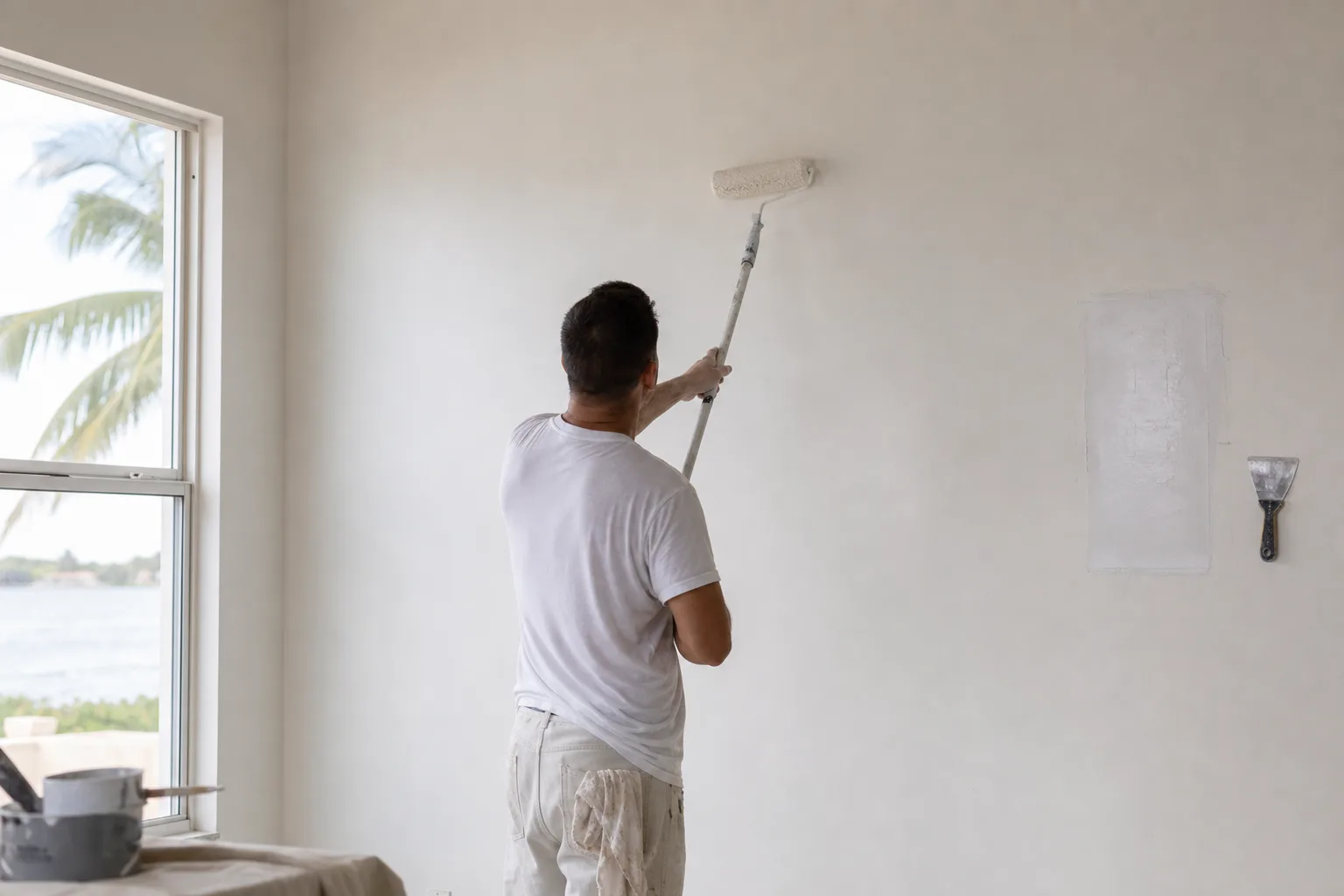
Here's a scene we walk into all the time: a homeowner had the drywall fixed a few months back, then hired a painter to come freshen the room. The paint looks great — except for the four spots where the old repairs sit under it like islands, catching the evening light. The drywall guy did his job. The painter did his. And the wall still has scars, because the two halves of one job were treated as two jobs with a seam in the middle.
Drywall repair and painting isn't two services that happen to land in the same room. It's one continuous process — patch, float, sand, texture-match, prime, paint — and the place repairs go wrong is almost always the handoff. When one accountable crew owns the whole sequence, the repair and the wall end up as a single surface you can't find. Here's why that matters more than most people realize, and what actually goes wrong when the work gets split.
Drywall repair and painting are the same job
A drywall patch isn't finished when the hole is filled. It's finished when it's invisible under paint — and getting there runs straight through the painting. Floating the compound, sanding it flush, re-creating the wall's texture, priming so it doesn't flash, and laying the finish coat are not "drywall steps" and "paint steps." They're one ramp from damaged wall to done wall, and every stage depends on the one before it.
That's why the foundation of any good paint job is the prep underneath it. A patch that wasn't feathered wide enough leaves a ridge that paint can't hide. A patch that wasn't textured to match sits there smooth in a textured wall like a window. A patch that wasn't primed drinks up color and flashes a dull halo. None of those are painting failures — they're prep failures the paint simply reveals. When repair and finish share one accountable scope, the prep gets built for the coating system instead of treated as a disconnected task.
What goes wrong when you split the work?
When drywall and paint are two separate contractors, you don't just get two invoices — you get a seam in the work itself, and that seam is where the trouble lives.
| What happens | Two separate trades | One accountable crew |
|---|---|---|
| Texture matching | Drywaller textures to 'good enough,' painter inherits it | Texture matched and judged with the finish in mind |
| Priming the patch | Easy to skip — each assumes the other did it | Built into the sequence, every patch primed |
| Who owns the final look | Nobody — each blames the other | One crew, one manager sign-off |
| Scheduling | A gap where the job stalls between trades | Continuous — repair flows into paint |
| If a repair shows later | Finger-pointing between contractors | One callback, one warranty, one crew |
The pattern is always the same. The painter says the drywall wasn't finished smooth enough to paint over. The drywaller says the paint job exposed work that was fine. Both are a little right, and you're the one staring at a patched wall that still looks patched. The most common casualties are texture and primer: a drywaller textures to a standard that looks fine bare but reads wrong under a finish coat, and priming the patch falls into the crack between trades because each assumes the other handled it.
Then there's the cost nobody quotes you — the repair that has to be redone. Sanding back a flashing patch, re-texturing, re-priming, and repainting a wall costs far more in time and aggravation than doing it once, in order, with one crew. The seam between contractors is the single most expensive part of a split job, and it never shows up on either estimate.
The two things that give a split job away
When a repaired wall looks repaired, it's almost always one of two culprits — and both come from prep and paint being treated as separate jobs.
The first is texture mismatch. Most Gulf Coast walls wear a knockdown or orange-peel texture, and a patch finished smooth — or textured to a slightly different coarseness — sits in that wall like a flat island the second light rakes across it. Blending those patterns back in is a skill of its own, which is why we break it down in how to match drywall texture. A repair can look acceptable bare and still show under paint. Under one coordinated scope, the texture is judged against the final coating, not just the bare wall.
The second is flashing — a patch that reads as a dull or shiny halo because bare joint compound drinks up paint differently than the wall around it. The only cure is priming the repair, and priming is exactly the step that falls into the gap between two trades, each assuming the other handled it. One crew never loses that step. This is also why the fix isn't "more paint" — rolling extra coats over an unprimed patch just deepens the halo, a trap we dig into in why primer matters on drywall patches.
Both failures share a root: they're prep problems that only become visible once the paint is on, so a painter who inherited someone else's drywall work has no way to catch them until it's too late. Owning the repair and the finish is what lets a crew get ahead of them.
What "one accountable crew" actually looks like
When we say drywall repair and painting should be one job, this is the sequence we mean — repair flowing straight into finish, with nothing falling through a handoff.
Assess the wall against the finish
We look at the damage already thinking about how it has to read painted — what has to be replaced, how wide each repair needs to feather, and which texture the wall is wearing. The repair plan is built around the final look from the start.Repair, float, and feather wide
Patches go in with the right method for their size, then get floated in layers, each coat wider than the last, so there's no ridge for light to catch. The written scope connects this repair standard to the finish that follows.Match the texture
We re-create the wall's texture — knockdown, orange peel, smooth, or a hand pattern — across each repair, blending into the surrounding wall so there's no hard line where new meets old.Prime every repair
Every patch is spot-primed so it takes color exactly like the wall around it. Priming is documented as part of the coordinated repair-and-paint scope.Paint to a natural break
We paint the full wall corner to corner, not just the patch, so aged color and sheen never give the repair away. The wall comes out as one continuous surface, then a manager signs off before final payment.
That continuity is the whole point. One crew runs your project from the free estimate through the final inspection, a manager checks the work before final payment, and there's one warranty standing behind both the repair and the paint — so if anything ever needs a second look, it's one call to one crew, not two contractors pointing at each other. It's the same standard we bring to every interior painting job, where drywall prep is the foundation the whole finish stands on — which is also why patching and texture matching are the first thing we cover in our drywall repair and texture matching guide.
The finish is only as good as what's under it
A wall is judged on the paint, but the paint is only as good as the drywall work beneath it. Bundle the two and you get matched texture, primed patches, no scheduling gap, and one crew that owns the result from the first cut to the final coat. Split them and you inherit a seam between trades that shows up, sooner or later, as a repair you can still find.
Pro 1 Painters has been a family-owned Gulf Coast painting crew since 2013, and we handle drywall repair and painting as a single job for exactly this reason — repair, texture-match, prime, and paint, so the wall reads as one surface instead of a patch with paint laid over it. One accountable crew runs it from your free estimate through the final inspection, a manager signs off before final payment, and the work is backed by our 3-year workmanship warranty and a 4.8-star reputation. If you've got walls that need repair and a repaint, book a free in-home estimate and we'll handle the whole thing in one pass — and email a written quote within 24 hours. Pay by Cash, Check, or Credit Card.