
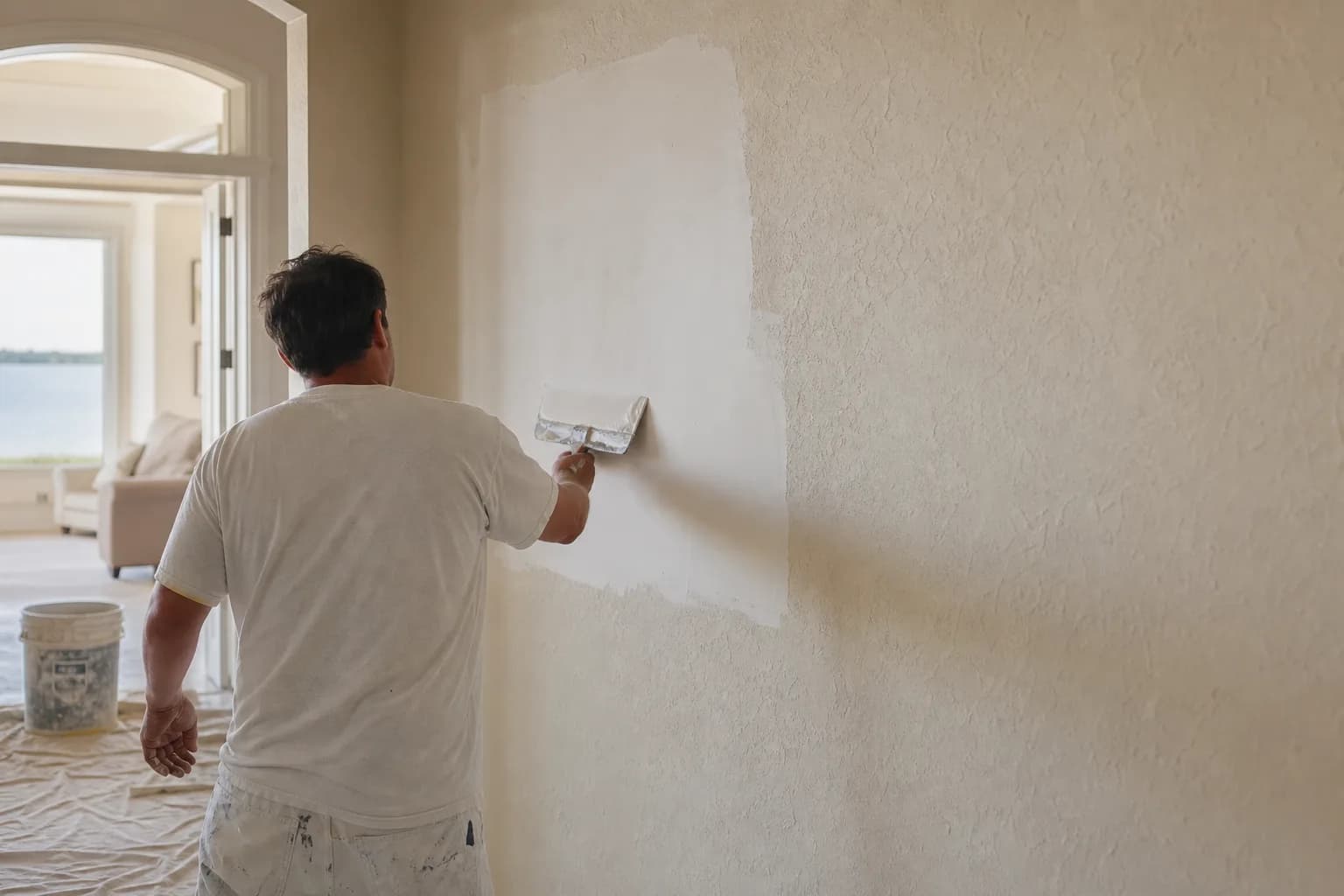
There's a spot on your wall you've stopped seeing. A hairline crack creeping out from a doorway corner. A little dome where a nail used to sit flush. A brown ring on the ceiling from that one storm a couple summers back. You walked past it this morning. But a guest sees it the second they sit down, and so does a buyer the day you list the house.
Drywall is forgiving stuff right up until it isn't. On the Gulf Coast it takes a beating most homeowners never think about — humidity swelling the framing behind it, the occasional roof or plumbing leak, the slow settling every house does. The good news is almost all of it is repairable, and a repair done right vanishes completely. The trick that separates a real fix from a smear of spackle is texture matching: getting the patched area to wear the same skin as the wall around it, so the eye slides right past it. This guide walks through the whole thing — cracks, holes, water-damaged ceilings, nail pops, and how we blend a repair back into the wall and the paint.
The repair nobody sees vs. the patch everybody does
Most failed drywall repairs don't fail because the hole came back. They fail because the patch shows. You painted over it, and now under a lamp at night or with afternoon sun raking across the wall, there's a faint smooth island in a textured sea, or a dull halo where the compound drank up the paint.
That happens for two reasons, and they're both avoidable: the patch wasn't feathered wide enough, and it wasn't primed. Drywall finishing is the art of hiding a repair by spreading the transition out so far and so thin that there's no visible edge — then giving that whole area the same texture and the same primed surface as everything around it. Skip either step and you've traded a hole for a smudge that's almost as distracting.
Matching the texture: knockdown, orange peel, and smooth
Walls around here are rarely dead flat. Most homes wear one of three textures, and matching the right one is what makes a patch disappear.
Knockdown is the most common texture in Gulf Coast homes. It's sprayed on as wet splatter, given a minute to set, then "knocked down" with a wide blade so the peaks flatten into soft, irregular islands. The whole match lives in the timing — knock it down too soon and it smears, too late and the peaks stay sharp.
Orange peel is a finer spray texture, a bumpy stipple that genuinely looks like the skin of an orange. No knockdown step; it's all in the spray pressure and tip. Lighter and tighter than knockdown.
Smooth sounds like the easy one and is quietly the hardest. With no texture to hide behind, a smooth wall shows every imperfection, so the compound has to be floated and sanded glass-flat across a wide area, then primed dead-even.
| Texture | How it's applied | How we match it | Trickiest part |
|---|---|---|---|
| Knockdown | Sprayed splatter, then flattened with a blade | Spray to match the splatter size, time the knockdown | Getting the knockdown timing right so islands match |
| Orange peel | Sprayed fine stipple, left as-is | Match spray pressure and tip size on a test board | Matching the stipple coarseness exactly |
| Smooth / flat | Floated and sanded, no spray | Float wide, sand flush, prime perfectly even | No texture to hide flaws — every ridge shows |
| Hand-troweled / skip-trowel | Applied and shaped by hand with a trowel | Re-create the trowel pattern by hand to blend | Reading and copying the original hand pattern |
The rule we live by: never spray straight onto the wall and hope. We dial the texture in on a scrap of cardboard or drywall first, get the splatter and knockdown reading right, then blend it onto the actual wall, fading it into the existing texture so there's no hard line where new meets old. Matching texture is as much patience as skill — and it's exactly the kind of detail our drywall repair and painting crew sweats so the finished wall reads as one surface.
The three-stage float: how a patch actually disappears
Whether you're closing a hole or skimming a crack, the finishing follows the same logic — thin coats, each one wider than the last. We call it the three-stage float, and rushing it is the number-one reason a DIY patch shows.
Patch & set the base
Bridge the hole with the right method for its size (see below), then lay the first coat of joint compound. This coat does the structural work — it embeds the tape or backs the patch. It will not be pretty, and that's fine.Tape the seams
Any joint or crack gets tape — paper or mesh — bedded into that first coat to keep the repair from cracking again as the house moves. No tape over a seam means the crack comes straight back through your paint.Second (fill) coat — go wider
Once the base is dry, spread a wider, smoother coat that fills the weave of the tape and starts feathering the edges out past the repair. You're building the transition zone here.Third (skim) coat — feather it out
A final thin, wide coat that fades the compound to nothing well beyond the patch. Feather a hand's width or more past the damage so there's no edge to catch the light.Sand flush
Sand the dried compound smooth and level with the wall, checking under raking light. The patch should feel like glass under your palm with no ridge at the edges.Match the texture
Re-create the wall's texture over the repair — knockdown, orange peel, or hand pattern — blending into the surrounding area. This is the step that makes the patch vanish.Prime, then paint
Spot-prime the whole repaired area so it absorbs color the same as the wall, then paint. Without primer the patch flashes dull no matter how good the finish coat is.
That sequence is the same whether the wall is in a bedroom or a storefront. It just scales — bigger damage means wider feathering and more drying time between coats. And drying time is real on the Gulf Coast: high humidity stretches how long compound takes to cure, so a rushed patch that's still damp underneath will crack or flash later. We let each coat dry fully, humidity and all, before the next.
Holes: small, medium, and "that's a new piece of drywall"
Not every hole gets fixed the same way. The right method depends entirely on size.
| Damage size | Best repair method | Texture & blend after |
|---|---|---|
| Nail/screw holes, hairline cracks | Fill with compound or lightweight spackle, two thin coats | Light skim, match texture, spot-prime |
| Up to a few inches (doorknob dents) | Mesh patch or a setting-compound fill, then three-stage float | Feather wide, re-texture, prime |
| Roughly fist-size to medium | Cut a clean square, back it, set a drywall plug, tape all four seams | Float wide past seams, match texture, prime |
| Large / multiple panels / water damage | Cut back to the studs, screw in a new drywall section, tape & float | Full re-texture across the new panel, prime whole area |
Two notes from the field. Small holes are where DIY does best — a little compound, two thin coats, a quick texture touch-up, and you're done. But "lightweight spackle slapped on in one thick glob" is exactly how you get a shrinkage crater that needs redoing. Thin coats, every time.
Big holes and anything structural are where it's worth a call. Cutting back to the studs, hanging new board so it sits flush with the old, taping every seam, and then re-texturing a whole panel to match the room is finish carpentry as much as patching. For walls that are more damage than wall — old water trouble, a removed wall heater, multiple bad patches — resurfacing the whole wall often gives a cleaner result than chasing a dozen separate repairs.
Water-damaged ceilings: when to patch and when to cut
Water stains on a ceiling are the repair we get asked about most on the Gulf Coast, and for good reason — between roof wear, attic condensation, second-floor plumbing, and storm season, ceilings here take the brunt of it. The instinct is to paint over the stain and move on. Sometimes that's fine. Often it's a mistake.
The first question is never "how do I hide it" — it's "is the leak fixed?" Painting over an active leak just gives the next stain a fresh white canvas to bleed through. Find and stop the water first, always. When the damage traces back to a roof leak or storm, our guide on drywall repair after a water leak or storm covers how we handle a soaked wall or ceiling start to finish.
Once the source is handled, the drywall itself tells you what it needs:
If the ceiling is still firm and only discolored, you're in luck: a stain-blocking primer over the ring (a plain wall primer will let it ghost right back through), then repaint, and often re-texture so the repaired area matches the rest of the ceiling. If it's soft, it's a cut-and-replace job following the same three-stage float and texture match as any panel. When you're staring up at a brown ring and not sure which camp you're in, our deeper guide on fixing a water-damaged ceiling and when to cut it out lays out exactly what to look for.
Nail pops and stress cracks: fixing the cause, not the symptom
Nail pops are those little circular bumps or chips that appear in lines along the wall or ceiling, usually over a stud. They happen when a fastener works loose as the framing swells and shrinks with our humidity swings, pushing a dome of compound off the wall. Just refilling the bump treats the symptom — the fastener is still loose, and it'll pop again.
The real fix: drive a drywall screw an inch or two from the pop to re-secure the panel tight to the stud, then back out or set the popped fastener below the surface, and patch both spots with the three-stage float and a texture match. Done with screws instead of nails, they rarely come back.
Stress cracks — the ones that radiate from the corners of doors and windows — are the same idea. They open because that's where a wall flexes most as the house moves. Bridging them with tape (not just compound) before floating is what keeps them from cracking straight back through your fresh paint. Skip the tape and you'll be looking at the same crack by next season — and if cracks are your main headache, our guide on drywall crack repair that won't come back digs into exactly why they return and how we stop them for good.
Blending the repair into the wall — and the color
Here's the part homeowners forget until it's too late: a perfectly textured patch can still be obvious if the color doesn't match. Paint changes as it ages — sun fades it, kitchen and bath films yellow, and last decade's "builder white" is not this can's "builder white." A spot-painted patch can leave a slightly brighter or different patch right where you worked so hard to hide the repair.
For a patch that truly disappears, the safe move is to prime the repair and then repaint the entire wall, corner to corner. Painting to a natural break — a corner, a trim line — means there's no halo, no almost-match, just one even surface. On a stained ceiling, that usually means doing the whole ceiling, not just the ring.
Drywall is the literal foundation of every interior paint job, which is why prep like this comes first in our complete interior house painting guide for Mobile and Baldwin County. It matters just as much commercially — a scuffed, patched-over wall undercuts an otherwise sharp space, something we get into in our commercial painting guide for Mobile and Baldwin County.
When should you DIY a drywall repair and when should you call a crew?
Filling a few nail holes or a small dent before you repaint? That's a good weekend job, and doing the prep yourself can save you money. Where it's worth bringing in a crew: anything textured that has to match (knockdown and orange peel are genuinely hard to fake), water damage where you're unsure if the board is sound, large or multiple holes, or any repair on a ceiling, where gravity and overhead light are merciless on a so-so patch.
Pro 1 Painters has been a family-owned Gulf Coast painting crew since 2013, and drywall repair and texture matching is part of nearly every interior job we do. One accountable crew runs your project from your free estimate through the final inspection, a manager signs off before final payment, and the work is backed by our 3-year workmanship warranty. If there's a crack, hole, or water stain you've stopped seeing — but your guests haven't — book a free in-home estimate and we'll tell you straight whether it's a patch or a replacement, and what it takes to make it disappear.