
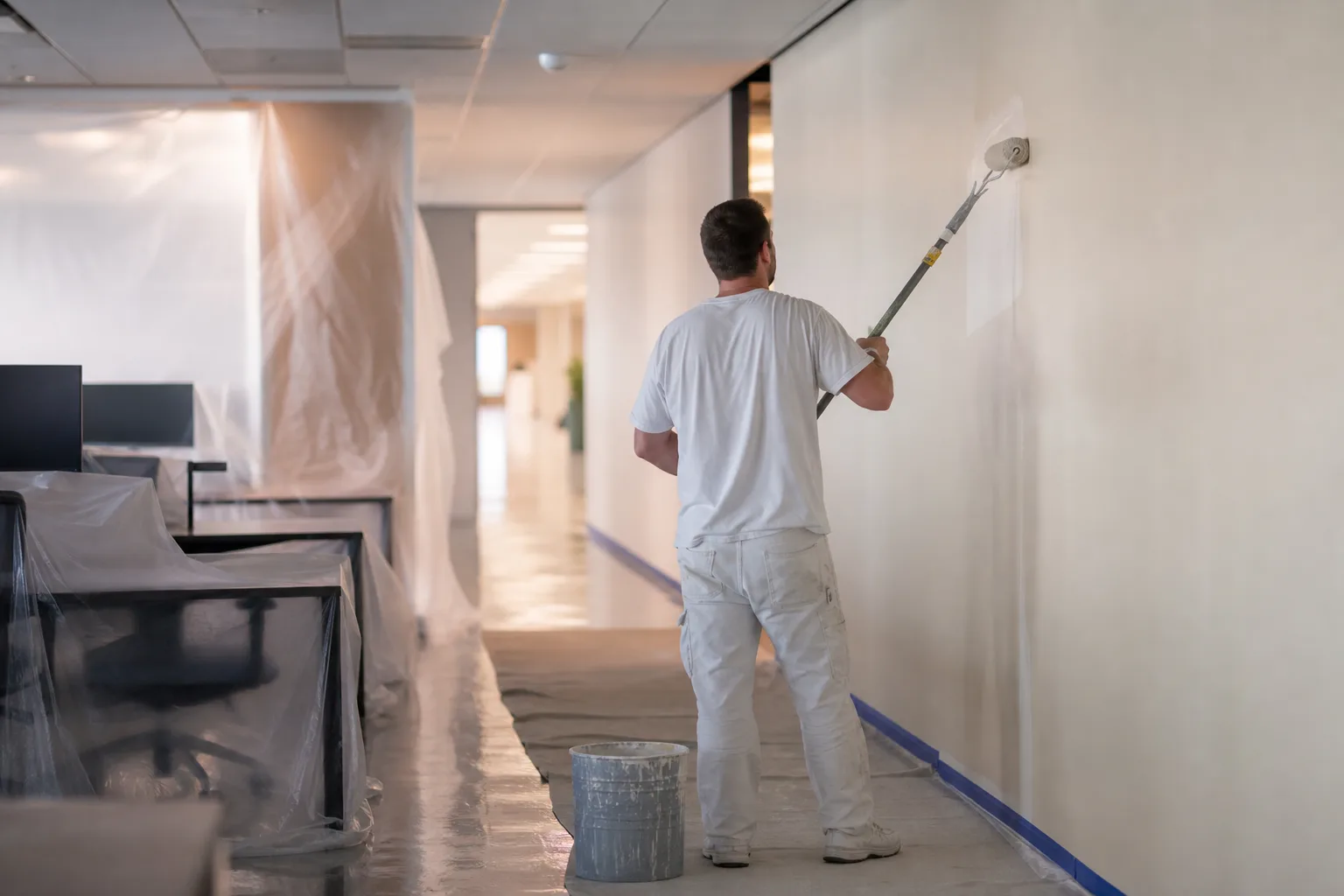
The hardest part of repainting a working commercial space isn't the paint. It's the part where you can't shut the doors. A restaurant can't go dark for a week. A dental office has a full schedule. A retail floor lives or dies on foot traffic. So the real question business owners ask us isn't "what color" — it's "how do we get this done without losing days of business?"
The honest answer: a commercial repaint in an occupied building is a scheduling and containment problem first, and a painting problem second. Get those two right and your customers may never know we were there, except that the place looks sharper than it did Friday. Here's how we pull that off on the Gulf Coast, where heat, humidity, and a long tourist season mean nobody can afford to close.
Schedule the work around your hours, not the other way around
The biggest lever is when we paint. Before anything gets masked, we sit down at the free estimate and map your real rhythm — when you open, when you close, your slow days, the hours a given area sits empty. Then we build the schedule around that.
There are three common ways to stay open, and the right one depends on your business:
| Approach | Best for | Trade-off |
|---|---|---|
| After-hours / overnight | Restaurants, retail, medical offices, lobbies | Higher labor hours, but zero impact on trading |
| Phased / zone by zone | Large offices, warehouses, multi-room suites | Takes more calendar days, but you never lose the whole space |
| Weekend / closed days | Anyone with a predictable dark day | Limited working window, so bigger jobs run several weekends |
Most jobs end up being a blend. A retail store might get its sales floor painted overnight and its back office done during open hours behind a sealed wall. A church or event venue gets its big rooms on the days nothing's booked. We honor the time requests — sometimes that means the crew shows up before dawn, sometimes it means we work after you've locked up for the night.
Containment is what makes painting an occupied commercial space work
Painting an occupied commercial space only works if the paint, dust, and crew stay on one side of a line. Containment is what makes that line real. We seal the active zone off from the parts of your building that are still trading, so customers and staff move through a clean, open space while we work behind plastic a few feet away.
That means floor-to-ceiling poly sheeting, zip-wall doorways you can actually walk through, and taped seams so nothing drifts. Foot-traffic paths, restrooms, and exits stay clear and obvious. In a phased job, we finish one zone completely — prep, paint, cleanup — before the barrier moves to the next, so you're never living inside a half-torn-apart building.
1. Map the zones
At the estimate we split the space into work zones and number them by when they can go dark — the conference room nobody books on Tuesdays goes first, the front counter goes overnight.2. Seal zone one
Before any prep, we wall off the first zone with plastic and zip walls, protect the floor, and set up containment so dust and odor stay put.3. Prep, paint, cure
We do the dusty work — patching, sanding, priming — then apply low-odor finish coats and let them recoat fast inside the sealed zone.4. Clean and reopen the zone
We pull the containment, clean the area top to bottom, and hand that zone back ready to use before the barrier moves to zone two.5. Final inspection
When the last zone's done, a manager walks the whole space with you and signs off before final payment.
Because every zone gets handed back finished and clean, a long job never feels like a long job to your customers. They just see one tidy area at a time.
The zone order matters more than people expect. We don't just paint left to right — we sequence around your actual day. Customer-facing areas like a lobby, sales floor, or dining room get the after-hours treatment so they're never roped off during business. Back-of-house rooms — break rooms, storage, private offices — can often run behind a sealed wall while you're open, because nobody but staff passes through. Mapping it this way is the difference between a repaint that interrupts your week and one that just quietly happens.
Control the dust before it controls your day
Paint doesn't make the mess on a commercial job — prep does. Sanding old drywall, scuffing trim, patching nail pops, and cutting in repairs throw fine dust, and in an occupied space that dust is the thing most likely to land on a desk, a product display, or a plate of food.
So we treat prep as the containment-sensitive step. We mask and tarp everything staying in the room, run the messy work inside the sealed zone, and use vacuum-assisted sanding where it makes sense to catch dust at the source instead of letting it settle. At the end of every shift the area gets cleaned, not "tidied" — wiped down, floors gone over, so you're not opening to grit on the counters.
Which coatings let people back into a space fast?
The fumes problem is mostly a product problem, and modern paint has come a long way. For occupied commercial work we lean on low-VOC, low-odor coatings that recoat fast. Low VOC means less of the smell and off-gassing that used to force a space to sit empty for a day; fast recoat means we can put two coats up in a single after-hours window instead of stretching it across two nights.
We still schedule the strongest-smelling steps — primers, oil-based touch-ups where they're unavoidable — for your emptiest hours, and we run air movers and ventilation so the air clears before your people return. The combination is what lets a dental office, a daycare, or a restaurant kitchen reopen the next morning without anyone wrinkling their nose. Our guide to low-odor paint for occupied commercial spaces digs deeper into how those coatings keep a working space breathable while we paint.
Coatings also have to suit the room, not just the schedule. A high-touch corridor, a restroom, and a back warehouse all take different finishes — a scrubbable surface where hands and carts hit the walls, something that stands up to moisture where it's humid. Picking the right product up front is part of what keeps the space looking fresh long after we leave, and it's worth talking through at the estimate so the finish matches how the room actually gets used. If you'd like a hand choosing colors and sheens that read well under commercial lighting, that's exactly what a free color consultation is for.
Protect the stock, equipment, and finishes you can't replace
An occupied space is full of things that can't get paint on them — point-of-sale systems, kitchen equipment, inventory, server racks, fixtures, finished floors. Our rule is simple: move what can move, wrap what can't.
Before a brush opens, we relocate small movable items out of the zone, then cover everything that stays with plastic and drop cloths. Floors get protected and outlets, switches, fixtures, and trim get taped off. Electronics and sensitive equipment get wrapped first, not last. For retail and warehouse jobs we work with you on shifting stock so a shelf isn't sitting under a wall we're about to cut in.
This is also where carrying insurance matters. We protect your space, your people, and us — and if a question ever comes up, you're not the one holding the risk. (For the full picture of how a commercial job is scoped and run end to end, our commercial painting guide for Mobile and Baldwin County walks through the whole process.)
Keep the space trading — and keep you in the loop
The whole point is that you stay open. Customers walk in, staff works, registers ring, and the repaint happens in the margins. That only holds together if communication is tight, because most of the work is happening when you're not there to see it.
So we send a daily photo update. You get to watch progress from your phone — which zone's done, what's masked, what's next — without standing on site at 10 p.m. If a finish question or a color call comes up, we flag it before we proceed instead of guessing. And at the end, a manager does a final inspection with you and signs off before final payment, so the last thing that happens is you confirming it's right, not discovering a miss after the crew's gone.
The bottom line for Gulf Coast business owners
You don't have to choose between a fresh space and a closed sign. With the work scheduled around your hours, the active zone sealed off, dust controlled at the source, low-odor coatings that let people back in fast, and your stock and equipment protected, a commercial repaint can happen right under an open business without costing you a single day.
That's the way we run every occupied job — family-owned since 2013, one accountable crew from your free estimate through the final inspection, all backed by our 1-year workmanship warranty. If you're weighing a repaint for an office, store, restaurant, or any space that can't go dark, our commercial painting service is built for exactly this. Reach out for a free estimate and we'll show you how it gets done without the doors ever closing.