
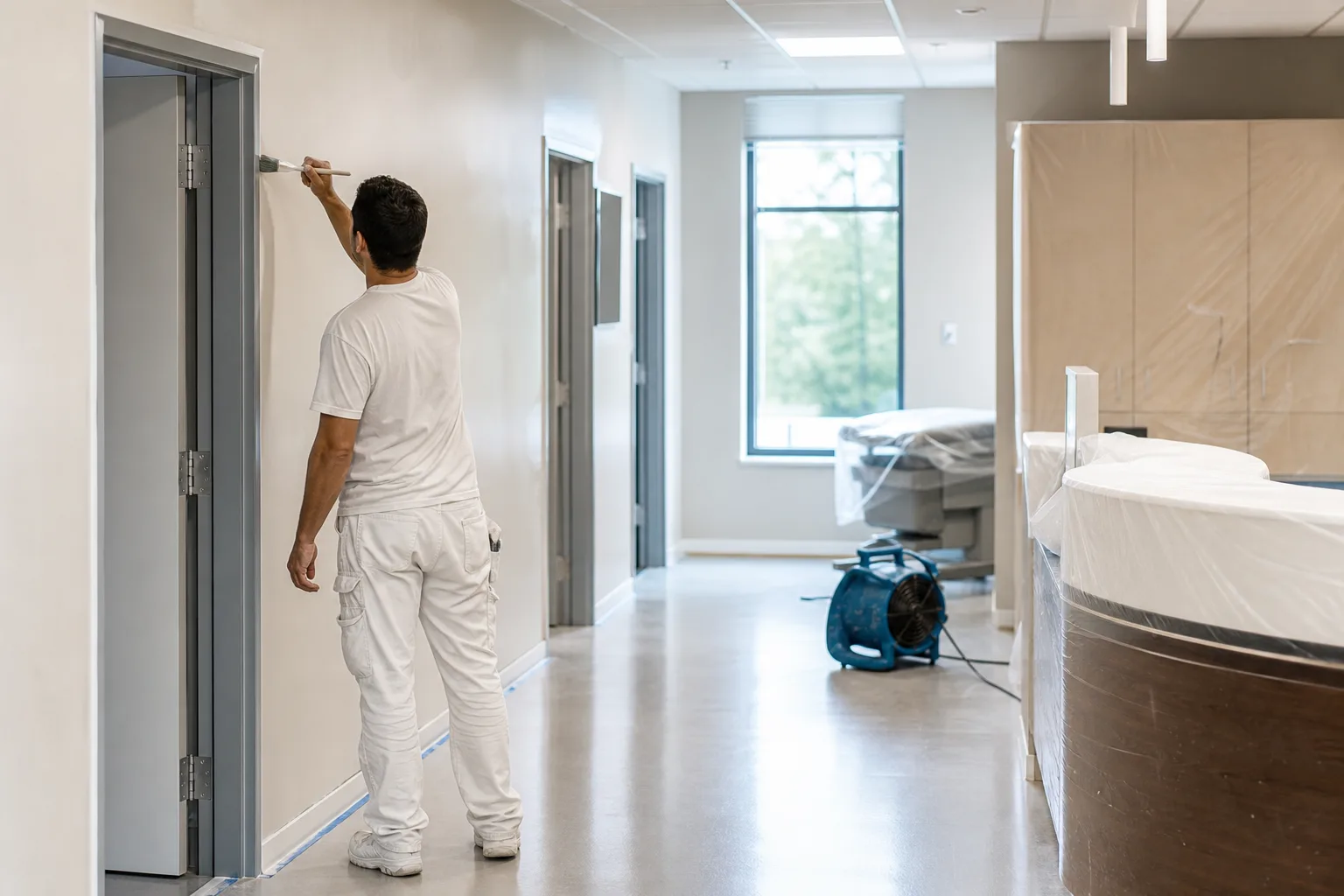
The walls in your waiting room have looked tired for a year, but you've put off painting because the obvious question stops you cold: how do you repaint a space full of patients, customers, or staff without the fumes driving everyone out? For an occupied office, clinic, or store, the smell of a fresh paint job isn't a minor annoyance — it's a reason to close, and closing costs real money.
That's exactly the problem low-odor commercial paint is built to solve. Low-odor, low-VOC products let a working space get repainted and back in use fast, with little of the lingering solvent smell that used to force a business to shut down or wait out a long weekend. Here's what the labels mean, where these paints fit a job in an occupied building, and how we use them to keep your doors open. For the full playbook on repainting without shutting down, our pillar on painting an occupied commercial space without closing walks through the whole approach — this piece is about the paint itself.
What "low-odor" and "low-VOC" actually mean
Answer-first: the smell of wet paint comes mostly from VOCs — volatile organic compounds, the solvents that carry the paint and then evaporate as it dries. Low-VOC and zero-VOC paints simply contain far less of that solvent, so there's much less to smell and much less to air out. "Low-odor" is the plain-English version of the same thing.
A few label terms are worth knowing before you compare products or read a quote:
| Label term | What it means | Why it matters in an occupied space |
|---|---|---|
| Low-VOC | Reduced solvent content versus a standard paint | Noticeably less smell; the space clears faster after each coat |
| Zero-VOC | Effectively no measured VOCs in the base paint | The least odor; a common pick for clinics and sensitive areas |
| Low-odor | Marketing term for low-/zero-VOC behavior | A fast read that the product is made to minimize smell |
| Fast-recoat | Dries and accepts a second coat quickly | Two coats can go up in one off-hours window |
One honest caveat: tinting a zero-VOC base with deep colors can add a small amount of VOC back, and that's normal. The point isn't a lab-perfect zero — it's that the air in your space clears in hours, not days, so people can get back to work.
Where does low-odor paint fit an occupied job?
Low-odor paint earns its keep anywhere people can't easily leave while the work happens. The most common fits we see on the Gulf Coast:
- Medical, dental, and veterinary offices — exam and treatment rooms need to return to service fast, and patients shouldn't sit in fumes. Low-VOC paint is a standard choice here.
- Open offices and call centers — staff are at desks all day, so we zone the floor and paint sections with low-odor product while the rest keeps working.
- Retail and showrooms — merchandise and customers stay in the building; low-odor paint plus careful zoning keeps the sales floor usable.
- Schools, gyms, and clinics — anywhere a strong smell would be a real problem for the people inside.
In every one of these, the paint is only half the answer. The other half is how and when we use it.
How we use low-odor paint to keep you open
Low-odor product and smart scheduling work together. The paint reduces the smell; the plan keeps any remaining smell away from people. Here's the sequence we run on an occupied commercial job:
Plan the paint and the hours at the free estimate
We pick the right low-VOC or zero-VOC product for each area and pin down exactly when your space is empty or which zones can be walled off, then build the schedule around your real hours.Zone and protect before any paint opens
We wall off the active area, cover and wrap fixtures, merchandise, and equipment, and protect floors so the rest of your space stays open and clean.Paint with fast-recoat low-odor product
We apply the low-odor paint and sequence the work so the strongest-smelling steps land when the area is fully empty or after hours, using fast-recoat product so coats go up efficiently.Clear the air with movers
We run air movers to clear any remaining odor from the freshly painted zone before it's handed back, so people return to fresh air rather than a smell.Inspect and hand the space back ready to use
A manager checks the work, we touch up any misses, pull masking, clean up, and confirm the area is dry and ready before you put it back in service.
Because low-odor paint clears so quickly, this often means a zone painted overnight or after close is genuinely ready when your team or customers arrive — no lost day, no "we'll open late while it airs out." For spaces that can't tolerate any daytime disruption at all, we lean on after-hours and weekend commercial painting and do the whole job in the margins of your week.
A note for medical and sensitive spaces
Clinics, dental offices, and similar spaces have the lowest tolerance for fumes and the highest cost of downtime, so low-odor paint is almost always the right call there. The combination we use — zero-VOC or low-VOC product, tight zoning, after-hours timing, and air movers — is designed so a treatment room can go back into rotation the same day. If you run a medical or dental office in Baldwin County, that's exactly the kind of job low-odor paint is made for.
The bottom line
Low-odor commercial paint exists so a working business doesn't have to choose between fresh walls and open doors. Paired with zoning, after-hours timing, and good airflow, low-VOC and zero-VOC products let an occupied office, clinic, or store get repainted and back to normal fast — without the fumes that used to make painting an occupied space a non-starter.
If you've been putting off a repaint because you can't afford to close, that's the conversation to have. Learn more about how we approach commercial painting for working spaces, or book a free estimate and we'll bring a low-odor plan built around your hours.