
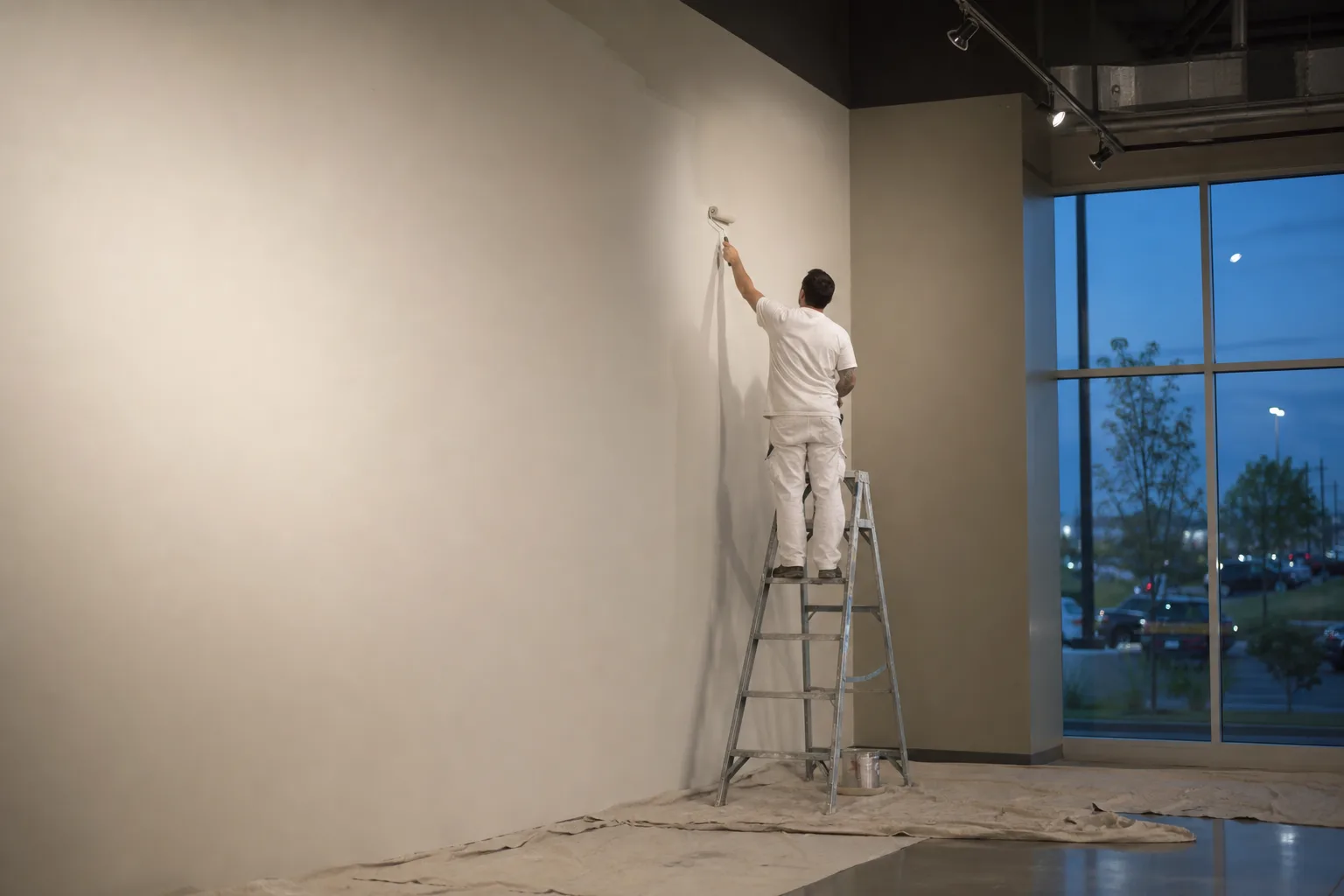
Ask three painters what it costs to paint a commercial office and you'll get three different answers — not because anyone's hiding the ball, but because a 2,000-square-foot office with eight-foot ceilings and a retail space with twenty-foot walls and a glass storefront are barely the same job. Commercial painting isn't priced like a bedroom. It's priced on scope, access, and schedule, and the only honest number comes from someone who's measured the actual space.
That said, you don't have to fly blind. Here's how the cost to paint a commercial office, retail space, or storefront actually gets built, what pushes the total up or down, and the scheduling factors that quietly drive a big share of the price.
What drives the cost to paint a commercial office?
The price of a commercial job comes down to a handful of measurable things. Get these straight in your head and any quote you receive will make a lot more sense.
| Cost factor | Why it moves the price |
|---|---|
| Square footage | Wall and ceiling area is the base of the estimate — more surface means more material and labor. |
| Ceiling height & access | High or hard-to-reach walls need lifts or scaffolding and slow the work, raising the cost per square foot. |
| Surface condition & prep | Patching, sanding, priming, and dealing with old or damaged finishes can be a large share of the labor. |
| Coats, colors & finishes | More colors, multiple finishes, and tougher finishes for high-traffic areas add labor and material. |
| Schedule | After-hours, weekend, or phased work to keep you open affects labor timing and the total. |
Notice what isn't on that list: a flat per-room or per-square-foot sticker price. A real commercial quote prices the work from these factors, which is why a credible painter wants to see the space before naming a number. For the wider picture on how painting jobs get priced in general, our guide on how painters price a job — square foot vs room vs project breaks down the methods.
Office vs retail vs storefront: where the money goes
These three jobs share a name and not much else, so it helps to see where the budget actually lands in each.
An office is usually about volume and minimal disruption — lots of similar wall area, standard ceiling heights, and the real challenge is working around people and equipment. The cost driver here is often the schedule: doing the work nights or weekends so the team isn't breathing fumes or stepping over drop cloths during business hours.
A retail interior tends to cost more per square foot because of the things that make a store feel like a store — higher ceilings, feature walls, multiple colors, and finishes that have to take customer traffic without scuffing. Prep and access drive the number more than raw floor area does.
A storefront or facade is its own animal. Exterior surfaces, weather exposure, and the prep that comes with an older building all factor in, and on the Gulf Coast that means accounting for humidity and sun the way any commercial building exterior does. A storefront is also your first impression, so it's often worth doing well even when the interior can wait.
The hidden cost driver: scheduling around your business
Here's the part homeowners never have to think about but every business owner does: a commercial paint job has to happen without shutting you down, and that constraint shows up in the price. The painting itself isn't dramatically different from residential work — it's the choreography around your operating hours that separates a commercial quote from a house quote.
After-hours work is the most common answer. Painting an office at night or a store on the weekend keeps customers and staff out of the work zone, but it means crews working off-peak hours, which factors into the labor side of the estimate. Phased work is the other lever — painting a building in sections so part of the space stays open while another part gets finished. Phasing keeps your doors open and your income flowing, and a good contractor will plan the sequence so the disruption to your customers is close to invisible.
There's also the matter of dry times and odor. A space that has to reopen to customers the next morning needs finishes that cure on schedule and a crew that plans ventilation around your reopening, not the other way around. The more your timeline is locked, the more the schedule shapes the plan — and a real quote prices that timing in rather than pretending the work happens in a vacuum.
The takeaway: when you compare two commercial bids, you're not just comparing paint and square footage, you're comparing how each contractor plans to keep you operating. A number that ignores your hours isn't really a commercial quote at all.
How we build a commercial quote
Because no two commercial spaces price the same, we don't hand out phone-quote guesses. We build the number from the actual space, in writing, so you can plan and compare.
Walk the space
We come out and measure the real scope — wall and ceiling area, heights, surface condition, and the access challenges that affect labor.Price the work by part
We break the estimate into its pieces — prep, coats, colors, and finishes — so you see where the money goes instead of one lump sum.Factor in your schedule
We plan around your business hours — after-hours, weekends, or phased sections — and reflect that timing in the quote so staying open is built into the price.Deliver a written quote in 24 hours
You get an itemized written quote within 24 hours, so you can approve it, phase it, or compare it with a clear apples-to-apples scope.
That's also the honest answer to "what's it going to cost." The factors above set the range; the walk sets the number. A painter who quotes a commercial space sight-unseen is guessing, and a guess on a big job is exactly where budgets blow up.
If you're vetting more than one bid, make sure each one prices the same scope and schedule — our guide on how to vet a commercial painting contractor covers what separates a real commercial bid from a number scribbled on the back of a card. And for the broader question of what painting costs across project types, see our cost to paint a house in Mobile and Baldwin County guide.
Pro 1 Painters has handled commercial interiors and exteriors across Mobile and Baldwin County since 2013, scheduled around our clients' hours and backed by a 1-year workmanship warranty. Book a free on-site estimate for your office, store, or storefront and we'll give you a clear, itemized written quote within 24 hours.