
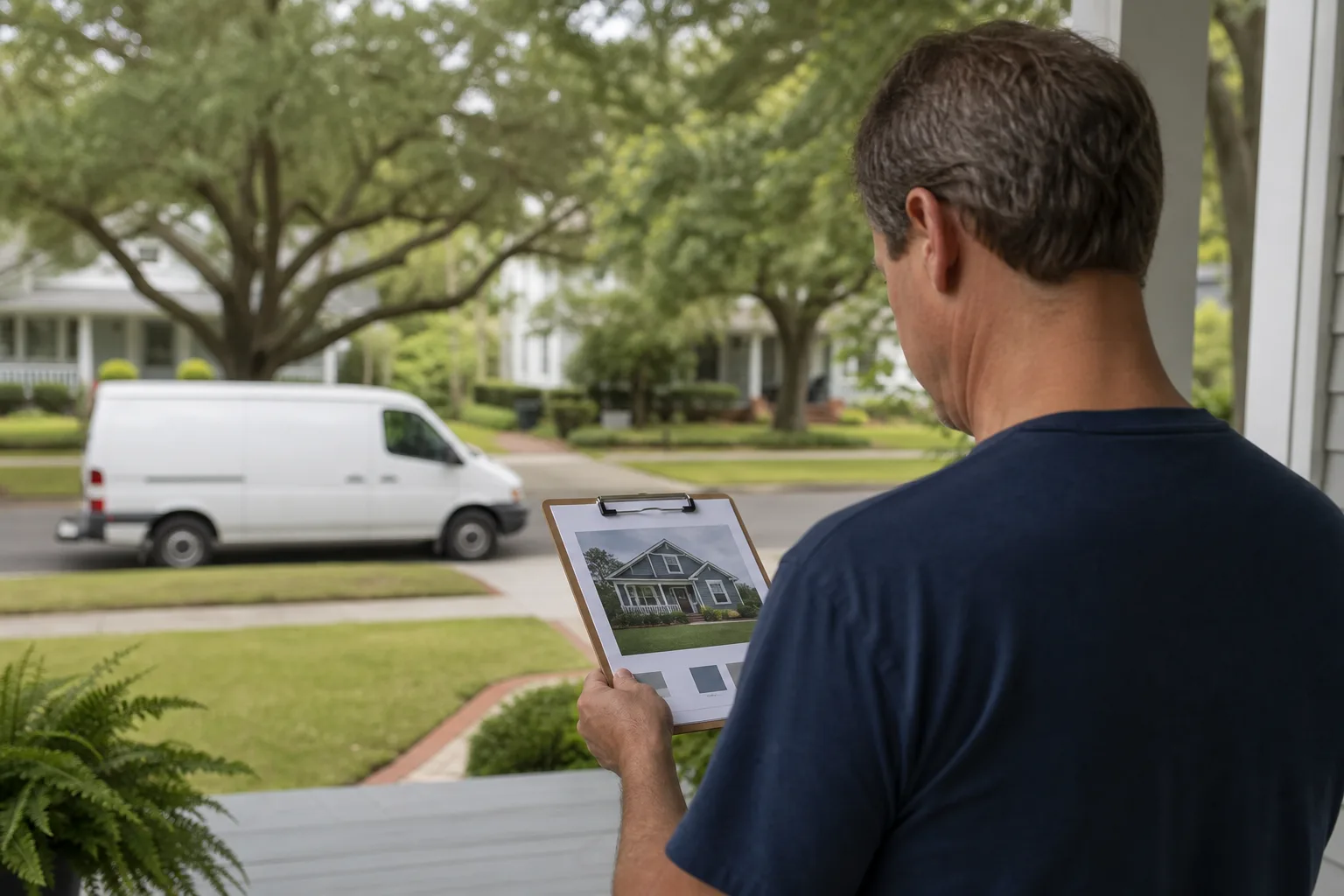
A van pulls up while you're pulling weeds out front. The guy's friendly, says his crew just finished a house down the street and has leftover paint — he can do your trim today for cash, way under the usual rate, but the deal's only good right now. It sounds like a lucky break. It's also the oldest painting scam there is.
Most people who get burned by a painter aren't careless. They're busy, the pitch sounds reasonable, and the warning signs only look obvious in hindsight. The good news: painting contractor scams almost all run on the same few moves, and once you can name them, they stop working. Here are the red flags worth knowing before you hand anyone a dime — and the simple checks that protect you.
The most common painting contractor scams
Most painting scams fall into a handful of recognizable patterns. The names change; the playbook doesn't.
The door-to-door "leftover paint" pitch
The classic. Someone shows up unannounced claiming they have material left from a nearby job and can give you a one-day-only price. The urgency is the whole trick — it exists to rush you past the basic checks you'd normally run. A real painter fills their schedule with quoted, planned work, not surplus paint they're trying to burn off before it dries up.
A door-knock isn't automatically a scam. But treat it like any other lead: take the information, verify it, and get a written quote. Anyone who won't let you do that just told you what you needed to know.
The big cash deposit and the vanishing crew
Here the painter asks for a large chunk — sometimes most of the job — up front, and strongly prefers cash or an instant payment app. Then the work starts late, stalls, or never happens at all, and the money's gone with no paper trail to chase. A reasonable deposit to hold your date and cover materials is normal. A demand for the bulk of the cost before a brush touches your wall is not.
The lowball that balloons
This bid comes in well under everyone else's. It wins on price, then the surprises start: the old paint "needs" extra prep, a second coat is suddenly "extra," the trim wasn't "included." By the end you've paid as much as the honest quotes — for a rushed job. The low number was bait, and the change orders were always the plan.
The unlicensed, uninsured crew
If a worker is hurt on your property or your home is damaged and the contractor carries no insurance, that can land on you. Scammers skip coverage to keep prices low and disappear if something goes wrong. This one's invisible until it matters, which is exactly why you ask up front.
Red flags to watch for before you hire
No single one of these proves a scam. Stack two or three and you should walk.
| Red flag | What it usually means | What's normal instead |
|---|---|---|
| 'Today only' pressure to sign | Rushing you past your own checks | A quote that's good for days or weeks |
| Cash-only or pay-an-app-now | No paper trail if it goes wrong | Traceable payment, modest deposit |
| Bid far below the others | Prep, coats, or materials left out | Comparable scopes within a sane range |
| No written estimate | Wiggle room to add charges later | An itemized scope you can hold them to |
| No address, vague company name | Hard to find if they disappear | A real local business you can verify |
| Dodges insurance questions | Likely uninsured - risk shifts to you | Proof of liability and workers' comp |
A few deserve extra weight. No written estimate is the big one — without an itemized scope, there's nothing stopping a crew from "discovering" extra charges once your kitchen's torn apart. Evasiveness about insurance is another: a real contractor answers that question flatly, because they carry coverage and know you're right to ask. And a price that's dramatically lower than everyone else's isn't a deal — it's a tell. Something got left out, or it's coming back as a change order.
How to vet a painter the right way
Avoiding scams isn't about being suspicious of everyone. It's about running the same short checklist on anybody before money moves. Do these five things and the schemes above have nothing to grab onto.
Get it in writing
Insist on a detailed written estimate listing prep, primer, number of coats, products, surfaces, and a payment schedule before any money changes hands.Verify insurance and identity
Confirm current liability and workers' comp coverage, a real local address and phone, and that the name on the quote matches the reviews and references.Check reviews and references
Read recent reviews across more than one platform, and actually call a couple of references about recent jobs - not one cherry-picked photo.Keep the deposit small and traceable
Pay a reasonable deposit by a traceable method, never the full amount up front and never cash-only, with later payments tied to completed work.Inspect before final payment
Walk the finished job for a final inspection and confirm the work matches the written scope before you release the last payment.
That last step is its own protection. When the final payment is tied to a real inspection — not handed over before the work is done — a crew has every reason to finish strong. It's also how we run our own jobs: a manager signs off and walks the work with you before we ask for the balance.
What does a legitimate painter look like?
It helps to know the shape of the real thing, not just the warning signs. A trustworthy painter gives you a written, itemized estimate you can compare line by line. They carry liability and workers' comp and don't flinch when you ask. They have a findable local presence — a real address, a phone that's answered, reviews that span years rather than a single week. They take traceable payment and keep the deposit reasonable. And they stand behind the work after the check clears, with a warranty that means something.
That's the bar we hold ourselves to. Pro 1 has been family-owned on the Gulf Coast since 2013, we put the full scope in a written quote within 24 hours of your free estimate, and every job is backed by our 3-year workmanship warranty with a manager sign-off at the end. You can pay by Cash, Check, or Credit Card — and you'll never get a "today only" number from us.
If you want to go deeper on vetting before you hire, our guide to hiring a painter in Mobile and Baldwin County lays out the full process, why the lowest bid usually costs more unpacks the lowball trap, and what licensed, insured, and bonded actually mean in Alabama explains the coverage questions. When you're ready for a straight quote from a crew you can check out first, our house painters are glad to come take a look — free, in writing, no pressure.