
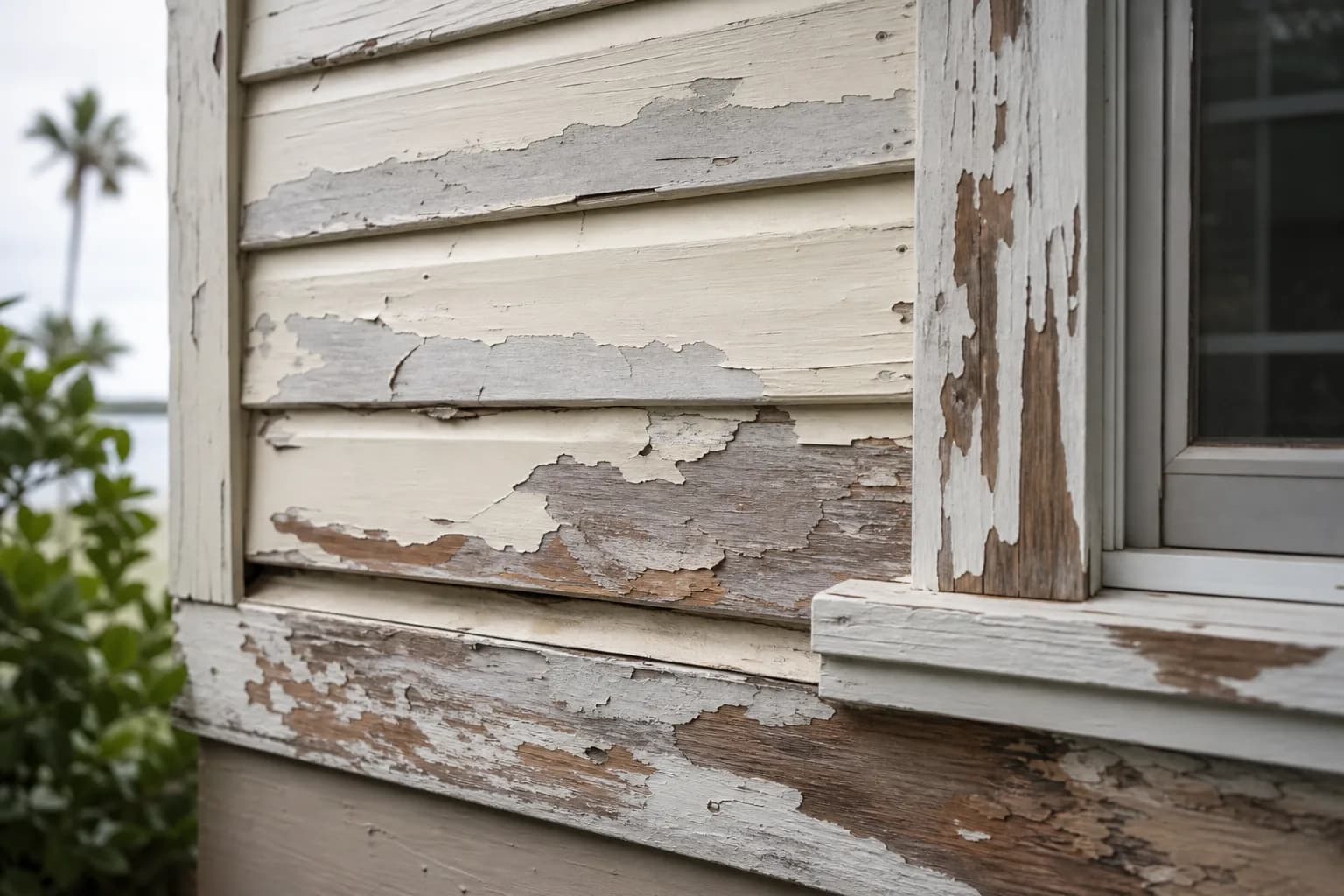
The lowest bid always feels like the smart bid. Three painters quote your house, one comes in two thousand dollars under the rest, and the math seems obvious — same job, less money, done. Then a year later the south wall is chalking, the trim's peeling at the seams, and you're getting fresh quotes to fix a job you already paid for. The "deal" turned into two paint jobs at full price.
That's the trap, and it's a predictable one. A lowball painting quote is almost never cheaper work — it's less work, priced to win and built to fail. The number is lower because something got cut, and on the Gulf Coast, where salt air, humidity, and hard sun punish a thin finish, the cut shows up fast. Here's exactly what gets shaved off a cheap bid, the real math on what it costs you later, and how to tell a genuine deal from a redo you haven't paid for yet.
Why the lowest painting bid usually costs you more
Answer first: the cheapest painting bid costs more because it wins on price by removing things you can't see in the total — and those things are what make paint last. You're not comparing the same job at a discount. You're comparing a complete job against a smaller one wearing the same two words, "paint" and "house."
A painter who wants to be the low number has only a few ways to get there, and none of them is a secret discount on labor or paint. They drop a coat. They thin the prep. They switch to a cheaper paint. They quietly leave surfaces out of the scope. Each move shaves the price today and trades it for a finish that fails early — and an early failure is the most expensive outcome there is, because you pay for the first job and the one that fixes it. The lowball bid isn't a low price for your paint job. It's a down payment on the redo.
What corners does a cheap bid cut?
A lowball quote doesn't announce what it left out. It just comes in low and lets you assume the rest. Here's where the money usually disappears, in roughly the order it costs you.
Skipped or thinned prep
Prep is most of what makes paint last on the coast, and it's invisible once the finish goes on — which makes it the easiest thing to cut. A bid that skips pressure-washing, scraping, sanding, caulking, and priming saves a day of labor now and peels in a season or two.One coat instead of two
Two coats is the standard for even coverage and lasting color, especially over a color change. Dropping to one coat is a fast, quiet way to shave the price, and it shows up as patchiness, thin spots, and early wear.Cheaper paint than you pictured
Builder-grade paint costs less per gallon and holds color and scrub far worse than a premium line. Swapping it in lowers the bid and shortens the life of the finish — a bad trade in our heat and humidity.Surfaces left out of scope
Ceilings, trim, doors, closets — quietly leaving surfaces off the quote makes the total smaller without the painter ever saying so. You find out when they're billed as 'extra' mid-job, or simply never get painted.No warranty, no insurance
A rock-bottom crew often carries no workmanship warranty and no insurance, because both cost money. That's not a savings you keep — it's risk handed to you if the job fails or someone's hurt on your property.
The through-line is simple: every one of these is invisible on day one and obvious within a year or two. That's the whole design of a lowball bid — push the cost past the point where you've already paid and moved on.
The real math: what a cheap paint job actually costs
Here's the part the headline number hides. Say the honest quotes land around $6,500 and the lowball comes in at $4,000. The $2,500 "savings" feels real — until the cheap finish fails.
When it does, fixing it isn't a touch-up. The next crew has to scrape or strip the failing paint, repair whatever the first crew skipped, re-prime the bare spots, and repaint — start to finish. So you pay the $4,000, then you pay for the teardown of that work, then you pay something close to a full job again to do it right. Add it up and the cheap bid didn't save you $2,500; it cost you the original $4,000 plus a correction that often runs more than the honest quote would have in the first place. That's the math behind the oldest line in the trade: the cheapest paint job is usually the most expensive one. If you want to ground your expectations on what a fair number actually looks like, our cost to paint a house in Mobile and Baldwin County guide lays out the real ranges and what drives them.
| Lowball bid | Honest bid | |
|---|---|---|
| Up-front price | Lowest in the stack | In line with the others |
| Prep | Skipped or 'as needed' | Washed, scraped, sanded, caulked, primed |
| Coats | Often one | Two, over a color change |
| Paint | Builder-grade / unnamed | Named premium line |
| How long it lasts on the coast | A season or two | Years |
| What you actually pay | The bid + a full redo later | Once, for a job that lasts |
How to spot a lowball before you sign
You don't avoid the cheap-bid trap by always picking the priciest quote — sometimes the low number is honest. You avoid it by checking why a bid is low before you trust it. The corners above all leave fingerprints on the paper.
Pull the lowest quote and look for the gaps: a missing or vague prep section, no number of coats listed, paint that's unnamed or just "contractor-grade," no written warranty, and no mention of insurance. Stack two or three of those and the low price isn't a deal — it's a tell. The fix is to get every bid in writing and itemized, then compare them line by line instead of total to total. Our guide on how to compare painting quotes apples to apples walks through exactly how to normalize prep, product, and coats so the numbers finally mean the same thing, and what a written painting estimate should include shows you the full list of line items a complete quote spells out.
The bottom line
A lowball painting quote and a fair one are almost never the same job — one's just had the lasting parts quietly removed. The cheap bid wins the day you sign and loses the year the finish starts to fail, when you pay for the first job, the teardown, and a real one. Price absolutely matters. But it's the total cost that matters, and the total includes the redo a cut-rate job almost guarantees on the coast.
When you're ready for a quote that's priced for a job that lasts — full prep, two coats, a named premium paint, and a 3-year workmanship warranty in writing — that's how we bid every project. Pro 1 Painters has been family-owned on the Gulf Coast since 2013, with a 4.8-star Google rating across Mobile and Baldwin County. For the full vetting checklist before you hire anyone, see our guide to hiring a painter in Mobile and Baldwin County, and learn the schemes to watch for in painting contractor scams and red flags. When you want a straight number, our house painters are a call away — free in-home estimate, written quote within 24 hours, and you pay by Cash, Check, or Credit Card.