
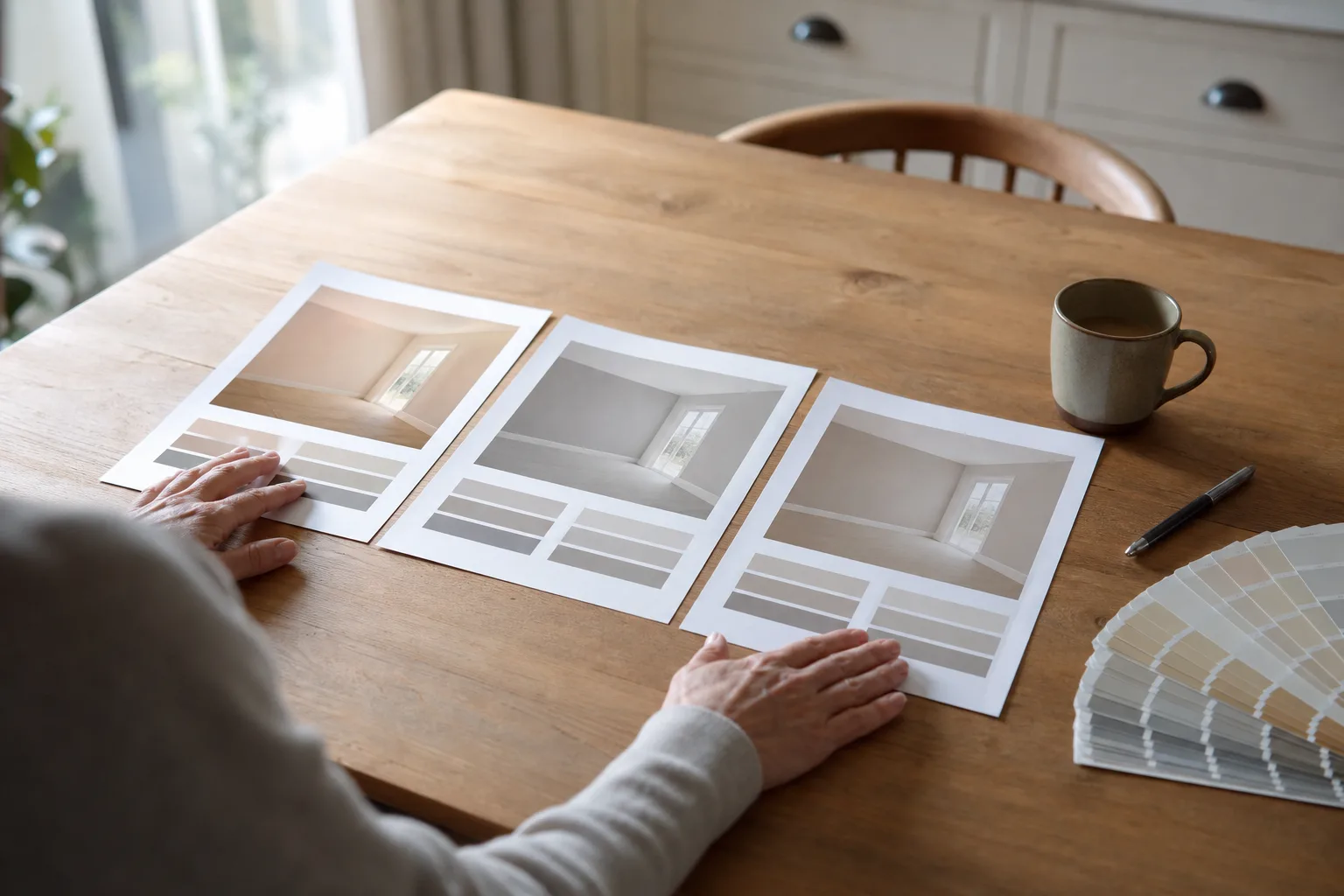
You did the smart thing and got three painting quotes. Now they're sitting in front of you and they don't make sense — one's $4,000, one's $6,500, and one's $9,000 for what you thought was the exact same job. The temptation is to circle the lowest number and call it done. Don't. Those three quotes almost certainly aren't pricing the same work, and the gap between them is usually hiding in the parts nobody reads.
Learning how to compare painting quotes apples to apples is the single best way to protect yourself from a paint job that peels in a year — or a "deal" that turns into a second job at full price. The trick is to stop comparing bottom-line numbers and start comparing what's behind them. Five things drive almost every difference. Line those up across all three quotes and the right choice usually makes itself.
Why do painting quotes vary so much?
Here's the answer up front: painting quotes vary because painters are quoting different jobs, not the same job at different prices. One bid includes two coats of a premium paint and a full day of prep. Another includes one coat of builder-grade and a quick once-over. On paper they're both "paint the living room." In reality they're not remotely the same, and the cheaper one will look it within a season.
That's why the cheapest number is so dangerous to chase. The easiest way for a painter to win a price war is to quietly shrink the scope — skip the second coat, thin the prep, leave the ceilings out, drop to a cheaper paint. You don't see what got cut; you just see a smaller total. So before price means anything, you have to normalize the work — and it helps to know what actually drives the cost of a painting project before you judge any single number. The five sections below are exactly what to line up.
1. Get everything in writing
Ask every painter for a written, itemized quote. A number texted as a lump sum or scribbled on a card can't be compared to anything — insist on detail before you weigh price.2. Normalize the prep
Read what each quote says about washing, scraping, sanding, patching, caulking, and priming. Prep is most of a job that lasts, so a bid that's vague here is usually cheap here.3. Match the product and coats
Confirm the exact paint line and the number of coats. One coat of builder-grade and two coats of a premium line are not the same job.4. Compare the real scope
Check which surfaces are actually included — trim, ceilings, doors, closets — and what's excluded. The cheapest number often covers the smallest scope.5. Weigh warranty, insurance, and reputation
Look past the total at the workmanship warranty, proof of insurance, and the company's track record — they decide what the price is actually worth.
Normalize the prep — it's where the money hides
Prep is 80% of a paint job that lasts, and it's the first thing a cut-rate quote shaves. Two quotes can show the same paint and the same number of coats, and one can still be worth half the other purely on prep.
So read each quote for the prep words: pressure-washing or cleaning, scraping loose paint to a sound edge, sanding, patching dings and nail pops, caulking gaps, and — the big one — priming. A quote that says "prep as needed" and stops there is telling you almost nothing. A quote that lists the steps is telling you exactly what you're buying. When you compare painting quotes, the prep section is where the real difference between a five-year finish and a one-year finish usually lives.
Match the product and the number of coats
Two coats or one? Premium paint or builder-grade? These two questions swing a quote more than almost anything else, and they're easy to miss because both quotes just say "paint."
Get the specifics. Ask each painter for the exact brand and product line they're quoting, and confirm how many coats are included. Two coats is the standard for a job that covers evenly and lasts; one coat is a corner being cut, and it usually shows as patchiness and early wear — our breakdown of how many coats interior walls really need explains why that second coat isn't optional. Premium lines cost more per gallon but hold color and scrub better, which matters a lot in our Gulf-Coast heat and humidity. None of that is visible in a bottom-line price — you have to ask for it and write it next to each quote.
| What to confirm | Cheap version | Worth-it version |
|---|---|---|
| Coats | One coat | Two full coats |
| Paint grade | Builder-grade / unspecified | Named premium line |
| Prep | "As needed" / vague | Itemized: wash, scrape, sand, patch, caulk, prime |
| Surfaces | Walls only | Walls, trim, ceilings, doors as agreed |
| Warranty | None stated | Written workmanship warranty |
Compare the real scope, not the headline number
A painting quote's total only means something once you know exactly what it covers. The cheapest bid is very often the cheapest because it quietly covers the least.
Go line by line and ask what's in and what's out. Does the quote include the ceilings, or just the walls? The trim, doors, and window casings? Inside the closets? Who moves and covers the furniture — you or the crew? Is daily cleanup and a final clean included? Is there a timeline, or just a vague "couple weeks"? A quote that's silent on a surface usually isn't including it, and those gaps are exactly where a low number comes from. Two quotes that look $2,000 apart can be identical once you add back the rooms and surfaces the cheap one left out.
Weigh warranty, insurance, and reputation last
Once the work is normalized, the tie-breakers are the things that protect you after the crew leaves. A written workmanship warranty tells you the company stands behind the job; no warranty tells you that you're on your own if it fails. Proof of general liability and workers' comp insurance protects your property and you if something goes wrong on site — never skip confirming it, however good the price looks.
Then there's track record: how long they've been in business, their reviews, and whether they'll give you references. A real local company with years behind it and a rating to protect has every reason to do the job right; a name that appeared last spring and bids rock-bottom has none. Price matters, but it's the last thing you compare, not the first. For the full vetting checklist, our guide on how to hire a painter in Mobile and Baldwin County walks through the questions worth asking before you sign anything.
The bottom line
The cheapest painting quote and the best painting quote are almost never the same piece of paper — but they can look identical until you do the work of comparing them properly. Get every bid in writing, normalize the prep, match the product and coats, line up the real scope, and weigh the warranty and reputation. Do that and you'll stop choosing a number and start choosing a job — which is the only way to make sure the lowest price isn't just the biggest set of corners cut.
When you're ready for a quote that's actually easy to compare — itemized, honest about prep and product, and backed by a 3-year workmanship warranty — that's how we write every estimate. Pro 1 Painters has been family-owned since 2013, with a 4.8-star Google rating across Mobile and Baldwin County. See how we approach a whole-home painting project, or browse our interior painting service to get started. Reach out for a free in-home estimate and a written quote within 24 hours. Pay by Cash, Check, or Credit Card.