
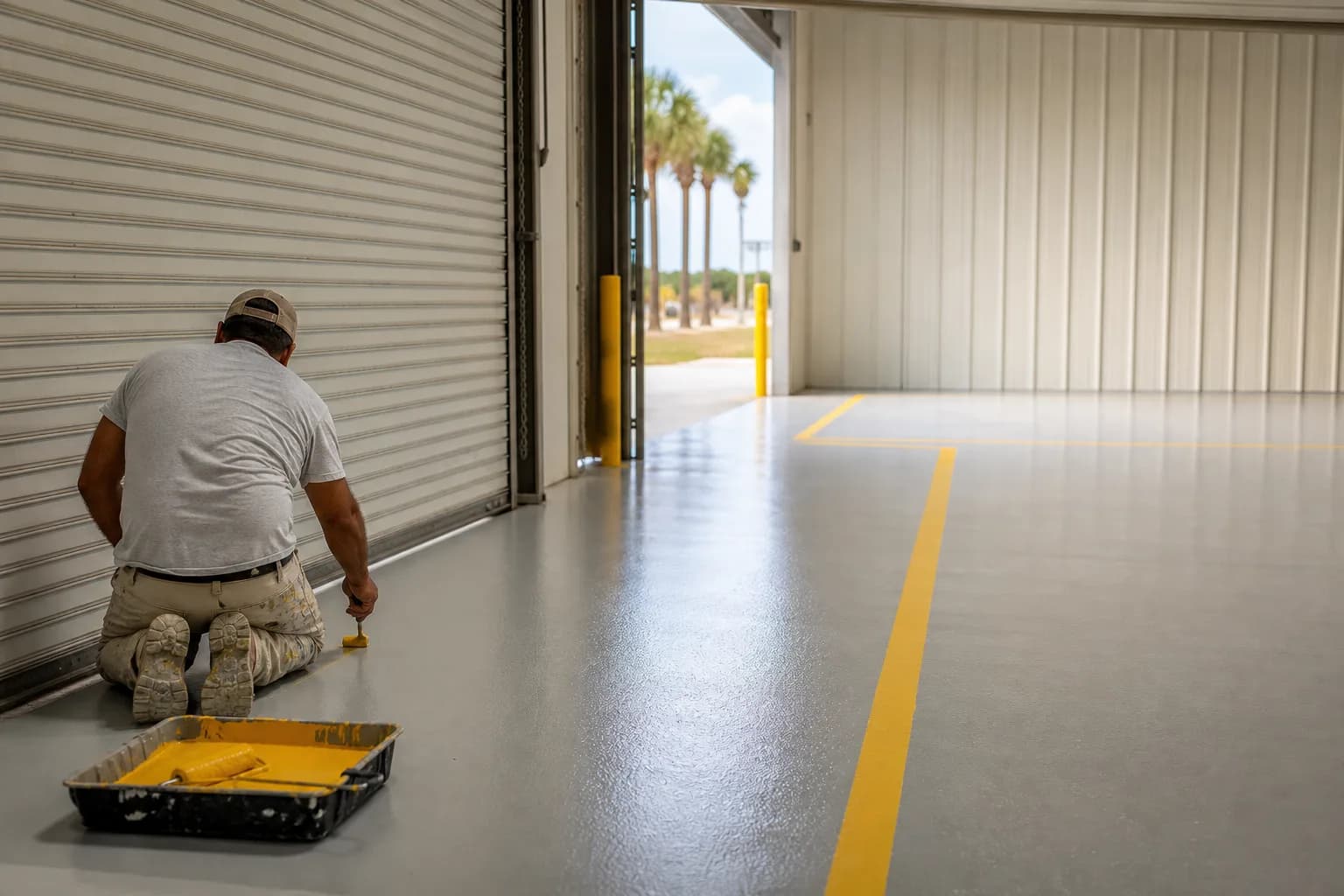
Walk the floor of a working shop on the Gulf Coast and it takes a beating you can see: oil stains, tire marks, bare worn patches where the old finish gave up, and a slab that sweats in August. A commercial floor is the hardest-working surface in the building, and in our climate it fights heat, humidity, and moisture coming up through the concrete itself. A good painted floor makes that space cleaner, brighter, safer, and easier to keep up — but only if it's done with the prep this climate demands and matched honestly to how the floor actually gets used.
So here's the straight version of commercial shop floor painting on the Gulf Coast: what a painted concrete floor does well, how the slab gets prepped, why striping matters, and exactly where paint ends and a heavy industrial coating begins.
What commercial shop floor painting does well
A quality painted concrete floor seals and finishes the slab so it stops shedding dust, resists stains, cleans up easily, and looks sharp. For a lot of commercial spaces, that's exactly the right amount of floor. Painted floors are a strong fit for:
- Light-to-moderate-duty shops — service bays, workrooms, and assembly areas without constant heavy forklift traffic.
- Warehouses and stockrooms — storage zones, racking aisles, and pick areas that see carts and foot traffic.
- Back-of-house and retail support — break rooms, stockrooms, hallways, and prep areas behind the counter.
- Any slab that needs striping — where clear safety lanes and zone markings matter more than maximum toughness.
The big advantages are cost and maintainability. A painted floor goes down for far less than a thick industrial build, and when it eventually wears in the traffic paths, it takes a fresh coat easily instead of a full strip-and-rebuild. That recoatability is a real edge in a busy commercial space. This is the lane our floor painting service lives in, and it pairs naturally with the rest of a commercial refresh — walls, trim, and exterior — that we cover in our Mobile and Baldwin County commercial painting guide.
Prepping a Gulf Coast concrete floor — where the job is won
On a commercial floor, the prep is the job. Paint is only as good as what's under it, and a slab that's greasy, sealed smooth, or holding moisture will reject a finish no matter how premium the bucket. Here's the sequence we follow.
Degrease the whole slab
Strip the oil, grease, brake dust, and grime ground into the concrete. Painting over invisible grease is the number-one reason a shop floor finish lets go.Open the surface (etch or profile)
Smooth, troweled, or sealed concrete gives paint nothing to grip. Acid-etch or mechanically profile the slab so the finish can bite into the pores.Confirm the slab is dry
Run a moisture test and address any vapor issue before painting. In our humid climate this step gets skipped — and trapped slab moisture pushes finishes off from underneath.Patch, clean, and lay out
Fill cracks and spalls, vacuum every speck of dust, and lay out the striping and traffic zones so the markings land where the floor needs them.Paint the field and stripe the lines
Apply the floor paint in proper conditions, then add safety striping, walkways, and forklift lanes in contrasting color once the field coat is set.Let it fully cure before traffic
Give the floor full cure time before foot traffic returns, and longer before carts and vehicles roll on it.
The one step nobody can see — and the one that causes the most failures here — is the moisture check. A concrete slab sitting on Gulf Coast soil wicks ground moisture up through itself and releases it as vapor at the surface, year-round and worse in the wet season. Seal that surface without testing it and the vapor pressure builds until it pushes the finish off from underneath. That's the bubbling and the lifting people blame on "bad floor paint." Usually it's vapor with nowhere to go, under a slab that was never tested.
Safety striping and traffic markings that hold
One of the most useful things a painted floor gives a commercial space is clear, durable striping. Forklift lanes, pedestrian walkways, keep-clear zones around panels and exits, staging areas — all of it reads instantly when it's painted onto the floor in contrasting color. On a busy shop floor, that layout isn't decoration; it's how traffic stays organized and people stay out of the way of equipment.
Striping lasts the same way the field coat does: it has to go onto a properly prepped, cured floor, and it wears fastest in the highest-traffic turns. The advantage of a painted floor is that touching up a worn lane is straightforward — you re-stripe the path that took the wear without redoing the whole floor. We lay out the markings with you before we paint so the lanes and zones match how the space actually runs.
Where does floor painting end and coatings begin?
To be straight with you: we do floor painting, not epoxy or coating systems. That honesty matters more on a commercial floor than anywhere, because the wrong choice is expensive. Here's the line.
Floor paint is the right answer for light-to-moderate-duty commercial floors — storage, stockrooms, back-of-house, light service areas, and any slab where a clean, sealed, striped finish at a sensible cost is the goal. A genuinely high-abuse floor — constant loaded forklift traffic, hard turns, dropped steel, aggressive chemicals — needs a thick industrial coating build, and that's a coatings specialist's job, not ours. If your space needs that, we'll tell you at the free estimate and point you the right direction rather than sell you a finish that won't hold up. What we're great at is a painted concrete floor done with the prep and cure discipline this climate demands — and tied into a full commercial refresh through our commercial painting service when you want the walls and floors handled together.
Either way, the slab and the prep decide the outcome far more than the bucket does. If a painted, striped shop or warehouse floor is what your space needs, reach out for a free estimate and we'll come look at the slab, talk through the right call, and get you a written quote — all backed by our 1-year workmanship warranty and our 4.8-star Google rating.