
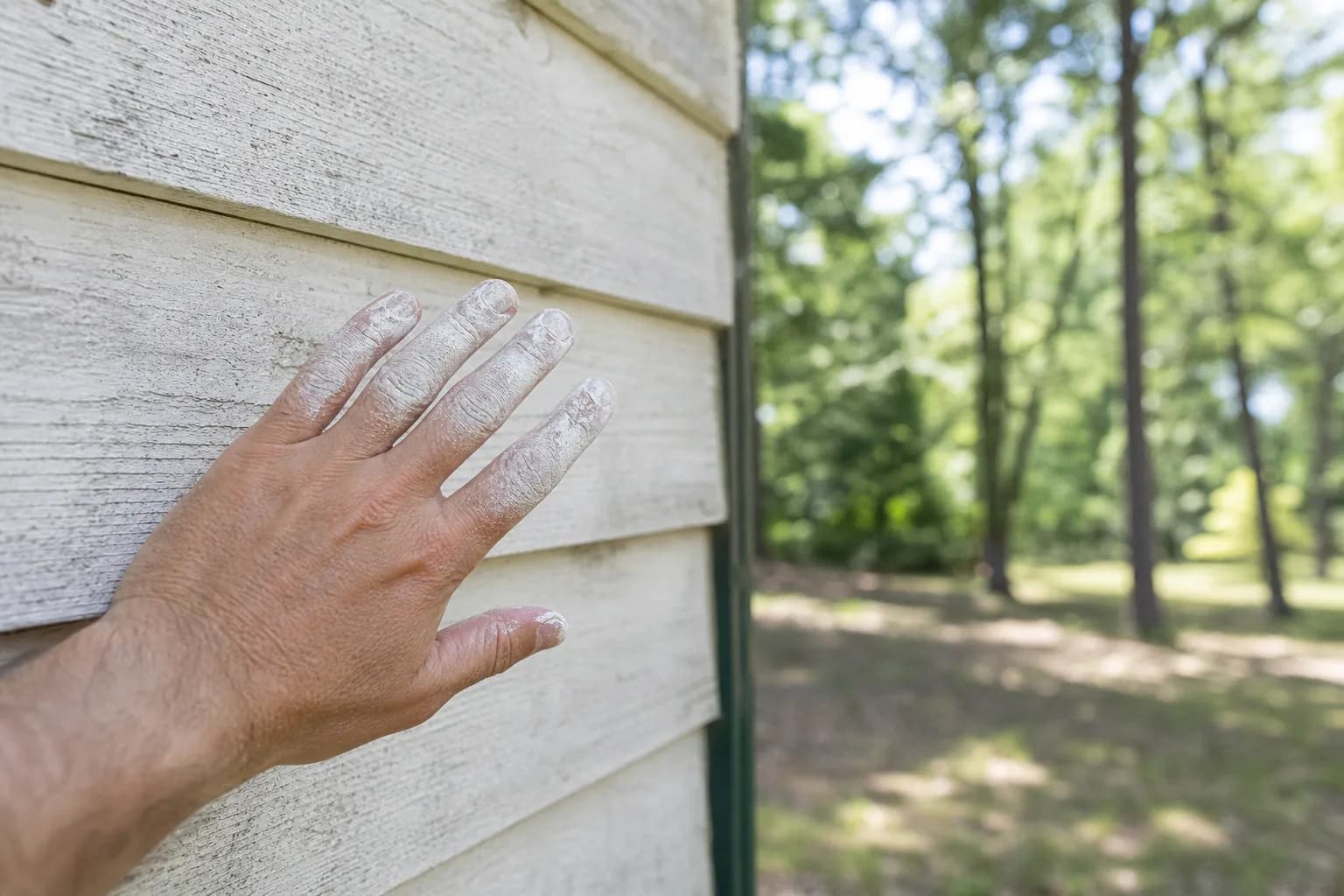
You run a hand along the side of the house and it comes away dusty — a fine, pale powder, the same washed-out color the wall used to be. Rain has been leaving chalky streaks down the brick and trim for a while now. That powder has a name in the trade: chalking. It's one of the most common things we get asked about on older Gulf Coast exteriors, and it's also one of the most misunderstood, because the instinct is to just paint right over it. Do that and the new coat won't last a year.
Exterior paint chalking is the powdery residue left when the binder in a paint film breaks down and starts shedding its pigment. It's a normal wear sign, but it's also a warning — and it changes how the house has to be repainted. Here's what the chalk is actually telling you, why our coast brings it on faster, and the right way to wash and recoat so the fix holds.
What exterior paint chalking actually is
Chalking is the binder giving up. Paint is two basic things working together: pigment, which gives color and hides the surface, and binder (the resin), which glues the pigment into a tough film and sticks that film to your siding. Sun and weather slowly degrade the binder at the very surface of the film. As it breaks down, it can no longer hold onto the pigment particles, and they let go as a loose, fine powder. That powder is the chalk.
So the dust on your hand is literally the surface of your paint shedding itself. A little, late in a coating's life, is normal — every exterior finish chalks eventually. A lot, especially early, means the film is wearing out and the color and protection are going with it.
Why does Gulf Coast sun cause chalking faster?
The number-one driver of chalking is UV, and our coast serves up a lot of it. Long, intense sun exposure most of the year pounds the binder in the paint film and breaks it down faster than it would in a milder climate. That's why chalking almost always shows up first on the elevations that take the most sun — the south- and west-facing walls — while a shaded north wall on the same house can still look fine.
A few things speed it up beyond just the sun:
- Cheaper or older paint. Builder-grade and bargain finishes use less durable binders that surrender to UV sooner. A premium exterior paint with a UV-resistant binder chalks far slower.
- A coat applied too thin. Less film means less binder to sacrifice to the sun before the pigment starts shedding.
- Flat sheens. Flatter finishes tend to chalk a bit more readily than satins and semi-glosses, which is part of why sheen choice matters on a sun-facing wall.
- Light, bright colors hiding it. Dark walls show chalk-fade dramatically; very light walls can be chalking noticeably before you even notice the color shift.
This is the same coastal sun that drives exterior paint lifespan differences between Mobile and inland homes — exposure is what sets the clock on how often a wall needs to be repainted out here.
How to tell if your siding is chalking
Answer-first: do the rub test. Press a dark cloth — or just your bare hand — firmly against the wall and drag it a foot or so. If it comes away coated in a fine, flat-colored powder, that's chalk. The heavier the powder, the further along it is.
A few other tells confirm it:
| What you notice | What it means | How bad |
|---|---|---|
| Faint dust on your hand | Early, normal chalking | Light — plan ahead, wash well at repaint |
| Heavy powder, color comes off | Advanced binder breakdown | Heavy — must be washed off before any paint |
| Chalky streaks down brick or trim | Rain carrying chalk off the walls | Active — the finish is shedding now |
| Walls look pale and washed-out | Chalking plus UV fading together | End of life — time to repaint |
If your hand barely picks anything up, you've got time — just plan on a thorough wash whenever you do repaint. If it's coming off heavy, or rain is streaking chalk down onto your brick and walkways, the finish is at the end of its road and the surface needs serious cleaning before a new coat goes anywhere near it.
How to fix chalking paint the right way
Here's the part that saves you from repainting twice: you cannot paint over chalk. Fresh paint bonds to the powder instead of the wall, and a powder layer has no grip — so the new coat peels within a season or two. We see it constantly: a homeowner or a rushed crew rolls a new color straight over a chalky south wall, and by next summer it's flaking off in the exact shape it was applied. The chalk has to come off first.
The real fix is a sequence, and the cleaning is the heart of it.
Confirm it's chalking
Wipe a dark cloth or your hand across the siding. A fine, flat-colored powder means the binder has broken down and is shedding pigment — that's chalk, and it changes how the wall has to be prepped.Wash off every bit of the chalk
Pressure-wash the walls, scrubbing chalky areas with a stiff brush and a cleaner so the powder lifts instead of smearing, then rinse from the bottom up and let the siding dry fully.Re-test on dry siding
Once dry, rub the surface again. If a cloth still picks up powder, wash again — fresh paint can't bond to a chalky surface, so the wall has to come away clean before you prime.Prime to lock down residual chalk
Coat the cleaned surface with a bonding primer made to seal in any remaining chalk and give the topcoat something solid to grip — especially on faded masonry, stucco, or aged siding.Repaint with a UV-resistant finish
Apply a premium exterior paint rated for sun and salt at full film thickness, so the new binder resists UV breakdown and the wall stays sound far longer than the coat it replaced.
The washing step is the one that gets shortchanged, and it's the one that decides whether the job lasts. On the coast we're already pressure-washing every exterior to strip the salt film, mildew, and pollen before we paint — and on a chalking wall, that wash does double duty by carrying the chalk off too. We scrub the chalky elevations, rinse, let it dry, and then we rub-test it again. If a cloth still comes back dusty, the wall isn't ready and we wash it again. Only a surface that passes that test gets primed and painted.
Choosing the new finish matters too. Because chalking is a UV story, the answer is a quality exterior paint with a UV-resistant binder, applied at proper thickness — that's what chalks slowest on a sun-blasted Gulf Coast wall. If you're also rethinking the color while you're at it, our free AI Color Visualizer lets you preview real exterior colors on a photo of your own house, so you can see it on your own walls before you commit. And for choosing a color and sheen that hold up to coastal sun without fading fast, a free color consultation is worth the conversation.
The bottom line on exterior paint chalking
Chalking is the powdery residue your exterior paint leaves on your hand when the sun has worn its binder down past the point of holding pigment. A little is normal end-of-life wear; a lot — especially streaking off the walls onto your brick — means it's time to repaint. The one rule that matters: you can't paint over it. The chalk has to be washed completely off, the wall has to pass a rub test, and on faded surfaces a bonding primer locks down what's left, before a UV-resistant finish goes on.
We're a family-owned crew that's repainted sun-faded homes across Mobile and Baldwin County since 2013, and we wash and test every chalking wall before we open a can — because prep is 80% of a paint job that lasts. See how we handle a coastal repaint on our exterior painting page, then reach out for a free in-home estimate and a written quote within 24 hours, all backed by our 3-year workmanship warranty.