
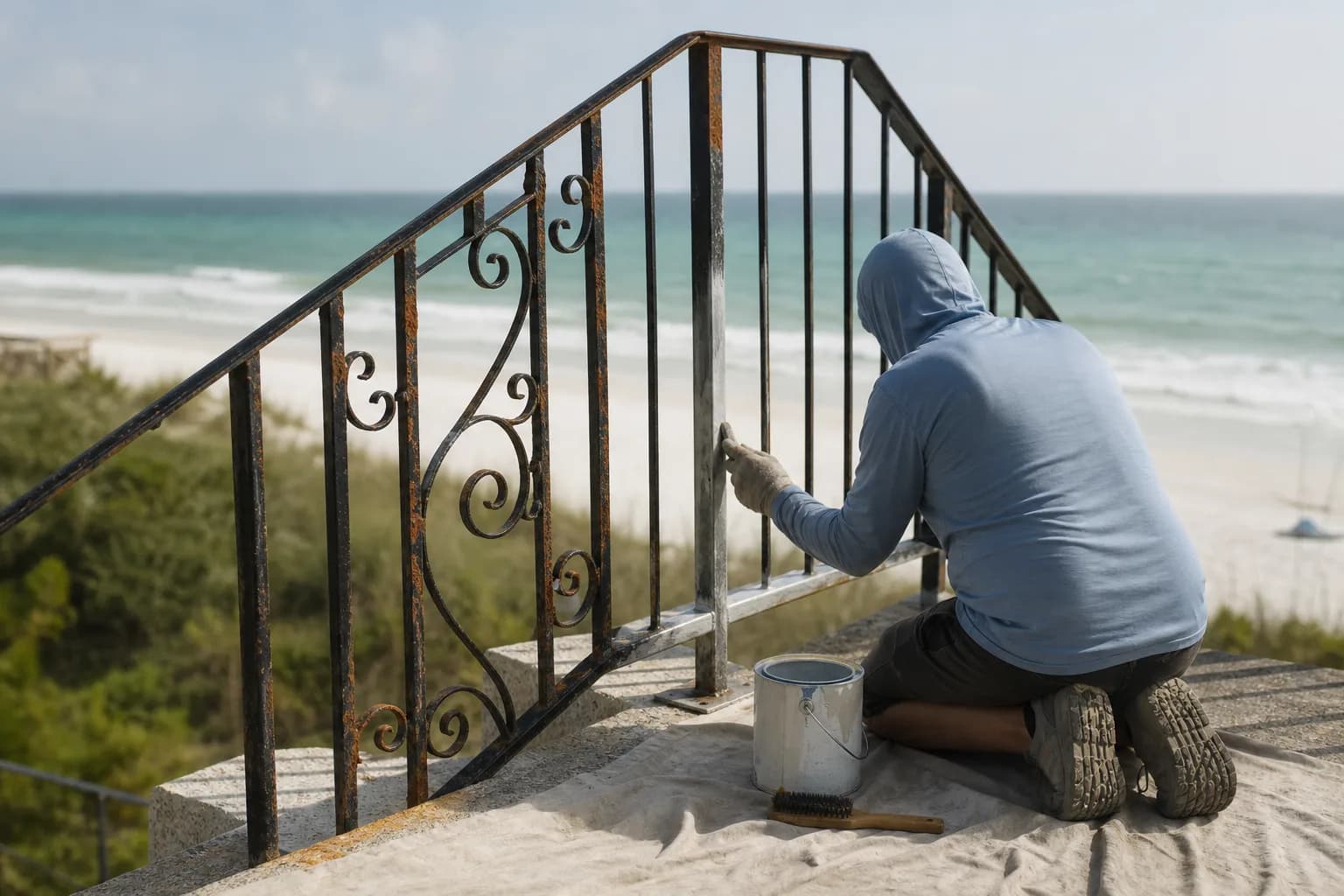
The salt finds the railings first. On a Gulf Shores beach house, the metal stair rail, the deck guardrail, the rail around the pool — those are the parts streaking orange and chalking white while the siding still looks fine. They sit out in the wind off the water taking salt around the clock, and a quick coat of paint over the corrosion buys you almost nothing. To repaint rusting metal railings on the coast and have it actually hold, you prep the metal honestly first. Here's the order that works on a Gulf-front rail, including the part most people get wrong — iron and aluminum don't corrode the same way.
Why do railings rust first on a Gulf Shores beach house?
Answer first: salt holds moisture against metal, and moisture is what drives corrosion — so the exposed, horizontal, hand-touched metal of a railing takes the hardest hit on the whole house. Gulf Shores sits right on the open Gulf, true beachfront, not the calmer Mobile Bay shoreline up around Spanish Fort. That means full salt-air exposure, and a lot of the homes here are second homes and rentals that sit empty between visits, quietly corroding with nobody rinsing the rails.
The building stock matters too. The median Gulf Shores home was built around 1997, so a huge share of these houses are carrying original or first-replacement railings that have weathered 25-plus years of salt. The exposure is worst on the front-row stretches — the elevated homes out along West Beach and the Fort Morgan peninsula catch wind-driven salt off the open Gulf with nothing to block it, while even the canal and lagoon-side rails around Little Lagoon and Laguna Key get their share. Many are elevated coastal homes — Gulf Shores sits in FEMA flood zone AE with a base flood elevation around 9 feet — which means tall exterior stair rails and elevated deck guardrails getting blasted on every side, not a single ground-level porch rail. It's the same salt-air fight up the Baldwin County coast, just most intense right here at the beachfront. More metal, more exposure, more rust.
Iron rusts, aluminum oxidizes — know which you have
Before you sand anything, figure out what the railing is made of, because iron and aluminum fail in different ways and want slightly different prep. This is the step the generic "how to paint a rusty railing" advice skips, and it's why some coastal repaints peel off aluminum in sheets.
| Iron / steel railings | Aluminum railings | |
|---|---|---|
| How it corrodes | Orange rust, scaling, pitting — loses metal | White powdery oxidation, chalking — no orange |
| Magnet test | Magnet sticks | Magnet does not stick |
| Prep target | Sand/grind to bright bare metal | Scrub oxidation, scuff-sand dull |
| Primer | Rust-inhibitive metal primer | Self-etching or DTM primer for aluminum |
| Topcoat | DTM exterior enamel for steel | DTM exterior enamel for aluminum |
The quick field test is a magnet: it grabs iron and steel and ignores aluminum. Iron shows the classic orange rust and pitting and physically loses metal as it corrodes. Aluminum never rusts orange — instead it forms a white, chalky oxidation and can pit in salt air. Both have to be cleaned and primed correctly, but aluminum is slick, so it needs a primer made to bite onto it or the topcoat won't bond.
How to repaint a rusting coastal railing, step by step
This is the sequence we use on Gulf-front rails. The order is the whole point — clean before you sand, sand before you prime, prime before you topcoat — and each step sets up the next.
Wash and rinse the salt off the railing
Pressure-wash the whole rail — top cap, balusters, base, and the underside — to strip the salt film and chalk first. On a Gulf Shores railing, rinse with fresh water afterward and let it dry fully. Coating over salt is the number-one reason a beach-house rail fails early, because the salt keeps pulling moisture against the metal under the new paint.Identify whether it's iron or aluminum
Iron shows orange rust and pitting; aluminum shows white, powdery oxidation and chalky streaks, not orange. They corrode differently and the prep differs slightly, so know which you have before you start. A magnet sticks to iron and steel and not to aluminum — the fastest field test on a coastal railing.Take iron back to bright metal
On iron and steel, sand, wire-wheel, or grind every rusted spot back to bright, sound metal — clean silver, not orange or brown. Feather the edges of any tight, sound old paint so the new coat lies flat. Bright metal is the standard on the coast: leave active rust under the primer and it keeps working its way back out.Scuff and de-oxidize aluminum
On aluminum, scrub off the white oxidation, then scuff-sand the surface dull so primer can bite — slick, shiny aluminum sheds paint. Wipe it down so no chalky residue is left. Aluminum won't rust orange, but uncoated coastal aluminum pits and chalks, and bare aluminum needs the right primer to hold paint at all.Prime bare metal with a rust-inhibitive primer
Coat every bare and treated spot with a rust-inhibitive metal primer rated for salt exposure, using a self-etching or DTM primer made for aluminum where the rail is aluminum. Hit the edges, welds, joints, and the underside where corrosion starts first. The primer is the corrosion barrier; the topcoat alone won't protect coastal metal.Topcoat with a DTM enamel built for metal
Once the primer cures per the label, brush or spray two thin, even coats of a direct-to-metal exterior enamel made for steel or aluminum — never leftover wall paint. Recoat inside the can's window, re-hit edges and welds, and let it cure hard before anyone leans on the rail. Two thin coats outlast one thick one in Gulf salt air.
Keep it from coming back
Even a perfect repaint is fighting the Gulf, so a little maintenance stretches it a long way. The single most effective habit on a beach-house rail is a fresh-water rinse every few weeks to wash the salt off before it drives corrosion under the paint — easy to do, easy to forget on a house that sits empty between trips. Touch up any nick or scratch quickly, because a bare spot on the coast is a rust seed.
And know when a rail is past painting. If iron has rusted through, flexes, or has soft, scaled sections, that's a repair-or-replace question before it's a paint question — and on a guardrail or stair rail it's a safety one. Where wood posts or a railing cap have gone soft alongside the metal, our carpentry crew can replace the failed pieces before we finish, so you're not painting over rot. Most often, rusty rails come up as one piece of a larger exterior painting project — the rails, the trim, and the body all aging in the same salt air at once. You can see the full picture for the area on our Gulf Shores service page, and for a balcony-specific take, our guide to condo balcony and railing painting on the Gulf Coast covers stacked and HOA buildings.
Get the rust handled before next storm season
To repaint rusting metal railings on the coast: wash off the salt, tell iron from aluminum, take iron to bright metal and scuff-and-de-oxidize aluminum, prime with the right rust-inhibitive primer, and topcoat with a DTM enamel made for metal — in that order. Do it right and a Gulf Shores rail holds for years. Skip the prep and you're repainting rust by next summer.
Got railings streaking rust or aluminum chalking white on a Gulf Shores home? Book a free on-site estimate and we'll tell you straight what the metal needs, then send a written quote within 24 hours, backed by our 3-year workmanship warranty. Pro 1 Painters is family-owned, in business since 2013, with offices in Mobile and Spanish Fort — Gulf Shores is about an hour from our Spanish Fort office. You pay by Cash, Check, or Credit Card.