
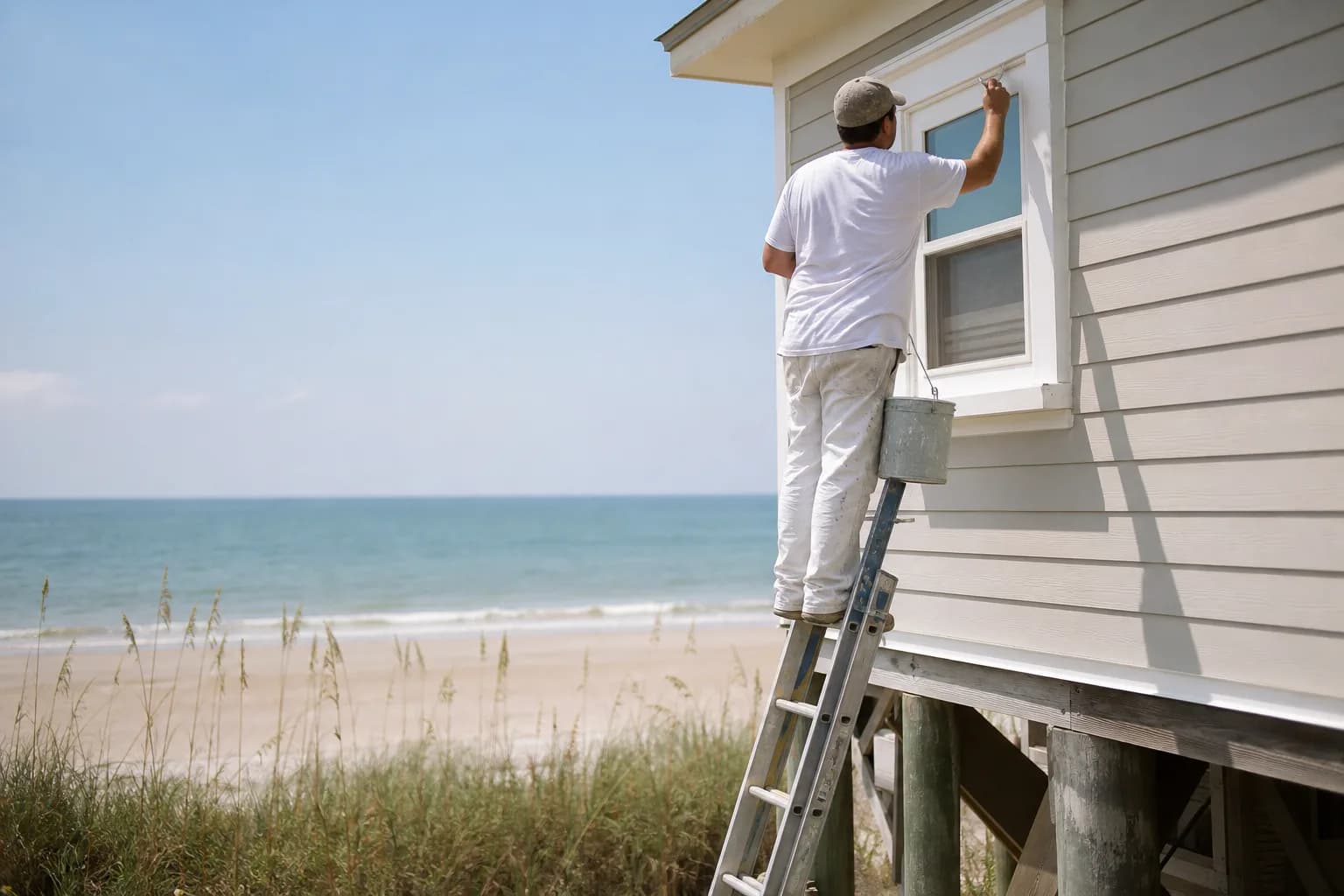
Stand on the deck of a beach house in Gulf Shores in July and you can feel everything that's working against the paint. The salt on your lips is the same salt settling onto the siding. The glare off the water is doubling the UV hitting the south wall. And the breeze that feels so good is carrying a fine corrosive mist into every railing, fastener, and seam on the structure. A Gulf-front home is one of the most beautiful places to own — and one of the hardest places in the country to keep paint on a wall.
This is the front row. It's a different job than painting a home on Mobile Bay or out in the pines, and pretending otherwise is how owners end up repainting twice as often as they should. Here's an honest look at what the Gulf does to a coastal exterior, the systems and prep that actually hold up beachfront, and how to plan the work around the realities of condos, HOAs, and a rental calendar.
What does the Gulf actually do to your paint?
Gulf Shores sits right on the water, and the exposure shows up in the data. Out on the front row — West Beach, the Fort Morgan peninsula, the cottages along Little Lagoon — roughly two-thirds of homes are owner-occupied, but a big share of the rest are rentals and second homes, and the whole town carries a coastal-storm risk that inland Baldwin County simply doesn't. Much of the area near the beach falls in a FEMA AE flood zone with base flood elevations around nine feet, which is why so many homes are built up on pilings. That elevation is great for flood protection, and it also means more exposed siding, soffit, and structure catching wind and salt from every direction.
Four forces do the damage, and on the front row they all run hot at once.
- Salt air. Airborne salt settles on every surface and keeps a thin film that paint struggles to grip if it isn't washed off. Worse, it's corrosive — it attacks the metal at railings, light fixtures, screws, and flashing, and that rust bleeds up through the finish. It's the same force behind the early chalking and peeling we cover in our guide to salt-air paint damage in coastal Mobile County.
- UV, doubled by the water. Sun alone fades color and breaks down the binder in paint. On the beach, reflection off the water and light sand amplifies it. South- and west-facing walls go chalky and dull years ahead of the shaded sides.
- Wind-driven rain. Storm season runs June 1 through November 30, and a tropical system drives rain sideways at 40-plus miles an hour. Water gets forced into seams, end grain, and any failed caulk joint — and water behind the film is what lifts paint off the wall.
- Humidity and heat. With July highs near 89 and heavy moisture in the air, paint cures slowly and any dampness trapped behind a coat causes blistering. It's why you can't rush a coastal job into a wet afternoon.
Prep for beachfront is its own discipline
We say prep is 80% of a paint job that lasts, and nowhere is that truer than on the water. The salt and the metal change the sequence — you can't just wash and roll. Here's how we approach a Gulf-front exterior, in order.
Rinse and wash the salt off first
Before anything, the whole exterior gets washed to strip salt film, mildew, and chalk. This step matters more on the beach than anywhere — paint laid over a salt film simply won't bond, no matter how good the can is. We let it dry fully before we go further.Hit the metal before the siding
Railings, fasteners, light fixtures, and flashing get scraped to sound metal and primed with a rust-inhibitive primer. If you skip this on the coast, rust works back through the finish within a season and streaks the wall below it.Scrape, sand, and repair the wood
Anything loose or flaking comes off, hard edges get feathered, and soft or rotted trim and fascia get rebuilt before paint. On an elevated home that means checking the soffit and the exposed underside, not just the walls you see from the street.Prime the bare and the chalky
Raw wood, repairs, and chalky siding get spot- or full-primed so the finish has something to grab. On a salt-loaded exterior, priming is the bridge that keeps the topcoat from peeling — it isn't optional out here.Caulk every seam and penetration
Failed joints, trim edges, and penetrations get re-caulked with a quality flexible sealant. On the coast this is your front line against wind-driven rain finding its way behind the paint during storm season.Apply two full finish coats
Two coats of a 100% acrylic exterior built for color retention and moisture. Two coats give the film thickness and even color one coat can't — and that's what carries the job through Gulf sun and salt to the next repaint.
That order is the whole point. Wash off the salt or the primer sits on it. Prime the metal or the rust comes through. Caulk the seams or the next storm drives water behind everything you just did. On the front row, each shortcut shows up faster than it would three blocks back.
Coastal exterior painting: match the system to the exposure
Not every coastal home takes the same beating. A direct Gulf-front house on the dune line lives in salt spray; a place a few blocks back gets the salt air without the constant spray; and a set-back home in a community like Craft Farms or Kiva Dunes behaves almost like an inland home. The smart move is to match the coating system and the repaint interval to how exposed the wall actually is.
| Exposure tier | What it faces | System & typical repaint |
|---|---|---|
| Direct Gulf-front / dune line | Constant salt spray, doubled UV off the water, full wind-driven rain | Rust-inhibitive metal primer + 100% acrylic, two coats; plan the exterior every 4-5 years |
| A few blocks back | Salt air and storm exposure, less direct spray | Quality acrylic over the right primer, two coats; every 5-6 years |
| Set back / bay-side coastal | Humidity, UV, occasional storm-driven rain | Standard premium exterior system, two coats; every 6-8 years |
| Metal & railings (any tier) | Salt-driven corrosion, rust bleed | Scrape to sound metal, rust-inhibitive primer first, then finish; re-check yearly |
The takeaway from that table: the same house can need attention on its Gulf-facing wall years before the protected side. We'll often refresh the exposed elevations and the metal on a shorter cycle and let the shaded walls ride longer — it's a smarter use of your money than repainting everything on the schedule of the worst wall. Our full approach to substrates and salt-air durability is laid out in our coastal exterior painting guide for Mobile and Baldwin County, the exterior painting service page covers what's included, and our breakdown of the cost to paint a beach home in Gulf Shores shows how this exposure shapes the price.
Condos, HOAs, and the rental calendar
Coastal painting isn't only about the climate — it's about the way these properties are owned and used. A big slice of Gulf Shores and Orange Beach is condos, vacation rentals, and second homes, and that changes the job as much as the salt does.
For a vacation rental, every day the unit is wrapped in plastic is a day it isn't booked. We schedule coastal exterior and unit work around turnover where we can, give you a realistic day count up front, and work clean so the place is guest-ready the moment we finish. Salt and sun are hard on rentals specifically because high turnover means the exterior and trim take wear from every direction — staying ahead of it with a planned repaint cycle beats waiting for it to look tired in listing photos.
For a condo building or HOA, consistency is the whole point. One faded elevation or one owner's mismatched balcony throws off the look of the entire property. We keep the building uniform, work to the association's approved colors and windows, and document the sequence so the board knows exactly what's happening and when. Whether it's a few units or a full exterior, the work runs as one accountable crew from the free estimate through the final inspection, with a manager sign-off before final payment.
Plan the work around the weather
Timing matters more on the coast than almost anywhere. Painting into storm season's wind-driven rain or a humid, dead-still August afternoon fights the cure and invites blistering. The better windows down here are late spring before the heat peaks and late fall once storm season winds down — stretches of mild, drier days that let two coats set up the way they should.
We won't put a finish on a wall that's damp, salty, or about to take rain. That sometimes means working around the forecast on a beach project, and it's worth it: paint that cures right is paint that lasts through the next round of Gulf sun and salt. If you're weighing a coastal painter, our take on what to ask is in our guide on hiring a house painter and the questions to ask, and you can see everything our house painters handle across the coast.
Ready when you are
A Gulf-front home asks more of its paint than any other house on the coast — and it rewards a job done right with years of color that holds through the salt, the sun, and the storms. The difference is never the brand on the can. It's washing off the salt, sealing the metal, priming what's bare, and timing the work to the weather. That's the job we do, backed by our 3-year workmanship warranty and a 4.8-star track record across Baldwin County.
Thinking about repainting a beach house, condo, or rental in Gulf Shores, Orange Beach, or Perdido? We serve the whole coast — see what's nearby on our Gulf Shores service area page, then schedule a free in-home estimate for a written quote within 24 hours.