
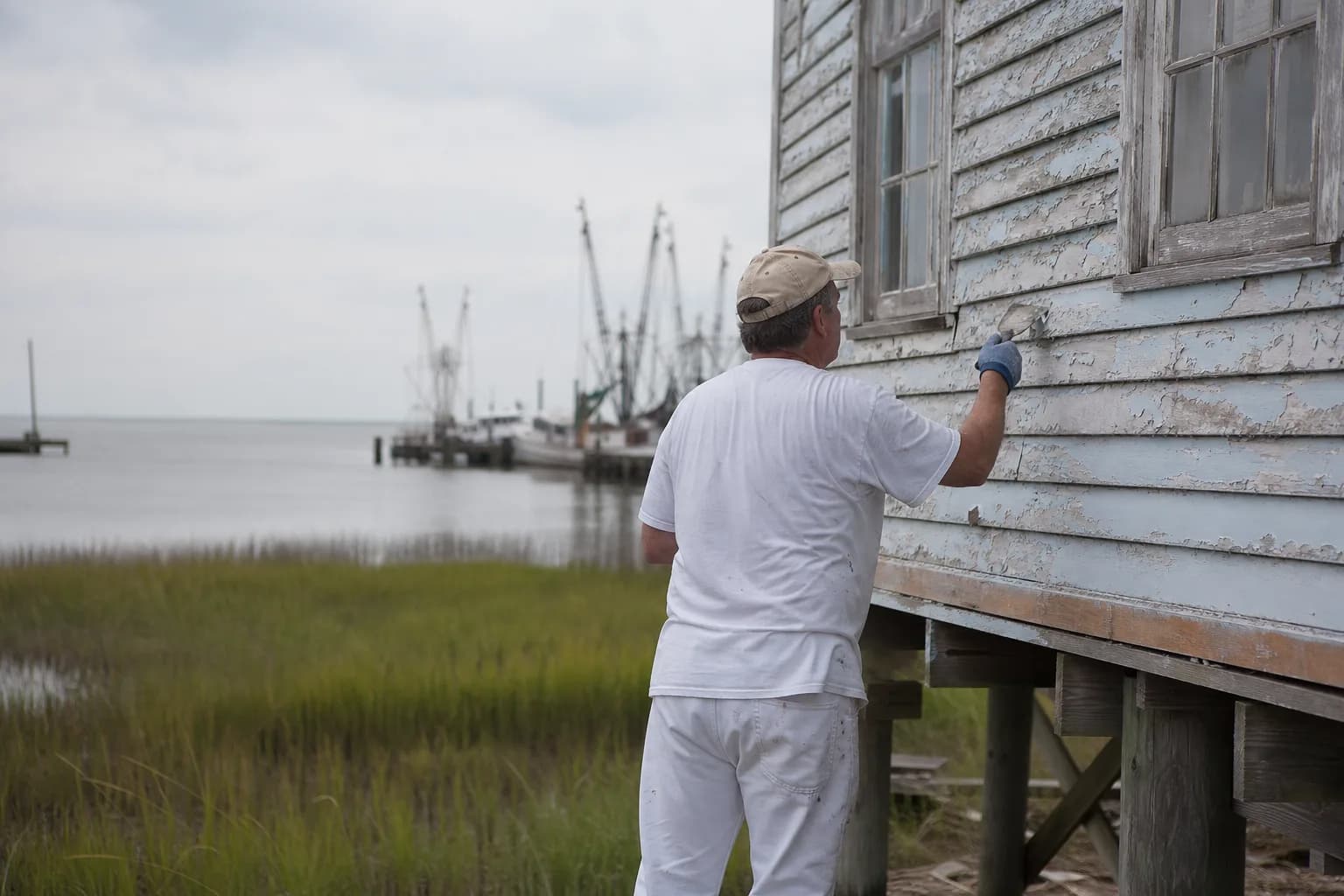
Drive down to the working waterfront in Bayou La Batre — past the shrimp boats, the docks, the seafood houses — and look at the homes facing the water. The wind-facing walls tell the story: chalk you wipe off with a thumb, paint blistered off the trim, fascia peeling at the ends. This is the working coast, and salt air paint damage in coastal Mobile County is harder here than almost anywhere in the region. A paint job that holds for years in Mobile or up in Grand Bay's pine country can fail in a couple of seasons on a house facing the bayou.
Here's what salt air actually does to paint on the south Mobile County coast, and the prep that makes a coastal exterior last.
What salt air paint damage in coastal Mobile County actually is
Salt air isn't just "humid air." It's humid air carrying fine, airborne salt, and on the coast from Bayou La Batre to Coden the wind drives it into every exterior surface, day in and day out.
That salt does two things to paint. First, it's hygroscopic — it pulls and holds moisture against the paint film, so the surface stays damp longer than it would inland. Second, it works into any gap, edge, or microscopic crack and sits there, keeping water in contact with the wood. Paint that wasn't prepped and primed right gives that salt-laden moisture a way in, and once it's under the film, the surface chalks, blisters, and lets go.
This part of Mobile County also carries a heavy moisture load on its own. The area runs over 3,000 cooling degree-days a year and gets close to 50 inches of rain, and much of the working coast sits in a FEMA high-risk flood zone with base flood elevations around 15 feet. Homes here are built for water and take wind-driven rain and storm spray on top of the everyday salt. Stack all that on a south- or west-facing wall and you understand why coastal paint fails the way it does.
It's the prep, not the brand on the can
On the coast, the single biggest factor in how long paint lasts isn't the paint — it's what happens before it goes on. We've seen premium paint fail in two seasons over a surface that skipped prep, and ordinary-quality paint hold for years over a surface that didn't. Salt air punishes shortcuts.
Our exterior painting prep on a coastal home runs the same disciplined order every time, just harder on the wind-facing and low surfaces.
Wash off the salt and mildew film
We pressure-wash every surface to strip the airborne salt, mildew, and grime the humidity deposits, so the new coat bonds to clean material instead of sitting on a salty film.Scrape and sand to a sound edge
All the chalking, blistering, and peeling comes off down to a surface the paint can grip. Wind-facing and low surfaces get the most attention — that's where coastal failure starts.Treat and replace soft wood
Salt air and storm moisture soften trim ends, fascia, and window edges first. We repair or replace the bad wood before painting, so the finish isn't sitting on rot.Prime every bare spot
Bare wood and patched areas get primed so the topcoat seals and salt can't work back under the film — the thing that drives early coastal peeling.Coat with quality outdoor-rated paint
A quality 100% acrylic exterior paint that stays flexible as the wood moves with the humidity and resists the mildew and moisture salt air drives in.
Prime, scrape, treat, prime, paint — in that order, with the salt washed off first. That's roughly 80% of a coastal paint job, and it's the part that decides whether the color lasts.
Why working-coast homes are a different job
The south Mobile County coast isn't the bayfront, and it isn't the resort beach. Bayou La Batre, the Coden vicinity, and the waterfront stretches toward Grand Bay are a working coast — raised cottages, older homes, and houses built around the seafood industry, many of them facing open water with nothing to break the wind. We see it from the Shell Belt Road shipyard corridor and Downtown Bayou La Batre out toward the Alba area and the Hurricane Boulevard area: the homes taking the Gulf Coast wind straight off Portersville Bay / Mississippi Sound shoreline weather hardest. The median home here was built in the late 1980s, so a lot of these houses have decades of repaint layers and salt history baked into the wood.
That changes how we approach a job. Older layered paint means more scraping and sometimes more wood repair. Constant wind exposure means the prep can't be uniform — the water-facing wall needs far more work than the sheltered one. And the storm-and-flood reality means soft wood is common and has to be dealt with before a brush touches it. We treat each home for what it's actually facing, not as a generic "coastal" repaint.
| Factor | Inland Mobile County | Working coast (Bayou La Batre / Coden) |
|---|---|---|
| Salt-air load | Light to moderate | Heavy, wind-driven, constant |
| First failure point | Sun-faded south faces | Wind-facing walls + low trim |
| Wood-repair likelihood | Lower | Higher — storm + salt moisture |
| Prep intensity | Standard full prep | Standard prep, doubled on water-facing faces |
How long does paint last on the Mobile County coast?
A properly prepped, primed, and painted coastal exterior with quality paint will still last years on the working coast. One that skipped the prep can start failing in a couple of seasons. The difference is entirely in the preparation and the wood repair underneath.
If your paint's already chalking or peeling, the move isn't to paint over it — that just traps the problem. It's to get the failing surfaces taken back to sound material, the salt washed off, and the bad wood fixed first. For the bigger picture on coastal durability, our salt-air durability guide covers how Gulf-Coast homes hold up overall, our waterfront-home painting guide for south Mobile County digs into homes right on the water, and our post on the best time to paint an exterior in Mobile, AL covers timing the work around the weather. If you're on the south coast, here's our Bayou La Batre service area page.
Get an honest read on your coastal exterior
We've painted enough working-coast homes to know what salt air does and how to beat it. Book a free in-home estimate and we'll walk your exterior, tell you honestly which faces need a full repaint versus targeted work, and email a written quote within 24 hours. You can pay by cash, check, or credit card, and every job is backed by our 3-year workmanship warranty.
Ready to stop fighting the salt? Reach out for a free estimate and we'll take a look at your home.