
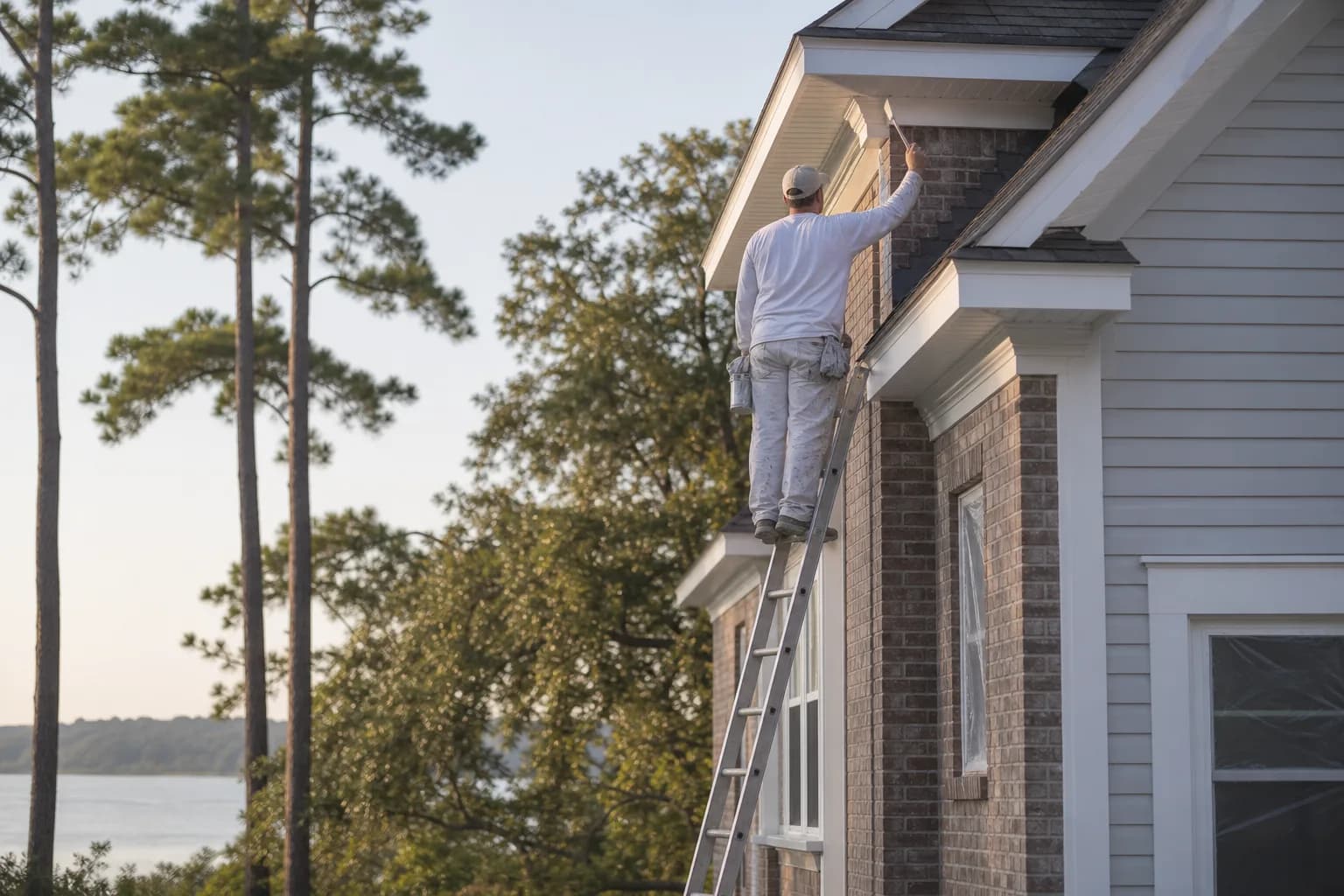
Stand in a driveway in Stonebridge on a July afternoon and you can feel exactly what your paint is up against. The sun comes down hard, the air is thick, and you know a storm could roll off the bay before dinner. Spanish Fort homes don't get the sugar-sand beach — we sit up on the bluff over Mobile Bay, with pines and live oaks instead of dunes. But the bay, the humidity, and the Gulf-Coast sun still test every coat of paint on every house out here.
This is our home turf. We keep an office right in Spanish Fort, so the Eastern Shore is where we work day in and day out. This guide walks through what makes painting a Spanish Fort home its own thing — the bay-air reality, the mix of new and established houses, the HOA color rules — and what you should expect when you hire a painter here.
Spanish Fort is bay and bluff, not beach
First, let's be honest about the geography, because it changes how a paint job should be approached. Spanish Fort sits on the eastern shore of Mobile Bay, up on a bluff above the water — the gateway you cross on the Battleship Parkway Causeway coming out of Mobile. It is not a Gulf beach town. Gulf Shores and Orange Beach get the open saltwater and the dunes. We get the bay, the Blakeley pines, and the Eastern Shore breeze.
That distinction matters for paint. Homes right on the open Gulf take a heavy, constant load of airborne salt, and they need a finish chosen and prepped for that punishment — we cover that in our Gulf-front coastal painting and salt-air durability guide. Spanish Fort's salt load is lighter. But "lighter" is not "none," and the other coastal forces are in full effect:
- Humidity. Our summers are heavy and wet. Spanish Fort sees right around 50 inches of rain in a typical year, and that moisture slows curing and lifts paint that went on over a damp or dirty surface.
- Hard UV. Long, intense sun is the great fader. With July highs averaging in the low 90s, south- and west-facing walls always tire first while the shaded north side still looks fresh.
- Bay salt and mildew. Moisture off the bay keeps a film on siding and feeds mildew on shaded north walls, under eaves, and behind shrubs. Paint over either one and it won't grab.
- Storm season. From June through November, a tropical system can drive rain sideways into seams, end grain, and any failed caulk joint. Water behind the paint is what lifts it.
A mix of newer subdivisions and established streets
Spanish Fort isn't one kind of house, and that shapes the work. The town's housing stock skews newer than a lot of Baldwin County — the median home was built around 1997, which puts the typical house in its mid-twenties. That's the sweet spot where a first or second repaint comes due: the original builder-grade finish has had two decades of Gulf sun on it, the caulk has let go in spots, and trim is ready for attention.
You can see that range driving the subdivisions. Stonebridge and TimberCreek run toward newer construction — fiber-cement and lap siding, big elevations, two-story facades that bake in the afternoon. Spanish Fort Estates, Churchill, Stillwater, Rayne Plantation, and the older streets closer to the Causeway and the bay have homes with more age on them and more wood that needs a careful eye. With Spanish Fort home values sitting well above the county average, owners out here tend to want the job done right rather than fast — and roughly two-thirds of homes here are owner-occupied, so most of the time we're painting for the people who actually live there and plan to stay.
| Home type | What we usually find | What the prep focuses on |
|---|---|---|
| Newer subdivision (Stonebridge, TimberCreek) | Fiber-cement and lap siding, original builder coat, sun-faded south/west walls | Washing off chalk, re-caulking failed seams, spot-priming, two even finish coats for color retention |
| Established streets (Spanish Fort Estates, near the bay) | More wood trim and fascia, older caulk, some soft spots near the ground and roofline | Scraping to sound edges, repairing or rebuilding soft wood, priming bare repairs before finish |
| Brick with painted trim and accents | Sound masonry, but tired soffits, shutters, doors, and eaves | Cleaning, scuffing glossy areas, priming bare wood, and a durable trim enamel that holds up to sun |
Whatever the house, the inside matters just as much. If you're refreshing rooms before a move or finally repainting the open living-kitchen areas these floor plans love, our interior painting service follows the same prep-first habits — clean, patch, prime, and cut clean lines — so the finish looks sharp and wears well.
Why is prep 80% of a Spanish Fort paint job?
We say it on every estimate because it's true: the prep decides whether you're repainting in ten years or three. The brand on the can matters far less than what happens before the can is opened. Here's the sequence we follow on a Spanish Fort exterior, in order.
Pressure wash the whole exterior
Bay salt, pollen, chalk, and mildew all sit on the surface where you can't always see them. We wash every wall, spot-treat mildew so it won't bleed back through, and let the siding dry fully before anything else happens.Scrape and sand to a sound edge
We knock off everything loose or flaking and feather the hard edges so the repaint lays flat instead of telegraphing every old chip. Glossy areas get scuffed so the new coat has something to bite into.Repair the wood first
Soft or rotted fascia, trim, and siding get fixed before paint — there's no point sealing a problem under a fresh coat. We dig into rot and rebuild sound wood as part of our carpentry work so the surface is solid.Prime the bare and the chalky
Raw wood, fresh repairs, chalky siding, and stains get spot-primed, or fully primed when the surface calls for it. Primer is the bridge that lets the finish actually grab — it's not optional on a humid, sun-baked home.Caulk the seams and gaps
We re-caulk failed joints, trim edges, and penetrations with a quality flexible sealant. On the Eastern Shore this is your front line against wind-driven storm rain getting behind the paint.Apply two finish coats
Two full coats of a quality exterior paint built for color retention and moisture resistance. Two coats give the film thickness and even color that one coat can't — and that's what carries the job through our sun and storms.
That order isn't arbitrary. Skip the wash and the primer sits on salt. Skip the priming and the finish peels off bare wood. Skip the caulk and storm rain finds the seams. Do them in order and the paint has every advantage when the next wet season rolls in.
HOA color rules on the Eastern Shore
Here's something specific to Spanish Fort that catches homeowners off guard: a lot of the subdivisions out here run an architectural review committee, and exterior colors usually have to be approved before you paint. Neighborhoods like Stonebridge and TimberCreek often keep an approved palette to maintain a consistent look across the community.
That's not a hurdle so much as a step to plan for. Approval is the homeowner's responsibility, and every HOA's rules are different — so check yours before the job starts. What we bring to it is flexibility and a good eye: we'll paint within whatever palette your committee approves, and our color consultation can help you choose from the approved options so you don't second-guess the result once it's on the wall.
What to expect when you hire us in Spanish Fort
We've been a family-owned Gulf-Coast painting company since 2013, and our Spanish Fort office puts us minutes from most of the Eastern Shore. Here's how a job goes from first call to finished.
It starts with a free in-home estimate — no fee for the visit, no pressure. We look at your siding, trim, and wood, talk through color and finish, and email you a written quote within 24 hours so you know the scope and the price in writing. From there, one accountable crew runs your job from that first estimate through to the final inspection, where a manager signs off before you make final payment. We keep a clean job-site daily, and the whole thing is backed by our 3-year workmanship warranty. You can pay by cash, check, or credit card.
If you want a deeper read on the coastal-prep specifics before you call, our exterior house painting guide for Mobile and Baldwin County covers substrates, timing, and salt-air durability in detail. And if you'd rather just talk through your home, you can see everything we offer across the Eastern Shore on our Spanish Fort service area page or our full house painting service.
Spanish Fort is where we live and work. We know what the bay, the sun, and the storms do to a finish out here, and we know how to prep for it so your color lasts. When you're ready to repaint — inside or out — call us for a free quote and we'll get out to your home and put it in writing.