
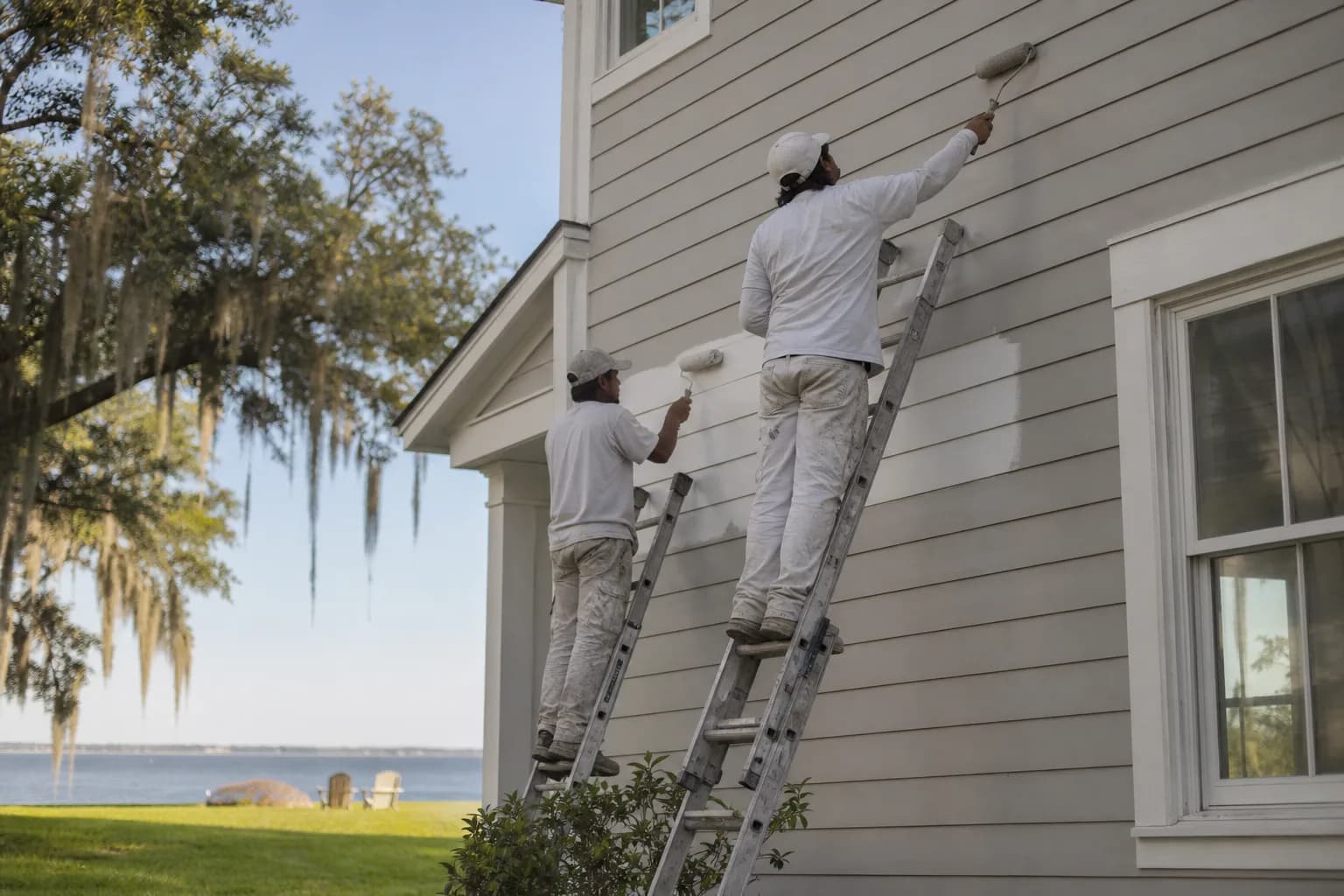
Drive any older street in Daphne or midtown Mobile and you can spot the houses that got painted on the cheap. The color looks fine from the curb, then you get closer and see it: paint curling off the south-facing wall, chalk rubbing onto your hand, a fascia board gone soft at the corner. That's not bad luck or a bad brand of paint. That's the Gulf Coast doing what it does to a job that skipped the boring part.
Salt air, summer humidity, hard UV, mildew, and wind-driven rain are all working on the outside of your home year-round. A good exterior paint job here isn't about the can — it's about reading those forces honestly and prepping for them. This is the full guide to how we approach it, what actually drives a lasting result, and how to time the work so the weather is on your side instead of against you.
What does the Gulf Coast do to exterior paint?
Coastal Alabama is one of the harder places in the country to keep paint on a house, and it's worth knowing why before you spend a dollar.
- Salt air. Closer to Mobile Bay and the Gulf, airborne salt settles on siding and works into any gap. It's mildly corrosive on metal and it keeps a film on the surface that paint struggles to grip if it isn't washed off first.
- Humidity. Our summers are wet and heavy. High humidity slows curing, and moisture trapped behind a film causes blistering and adhesion failure — which is exactly why painting over a damp surface is a recipe for early peeling.
- UV and heat. Long, intense sun fades color and breaks down the binder in the paint. South- and west-facing walls always go first, which is why one side of a house can look tired while the shaded side still looks fresh.
- Mildew. Shade, moisture, and warmth grow mildew on north sides, under eaves, and behind shrubs. Paint over it and it bleeds right back through.
- Wind-driven rain. Storm season runs June 1 through November 30, and a tropical system drives water sideways into seams, end grain, and any spot where caulk has failed. Water that gets behind the paint is what lifts it.
Prep is 80% of a coastal paint job
We say it on every estimate because it's true: prep is most of the work, and it's the part that decides whether you're repainting in ten years or three. Here's the sequence we follow on a Gulf Coast exterior, in order.
Pressure wash the whole exterior
Salt, pollen, chalk, and mildew all sit on the surface where you can't always see them. We wash every wall, spot-treat mildew so it doesn't bleed back, and let the siding dry fully before anything else happens.Scrape and sand to a sound edge
We knock off everything loose or flaking and feather the hard edges so the repaint lays flat instead of telegraphing every old chip. Glossy spots get scuffed so the new coat has something to bite.Repair and treat the wood
Soft or rotted fascia, trim, and siding get addressed before paint — there's no point sealing a problem under a fresh coat. We dig into rot and rebuild sound wood as part of our carpentry work so the surface is solid first.Prime the bare and the chalky
Bare wood, raw repairs, chalky siding, and stains all get spot-primed (or fully primed when the surface calls for it). Primer is the bridge that lets the finish actually grab — it's not optional on a coastal home.Caulk the seams and gaps
We re-caulk failed joints, trim edges, and penetrations with a quality flexible sealant. On the coast this is your front line against wind-driven rain getting behind the paint.Apply two finish coats
Two full coats of a quality exterior paint built for color retention and moisture resistance. Two coats give you the film thickness and even color that one coat can't — and that's what carries the job through our sun and storms.
That order isn't arbitrary. Each step sets up the next. Skip the wash and the primer sits on salt. Skip the priming and the finish peels off bare wood. Skip the caulk and rain finds the seams. Do them in order and the paint has every advantage when the next wet season rolls in.
Your siding type changes the plan
Not every exterior gets painted the same way. The substrate decides the prep, the primer, and sometimes the paint. Here's how the common ones around Mobile and Baldwin County differ.
| Siding type | Key prep | What to watch for |
|---|---|---|
| Wood lap & shingle | Scrape, sand, spot-prime bare wood, treat any rot | End grain and soft fascia soak up moisture — prime it or it fails |
| Fiber cement | Wash, scuff chalk, prime repairs and cut edges | Factory finish chalks over time; cut ends need sealing |
| Stucco & masonry | Patch cracks, use a breathable alkali-tolerant system | Trapping moisture behind a non-breathable film causes blistering |
| Brick (painted) | Clean, prime with a masonry primer, breathable topcoat | Brick holds moisture; the system has to let it escape |
| Vinyl | Wash, light scuff, use vinyl-safe paint colors | Dark colors on vinyl can warp from heat — color choice matters |
The takeaway isn't that you need to memorize this — it's that a real estimate should account for what your house is actually made of. A home with wood fascia over fiber-cement siding and a stucco chimney needs three different approaches on the same wall. Matching the system to each surface is exactly the kind of detail that separates a job that lasts from one that looks good for a year.
It also changes how we sequence the day. We don't want masonry primer drying next to fresh wood caulk, and we don't want to topcoat fiber cement before the repaired ends are sealed. On a mixed-substrate house we map the surfaces first, prep each one on its own track, and only then bring the finish coats together so the whole exterior cures evenly. That planning is invisible from the curb, but it's the reason the trim and the field still match three summers later instead of one side chalking ahead of the other.
Paint isn't all the same — pick the system, not just the color
Once the prep is right, the paint still matters. On the coast we lean toward quality exterior lines built for color retention, mildew resistance, and flexibility through our heat-and-humidity swings. Here's how to think about the tiers without getting lost in brand names.
| Tier | What you get | Best for |
|---|---|---|
| Builder-grade | Thin film, fades and chalks fast in UV | We don't recommend it for coastal exteriors |
| Quality exterior | Strong color retention, mildew resistance, good adhesion | Most Gulf Coast homes — the practical sweet spot |
| Premium exterior | Top-tier UV and moisture performance, longest color hold | Bay-front, full-sun, and high-exposure walls |
We'll talk through finish too. Flat hides surface imperfections on big wall areas; satin and low-sheen wear better and clean easier on trim and doors. Color help is part of what we do — a little color consultation up front keeps you from living with a shade that looked great on a chip and wrong on the whole house, or a dark color baking on a sun wall. Want to test a palette before you commit? You can preview exterior colors on a photo of your own home with our free AI Color Visualizer and see how a body-and-trim combination reads in real Gulf light.
Timing your exterior house painting around our weather
Around here, timing is part of the job. The best windows for exterior painting in Mobile and Baldwin County are late spring and fall — temperatures are mild, humidity backs off, pollen has settled, and you can usually count on a stretch of dry days for the paint to cure.
A few honest realities about our calendar:
- Deep summer is workable but tricky — the afternoon storms and the heat mean we plan around the forecast, often painting earlier in the day and watching the radar.
- Storm season (June–November) means we keep an eye on tropical systems and won't paint into wind-driven rain.
- January and February bring the cold, damp snaps where paint won't cure properly, so we time around them.
The practical rule: a good exterior job wants several days of mild, dry weather, not a single sunny afternoon. Most exterior paints want the surface and the air above about 50 degrees and below the paint's high limit while they cure, and they want low enough humidity that the film can flash off instead of staying tacky overnight. We schedule with that in mind, and we'd rather hold a day for weather than rush a coat that won't last. If you want a deeper look at the calendar, our guide on the best season to paint your house exterior in Mobile & Baldwin counties breaks it down month by month.
Wood repair comes before paint, not after
This is the one homeowners miss most. On older Gulf Coast homes, the fascia, soffit, trim, and the bottom course of siding are where rot starts — water sits, humidity lingers, and the wood goes soft long before the paint shows it. Painting over soft wood just hides the problem and seals moisture in.
We check the wood as part of every exterior estimate and handle repairs first. Our carpentry and wood-repair work and the full exterior painting service are built to go together for exactly this reason — you fix the substrate, then you protect it. For a closer look at how rot, fascia, and trim factor into a paint-prep plan, see our carpentry, paint prep, rot, fascia & trim guide. And if your home sits right on the water, the salt-air exposure is its own conversation — our gulf-front coastal painting and salt-air durability guide goes deeper on the highest-exposure homes.
What it costs — and what drives the number
Exterior painting prices swing widely because no two houses are the same. The honest answer is that the cost is driven by the work in front of us, not a flat per-square-foot sticker. The biggest factors:
- Size and height — square footage of siding and trim, and how many stories (ladder and staging time adds up).
- Prep condition — how much scraping, wood repair, and priming the house actually needs. This is usually the swing factor.
- Substrate — wood, fiber cement, stucco, and brick each take different prep and product.
- Number of coats and colors — full color changes and accent trim take more labor than a refresh in the same color.
- Repairs — rotted fascia or trim that has to be rebuilt before paint.
Rather than guess from a chart, the right move is a free in-home estimate where we actually look at your siding and put a real number on paper. For a fuller breakdown of the variables, our cost to paint a house in Mobile & Baldwin County guide walks through what moves the price.
Why homeowners here call us
We're a family-owned painting company that's been working Mobile and Baldwin County since 2013, and we hold a 4.8-star rating across hundreds of Google reviews. Every exterior job runs with one accountable crew from your free estimate through to the final inspection, a manager signs off before you make final payment, and the work is backed by our 3-year workmanship warranty. We're also EPA RRP Lead-Safe certified — which matters on the older homes around here where lead paint is a real possibility.
We work out of two offices, one in Mobile and one in Spanish Fort, so we cover both sides of the bay. If the outside of your home is starting to chalk, peel, or just look tired, the next step is simple: call us for a free in-home estimate and we'll email you a written quote within 24 hours. You can also look at our full exterior painting service or our house painters page to see how we work.