
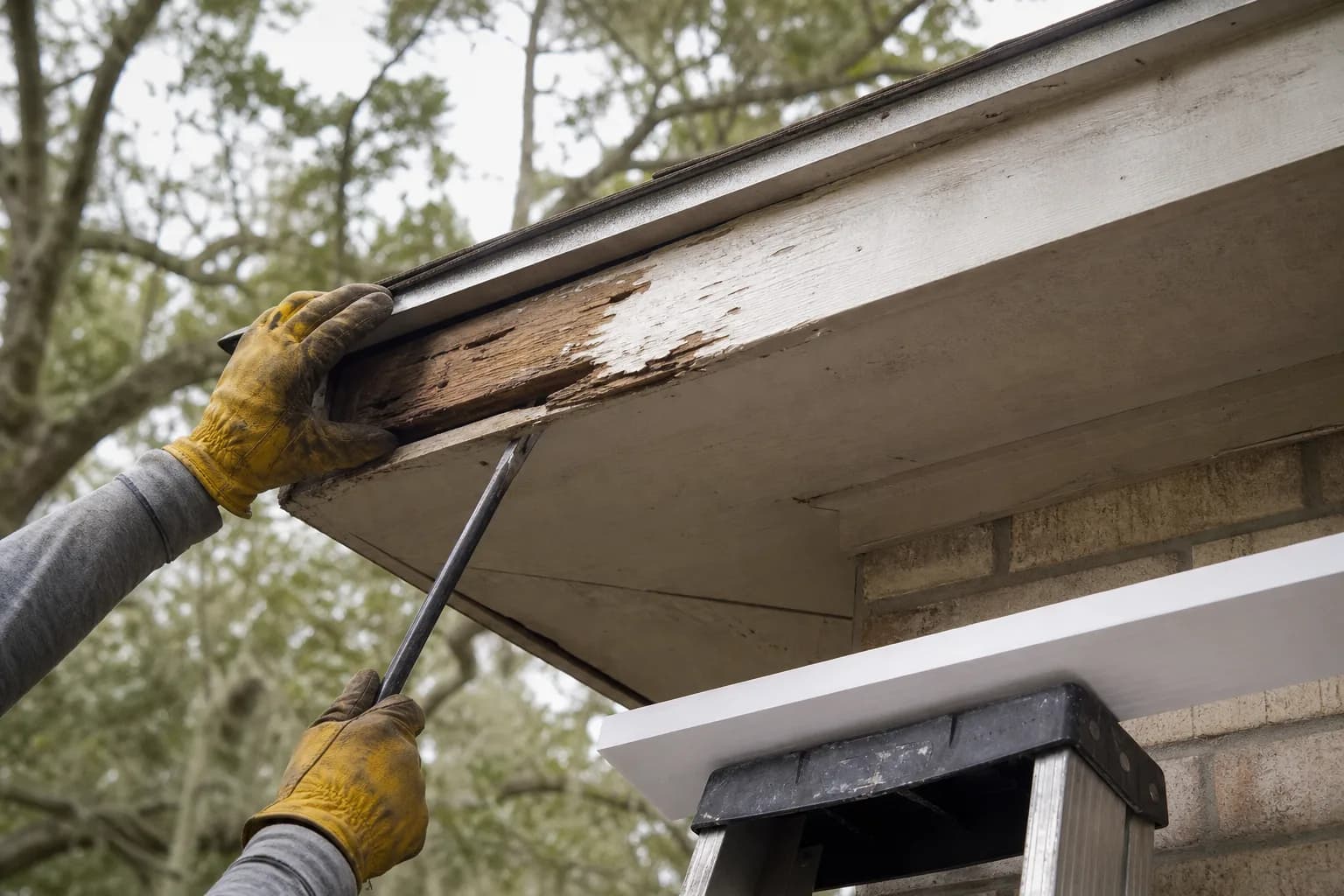
The estimate that surprises people isn't the paint. It's the carpentry. A homeowner in Daphne calls us to repaint a tired exterior, and somewhere around the second story we're pressing a screwdriver into the corner of a fascia board and it sinks in like a wet sponge. That soft spot isn't cosmetic. It's the reason the last paint job failed there, and if we coat over it, it'll be the reason this one fails too.
Here's the thing most homeowners never get told: on a Gulf Coast home, the wood is the job. Salt air, summer humidity, and wind-driven rain find every seam, every cut end, and every spot where the last caulk let go, and they rot the wood from the outside in. Paint is the protection that goes on top — but it can only protect wood that's actually sound. Skip the carpentry and you're painting a problem shut. This guide walks through how we find rot, what we repair versus replace, and how the wood repair carries straight through into a paint job that lasts.
Why carpentry is the part that decides the paint job
Paint is a moisture barrier and a UV shield. That's its job. What it is not is a structural repair — it can't add strength to a board that's gone soft, and it can't dry out wood that's already wet. When a coat goes over rotted fascia or a punky sill, two things happen, both bad. The fresh film traps whatever moisture is already in the wood, so the rot keeps spreading underneath where you can't see it. And the paint has nothing solid to grip, so the swollen, crumbling surface lifts the coat off within a season or two.
That's why we treat carpentry as the first step of prep, not a separate trade you handle later. It's also the piece a lot of cheaper exterior bids quietly leave out — they price the painting, skip the soft wood, and the homeowner finds out the hard way the next wet season. Doing it right means looking at the wood honestly before a brush comes out.
How do you spot wood rot before it spreads?
Rot rarely announces itself with a hole. It starts soft and dark, usually somewhere water sits or lingers, and it spreads quietly under intact-looking paint. Knowing where to look — and how to test — saves you from sealing a problem under a fresh coat.
The classic trouble spots on Gulf Coast homes:
- Fascia ends and corners — where two boards meet and end grain is exposed, water wicks in and rot starts at the joint.
- Soffit panels — shaded, slow to dry, and the first place a roof or gutter leak shows up as staining and sag.
- Window sills and casing — sills are angled to shed water but the back edge and the corners hold it; casing rots where it meets the sill.
- The bottom course of siding — splash-back from the ground and slow drying make the lowest boards a rot magnet.
- Door trim and thresholds — constant wetting at the base, plus foot traffic, breaks the paint seal early.
- Columns and railing posts — anywhere a post sits on a porch deck, the end grain at the base sucks up standing water.
The test is simple and you can do it yourself. Press a screwdriver or an awl into any spot that looks dark, cracked, blistered, or stained. Sound wood pushes back. Rotted wood gives — it feels spongy, crumbles, or lets the tip sink in. Tap along a fascia run too: solid wood rings, soft wood thuds. If you find give, that board needs carpentry before it needs paint.
The rot-repair sequence, step by step
When we find rot at an estimate, we don't reach for a tube of filler and smear over it. There's a sequence, and following it is what makes the repair last as long as the paint over it. Here's how a sound wood repair goes.
Find the full extent of the rot
We probe past the obvious soft spot to find where solid wood starts again. Rot always runs further than it looks — the visible damage is the middle of it, not the edge. We chase it to good wood so nothing punky gets left behind the repair.Decide: repair or replace
A small, contained soft spot in an otherwise solid board gets dug out and rebuilt. Once rot runs through the board, reaches structure, or covers most of its length, we replace the section. We make that call board by board and tell you which is which.Remove the damaged wood
For a repair, we dig out all the soft, crumbling material back to a clean, firm edge. For a replacement, we cut out the bad section square, save the sound wood, and check the framing behind it for any moisture damage that drove the rot.Treat and rebuild
Repaired spots get a wood hardener to firm up the surrounding fibers, then a structural epoxy filler shaped to match the profile. Replacements get new paint-grade wood — or PVC/composite trim where moisture keeps winning — cut to fit and fastened solid.Prime every face, including cut ends
Bare wood and raw fillers and every fresh cut get primed before they go up or get topcoated. End grain and back faces drink water fastest, so sealing all sides is what stops the new wood from rotting the way the old wood did.Caulk, then carry into the paint
We seal the seams around the repair with a quality flexible sealant, then the repaired area gets finished with the same two-coat system as the rest of the exterior so it's protected and the color matches — no patch that screams 'repair' from the curb.
That last step is the one that gets skipped when carpentry and painting are split into unrelated scopes. A separate carpenter can rebuild the board and leave bare or primer-gray wood exposed until the painting starts. On the coast, that delay is long enough for new wood to start weathering before it is sealed. Keeping repair and paint in one accountable scope allows the repair to be primed and finished in sequence.
Repair, replace, or upgrade to PVC — how we decide
There's no single right answer for a rotted board. The honest call depends on how far the rot has gone, where the spot is, and how often it's likely to rot again. Here's the framework we use, so you can see the logic behind the recommendation on your estimate.
| Option | When it's the right call | Trade-off |
|---|---|---|
| Repair with epoxy | Small, contained soft spot in a board that's otherwise solid and well-drained | Only works while most of the board is sound — not a fix for widespread rot |
| Replace with paint-grade wood | Rot runs through the board, but the location drains and dries well | Will rot again eventually if the moisture source isn't fixed; needs all-side priming |
| Replace with PVC or composite | High-moisture spots that keep rotting — sill corners, ground-level trim, wet fascia ends | Higher material cost; still primed and painted for color and UV, but it won't rot |
| Fix the water source first | Any spot where a gutter, flashing, or grade problem is feeding the rot | Adds a step, but skipping it means the new wood rots too — non-negotiable on repeat failures |
If you want a deeper look at how we make the repair-or-replace call on a whole exterior, our guide on whether to repair or replace rotted wood before a repaint lays out the thresholds. The PVC-versus-wood question comes up a lot, so it's worth being clear. PVC and composite trim don't rot — that's the whole appeal in a climate like ours. But they aren't a magic fix everywhere. They cost more up front, and they still get primed and painted, both for the color you want and because the dark exterior colors people love will hold better over a properly primed surface. Where we lean PVC is the spots that have already rotted once or twice: the bottom of door trim, sill corners, fascia ends that stay damp. Where good primed wood is the smarter spend is protected, well-drained trim that's never given trouble. The right move is usually a mix — upgrade the problem spots, keep wood where wood works.
Fascia, soffit, sills, and columns — the usual suspects
A few of these spots come up so often on Gulf Coast homes that they're worth their own word.
Fascia and soffit. The fascia is the band the gutters hang on, and the soffit is the underside of the eave. Together they take the worst of the roof's runoff. Fascia rots at the ends and behind the gutter where water sits; soffit rots from leaks above and from poor attic ventilation that traps humidity underneath. We repair or replace the damaged sections, make sure the area can dry, and prime and paint it back to match. Getting this band right matters beyond looks — it's what keeps water out of the rafter tails and the roof edge.
Window sills and casing. Sills live a hard life: angled to shed water but holding it at the corners and the back edge, and baked by sun on the south side. Rotted sills and the casing around them are some of the most common carpentry on an older repaint, and they're easy to miss because the rot often starts underneath. We rebuild or replace them, seal the joints where the window meets the trim, and prime every cut before paint.
Columns and railings. Porch columns and railing posts rot at the base, where the end grain meets standing water on the deck. A column can look perfect at eye level and be soft at the bottom six inches. We address the base, get it up off standing water where we can, and finish it so it sheds water instead of wicking it.
Across all of them, the move is the same: find the rot, repair to sound wood, prime all sides, then carry it into the exterior paint finish. For the bigger picture on how this fits a whole-house exterior, our exterior house painting guide for Mobile & Baldwin County covers prep, substrates, and timing alongside the carpentry.
Carrying the repair through the paint
This is the part that ties it all together, and it's the reason we do carpentry and painting under one roof instead of handing you off. A wood repair isn't finished when the new board is fastened. It's finished when that board is primed on every face, caulked at the seams, and carried into the same two-coat finish as the rest of the exterior — so it's sealed against the next wet season and you can't pick it out from the curb.
When one accountable crew owns the whole job, that hand-off never falls through the cracks. The carpenter who rebuilds your fascia is working the same project as the painter who seals it, so the repaired wood gets primed and topcoated in stride rather than sitting exposed — which is exactly why one crew for the carpentry and the paint beats hiring two separate trades. A manager signs off before final payment, and the work — carpentry and paint both — is backed by our 3-year workmanship warranty. We've been family-owned and working Mobile and Baldwin County since 2013, with a 4.8-star rating across hundreds of Google reviews, and we're EPA RRP Lead-Safe certified, which matters on the older homes around here where rotted trim and lead paint often show up together.
If you want to see how the wood repair affects the overall number, our cost to paint a house in Mobile & Baldwin County guide walks through what drives the price — and rotted fascia or trim that has to be rebuilt is one of the bigger swing factors. You can also read more about our carpentry and wood-repair service and how it pairs with our exterior painting service.
The bottom line: don't paint over soft wood, and don't let a bid skip the carpentry to look cheaper. Fix the wood, seal it, then protect it with paint — in that order. If you've got a fascia corner that keeps peeling, a sill that's gone soft, or trim you're not sure about, the next step is simple. Book a free in-home estimate, and we'll look at the wood honestly and email you a written quote within 24 hours.