
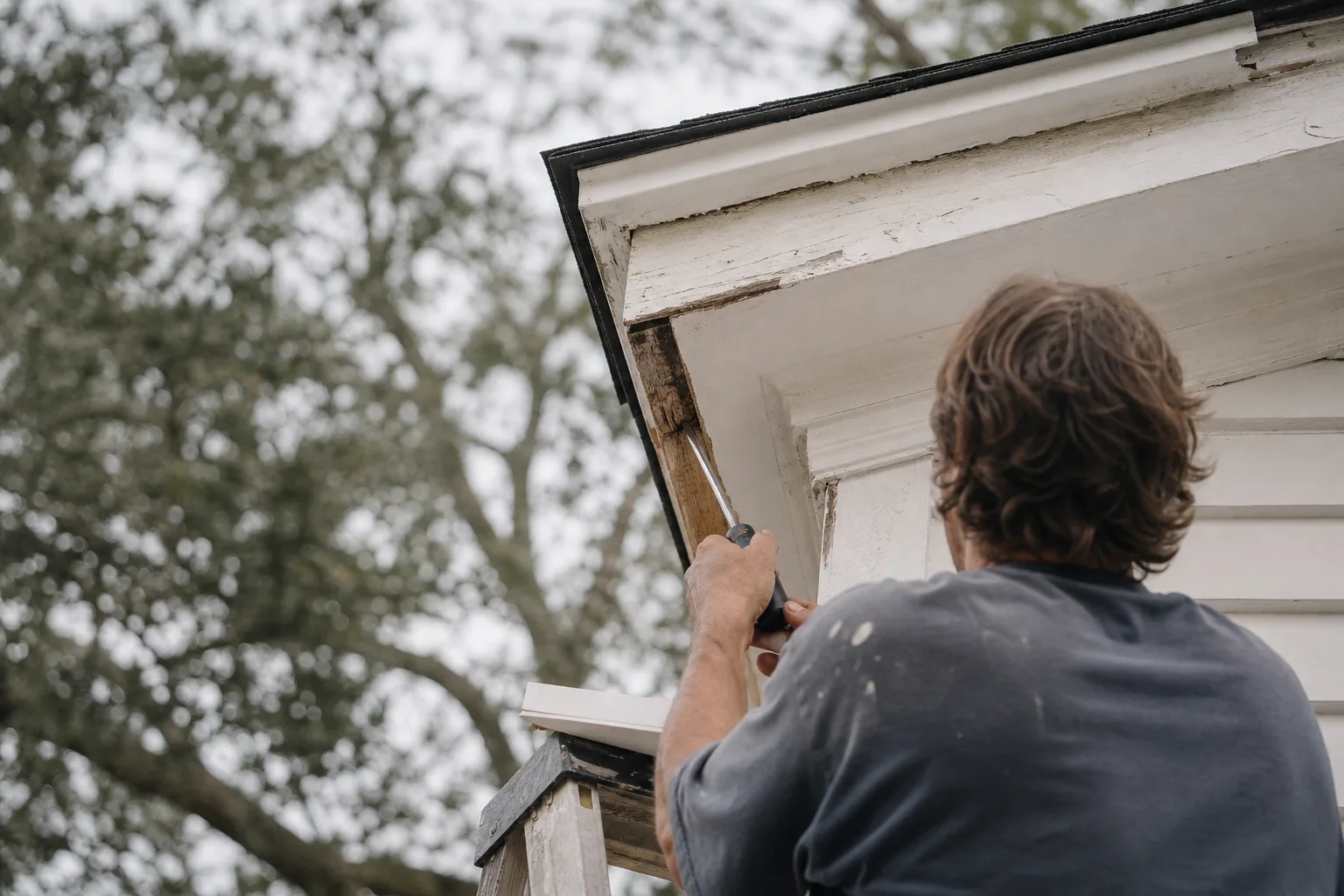
You found the soft spot. Maybe the screwdriver sank into a fascia corner, or a sill flexed when you leaned on it, or the paint keeps blistering in the same place every time you repaint. Now comes the question that decides the bid: do you dig it out and patch it, or does the whole board come out? Get that call wrong in the cheap direction and you'll pay for it twice — once for the patch, again for the replacement when the patch fails a season later.
This is the decision post. Not how to find rot, not which material to replace it with — just the judgment call painters and carpenters make at every soft board: repair or replace. Here's how far the rot has to go before a patch stops making sense, what each choice really costs over time, and why the cheapest-looking option on the estimate is sometimes the most expensive one you can pick.
Repair or replace rotted wood: the one-third rule
Start with the fast answer, then we'll get into the why. If a soft spot is small and contained — say less than about a third of the board's thickness or length — and the wood all around it is solid, it's a repair candidate. Dig the rot back to firm wood, rebuild it with structural epoxy, and a good patch lasts for years. Once the rot runs deeper than that, travels through the board, or reaches the framing behind it, you're past patching. Replace the section.
The reason the threshold matters is how epoxy repair actually works. A wood-rot patch isn't filler smeared over a soft spot — it's a structural rebuild that borrows strength from the solid wood around it. The filler bonds to firm fibers on every side and bridges the gap. Take away too much of that solid wood and there's nothing left for the patch to hold onto. It cracks loose, water gets back behind it, and you're worse off than before because now the repair is hiding the spread.
How far has the rot really gone?
The hardest part of the repair-or-replace call is that rot lies about its size. What you see on the surface is almost never the full extent — the visible soft spot is the middle of the damage, not the edge of it. So before you can judge whether a board is a third gone or two-thirds gone, you have to find where the rot actually stops.
Chase the soft spot to firm wood
Probe outward from the obvious damage in every direction until the tool stops sinking and hits wood that pushes back. The distance between the visible rot and that firm edge tells you how widespread it really is — and it's usually wider than the stain on the surface.Check the depth, not just the face
Press straight in, not just across. Rot that's only skin-deep on a thick board is a different decision than rot you can sink a screwdriver into up to the handle. Surface punk on a solid board patches well; full-depth softness means the board is structurally gone.Look behind and below
Rot runs downhill and inward toward whatever fed it. Check the framing or rafter tail behind a soft fascia, the corner behind a sill, the deck under a column base. If the rot has moved off the trim and into structure, that's an automatic replace, not a patch.Weigh the count, not just the one board
One soft corner on an otherwise sound exterior is a repair. A dozen soft spots across tired, end-of-life trim is a sign the whole run is failing — and replacing the section often costs less than chasing patch after patch around boards that are all on their way out.
That last point is the one homeowners miss. The repair-or-replace question isn't only about a single board in isolation — it's about whether you're fixing an exception or patching a pattern. One bad spot on good trim, patch it. A roofline's worth of soft fascia, and patching each spot is throwing good money at wood that's done.
The real cost: patch twice, or replace once
A repair almost always quotes lower than a replacement on the line item. That's true, and it's exactly why a patch is the smart spend when the board is mostly solid — you're keeping good wood and only rebuilding the bad inch. The trap is using "cheaper today" to justify patching a board that's too far gone.
Here's the math that doesn't show up on the estimate. A patch on a failing board doesn't hold. Within a season or two the rot it was hiding pushes the filler loose, the paint over it lifts, and now the board comes out anyway — except you've paid for the failed patch, the replacement, and a second round of priming and painting on that spot. Replacing it the first time would have cost less than that whole chain.
| The situation | Repair | Replace |
|---|---|---|
| Small soft spot, board otherwise solid | Right call — cheaper, keeps good wood, lasts for years | Overkill — you're paying to remove sound wood |
| Rot through the board, location drains well | False economy — the patch won't hold the load | Right call — one new board done once |
| Same spot rotted before | Pointless until the water source is fixed | Right call, paired with fixing the leak or drainage |
| A whole run of tired, soft trim | Death by a thousand patches | Cheaper overall than chasing patch after patch |
None of this means replacement is always the safe answer either. Tearing out a sound board around a small repairable spot is its own waste — you're paying for labor and material you didn't need, and every new seam is a new place for water to find its way in someday. The goal isn't to default to one or the other. It's to read the board honestly and pick the option that costs the least over the life of the paint job, not just on the day of the quote.
Longevity: which choice actually lasts?
Done right, both a repair and a replacement can outlast the paint over them — so longevity isn't really repair-versus-replace, it's done-right-versus-done-cheap. A patch fails early when someone skips digging the rot back to firm wood or skins filler over softness. A replacement fails early when the new board goes up bare-backed, unprimed on its cut ends, drinking water from day one. Either approach lasts when the fundamentals are respected.
There's one factor that beats both, though, and it's worth stating plainly: the repair only lasts as long as the reason for the rot is gone. Wood doesn't rot on its own — something keeps it wet. An overflowing gutter dumping on a fascia, flashing leaking behind a sill, grade pushing splash-back into the bottom siding. Fix the board and ignore the water, and the brand-new wood rots on the exact same schedule the old wood did. That's why a real repair-or-replace decision always includes a third question: what's feeding this, and is it fixed? Skip that and you haven't repaired anything — you've reset the clock.
How we make the call
When we find rot at a free in-home estimate, we don't price it off a blanket rule and we don't reach for filler to make the number look small. We probe each soft spot to firm wood, judge how far it's really gone, check whether it's moved into structure, and look for the water source that started it. Then we tell you, board by board, which spots patch and which come out — and why. You see the logic, not just the price.
What ties it together on a repaint is that the wood and the paint are one job, not two. Whether a board gets patched or replaced, it gets primed on every face, caulked at the seams, and carried into the same finish as the rest of the exterior — so the repair is sealed against the next wet season and you can't pick it out from the curb. The whole picture of how carpentry fits a coastal exterior lives in our carpentry as paint-prep guide for fascia, soffit, and trim, and if you want to see how rot affects the total, the cost to paint a house in Mobile & Baldwin County guide walks through what drives the price.
Two related reads if you're working through a soft board: when a patch is the right move, wood filler versus board replacement on rotted trim gets into the patching itself, and dry rot versus wet rot on Gulf Coast homes helps you read what kind of rot you're dealing with. You can also see our carpentry and wood-repair service and how it pairs with our exterior painting service.
The bottom line: patch what's mostly sound, replace what's mostly gone, fix the water either way, and never paint over soft wood to make it disappear. If you've got a board you're not sure about, that's exactly the call we make every day. Call us for a free in-home estimate and we'll read the wood honestly and email you a written quote within 24 hours — family-owned and working Mobile and Baldwin County since 2013, backed by our 3-year workmanship warranty and a 4.8-star rating across hundreds of Google reviews.