
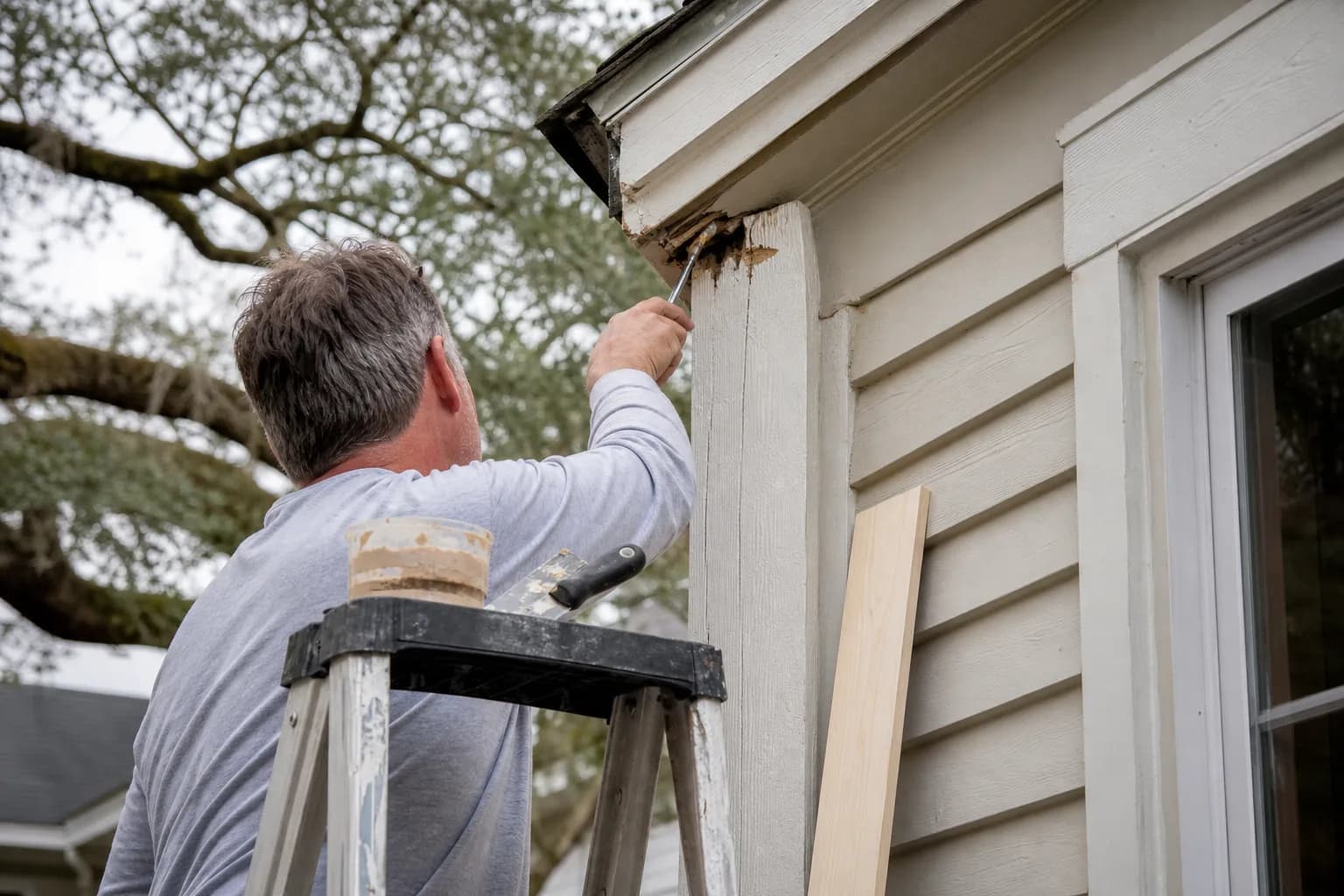
The screwdriver just sank into the corner of a window casing like it was cork. Now you've got a decision to make before the painters can do anything: do you dig the rot out and fill it, or does the whole board come off? It's the question that quietly decides the cost and the lifespan of the repair — and getting it wrong in the cheap direction is the classic way to pay for the same trim twice. This is the honest breakdown of wood filler vs replacing wood on rotted trim: where filler genuinely holds, where it can't, and how each one lasts once paint goes over it.
This post is the fill-or-replace call specifically. If your question is more about how to judge how far the rot has spread in the first place, start with repair or replace rotted wood before a repaint. And rotted window sills and casings have their own quirks, covered in window-sill and casing rot most painters skip. Here, we're comparing the two repair methods head to head.
First, the one thing that decides it
Before any product talk, one principle settles most cases: filler patches an exception; replacement fixes a pattern.
Epoxy filler works by bonding to and being carried by the solid wood around the rot. So the test is how much solid wood is left. A soft corner on an otherwise-firm board has plenty of good wood to anchor a patch — that's a fill. A board that's soft end to end has nothing left to hold the patch or carry the load — that's a replace. If more than about a third of the board's thickness or length has gone, or the rot has reached the framing behind the trim, the board comes out. Fill past that line and the patch is just buying one season.
Wood filler vs board replacement, side by side
| Factor | Structural epoxy filler | Board replacement |
|---|---|---|
| Best for | Local rot with solid wood all around it | Widespread rot, or rot into structure |
| Strength | Cures harder than the wood; takes fasteners | Full original board strength |
| How long it lasts | Years — as long as the leak is fixed and it's painted | Longest, especially rot-resistant or primed-grade wood |
| Cost | Usually cheaper for a small, contained repair | More labor and material, but one-and-done on a bad board |
| Risk if misjudged | Fails fast if the board was mostly gone | Overkill (and cost) on a board that only needed a patch |
| Paint result | Sands and paints invisibly when done right | Paints like new once primed on all faces |
When is wood filler the right call?
Reach for filler when the rot is local and contained and the board around it is still firm — a soft fascia corner, a punky patch around an old nail, a small bad section of an otherwise-sound sill. In those cases a proper epoxy repair is the smart, economical fix, and it genuinely lasts.
The catch most DIY repairs miss: the product matters enormously. The lightweight wood putty in a squeeze tube is for nail holes and dents — it has no business carrying structural rot. What holds is two-part structural epoxy, and it's done in a sequence:
Dig back to firm wood
Remove all the soft, punky material until you reach wood that pushes back — epoxy bonds to solid wood, not rot.Consolidate with wood hardener
Soak the firm-but-fragile edges with a penetrating wood-hardener consolidant so the epoxy has a stable surface to grip.Pack in structural epoxy filler
Press two-part structural epoxy into the cavity, slightly proud of the surface, and let it cure fully.Shape, prime, and paint
Sand the cured epoxy to the trim profile, prime it on every face, then carry it into the same finish coats as the rest of the trim.
Done that way, the cured epoxy is harder than the surrounding wood, holds fasteners, shapes to the molding profile, and paints like wood — the repair vanishes from the curb. How epoxy actually bonds and cures is worth understanding before you trust it; we cover it in how epoxy wood repair for rot works.
When the board has to come out
Replacement is the honest answer once the rot is widespread, runs through the board, or has moved into structure behind the trim. No filler carries a board that's mostly gone, and trying to is how you end up paying twice — once for the patch, again for the replacement when the patch fails, plus a second round of paint over the spot.
Replacement also wins on a long run of soft boards. Patching a dozen failing spots one by one costs more in labor than pulling and swapping the run, and you're left with a wall full of patches instead of sound wood. When we replace, we use rot-resistant species or primed-grade trim, back-prime every face before it goes up (the hidden back of trim is where the next rot starts), and seal the end grain — so the new board outlasts the old one. The real fix, with either method, is correcting the leak or drainage that caused the rot; skip that and any repair rots again on the same schedule. That's why carpentry and paint belong with one crew, as we lay out in our carpentry, paint-prep, and rot pillar guide — so the repair is primed and painted into the wall, not left for the next company.
How each one holds up before paint
Both methods, done right, take and hold paint for years — the difference is durability, not appearance. A correct epoxy repair lasts as long as the board it's in, provided the water source is fixed and it's primed and painted on all faces. A correct board replacement lasts longest of all, especially in a rot-resistant or primed-grade material that's back-primed and sealed at the ends. What ruins either one is the same thing: leaving the original leak alone, or letting the repair sit bare and unpainted so moisture gets back in. Paint isn't the repair — it's the seal that protects the repair you already made.
The bottom line on filler vs replacement
Wood filler vs replacing wood comes down to how much solid wood is left and what caused the rot. Local rot with firm wood around it is a structural-epoxy fill — cheaper, lasting, invisible under paint. Widespread rot, rot through the board, or rot into structure is a replacement — more work up front, but one-and-done on a board that was never going to hold a patch. Either way, fix the water and prime everything, or you'll be back at the same spot next season.
Not sure which way your trim should go? That judgment call is exactly what our carpentry crew makes on site, every day, before a brush touches the wood. Book a free in-home estimate and you'll get a written quote within 24 hours — with the fix spelled out and a manager final inspection before the job is done.