
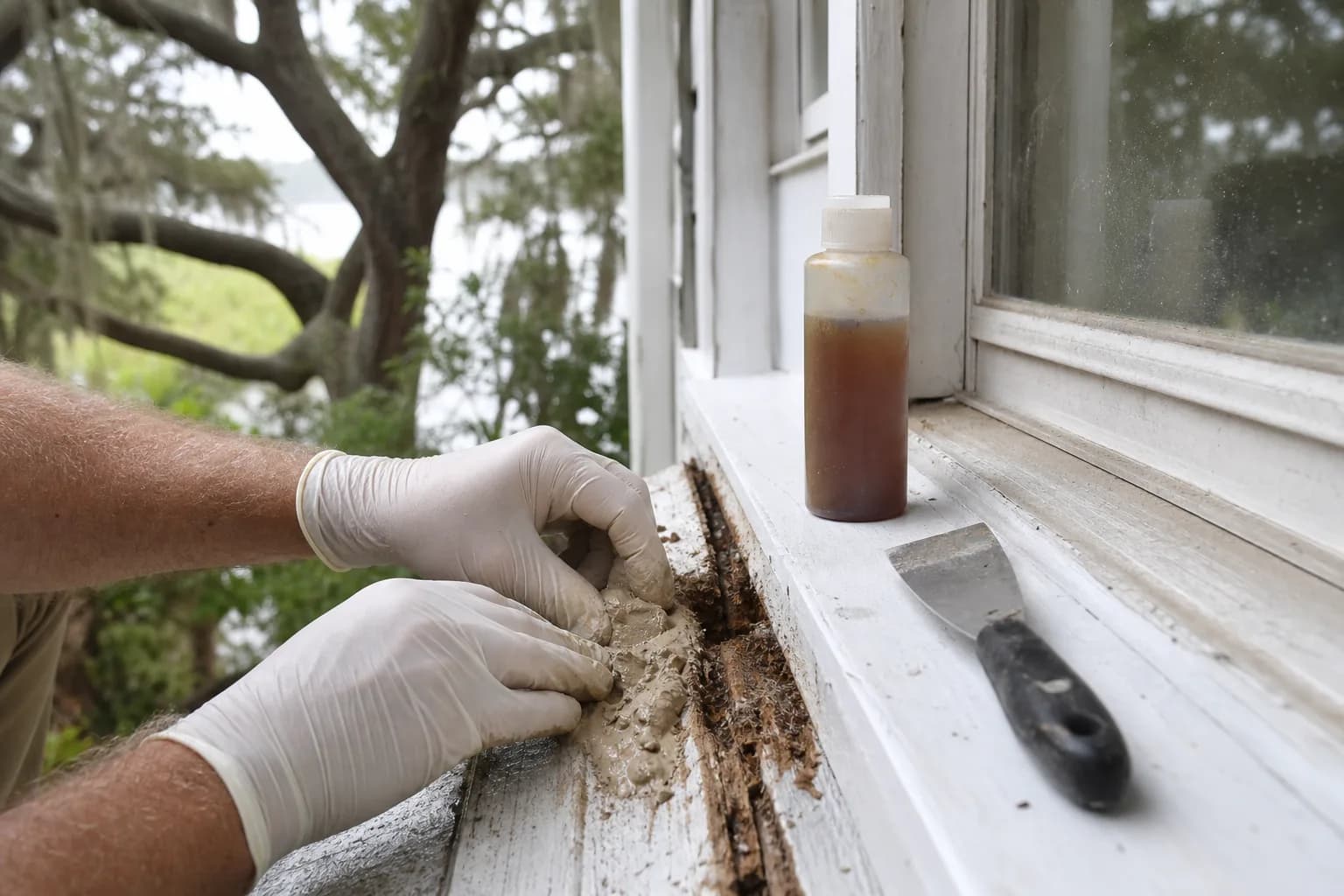
A screwdriver sinks into the corner of a window sill like it's foam, and the assumption is the whole board's coming off. Often it doesn't have to. Epoxy wood repair can take that soft, rotted section and turn it back into something solid, paintable, and lasting — without pulling and rebuilding the whole piece. But "epoxy" gets thrown around loosely, and the wrong product or a skipped step is why some DIY epoxy wood repair pops loose in a season. Here's how it actually works, what each part is doing, and where it genuinely holds versus where the board has to go.
This post is about the mechanism — what's happening when epoxy fixes rot. If your real question is whether to fill it or replace the board entirely, that's a different call, and we lay it out in wood filler versus board replacement for rotted trim. Here we're under the hood of the fill itself.
What epoxy wood repair actually is
Epoxy wood repair isn't one product — it's a two-part system, and understanding that is the whole game. Most failed repairs come from treating it like a single tube of filler.
The first part is a consolidant: a thin, almost watery liquid that soaks deep into soft, rot-weakened fibers and cures rock-hard. It doesn't add material — it re-hardens the punky wood that's still there, turning a fragile, crumbly edge into a solid base. The second part is the structural filler: a thick, putty-like two-part epoxy you pack into the missing area. It rebuilds the shape, cures harder than the surrounding wood, holds fasteners, and sands to a profile.
Neither one is the lightweight wood putty in a squeeze tube. That stuff is for nail holes and dents — it has no strength and no business carrying structural rot. Two-part structural epoxy is a different animal.
Why it works: bonding and strength
Epoxy holds because of how it bonds. The consolidant penetrates the wood's open, rot-softened cells and locks into them as it cures, so the repair isn't sitting on top of weak fibers — it's anchored into re-solidified ones. The structural filler then chemically cures into a dense, water-resistant solid that grips that consolidated base and the firm wood around the cavity.
The result is a patch that behaves like wood where it counts and better than wood where it matters. It cures harder than the board, so it won't dent. It takes screws and nails. And critically, epoxy doesn't rot — it doesn't feed mold or wick water the way bare wood does. That's why a correct repair can outlast the wood beside it.
There's one honest limit: the bond depends on solid wood to grip and dry conditions to cure. Epoxy can't anchor to mush, and it won't cure on damp wood. That's why prep — digging back to firm wood and letting it dry — does more for the repair's lifespan than the epoxy itself.
How an epoxy repair is done, step by step
Here's the sequence we follow on a sill, fascia corner, or column base. Each step is doing a specific job, and skipping one is usually what people get wrong.
Dig out the rot to firm wood
Remove every bit of soft, punky material with a chisel or scraper until you reach wood that pushes back — epoxy bonds to solid wood, not rot.Dry the wood thoroughly
Epoxy and consolidant won't bond to damp wood, so a saturated sill or column needs days of dry weather before you start.Soak in penetrating consolidant
Flood the firm-but-fragile edges with thin liquid consolidant and let it wick in and cure, turning weakened fibers into a hard, stable base.Pack in structural epoxy filler
Press two-part structural epoxy into the cavity slightly proud of the surface, working it into the consolidated wood, and let it cure fully.Shape to the original profile
Once hard, sand, file, or rasp the cured epoxy down to match the original molding or sill profile so the repair disappears into the board.Prime and paint every face
Prime the repair, caulk the seams, and carry it into the same finish coats as the rest of the trim — paint protects the epoxy from UV and water.
Where does epoxy wood repair genuinely hold, and where does it fail?
Epoxy is the right call when the rot is local and contained and there's firm wood all around it to anchor the patch. The classics on Gulf-Coast homes:
| Good epoxy candidate | Replace the board instead |
|---|---|
| A soft corner on an otherwise-firm sill or fascia | Rot that runs the full length of the board |
| A punky spot around an old nail or screw | Rot that's reached the framing behind the trim |
| A column base with localized soft wood | More than about a third of the board gone soft |
| A small bad section of an intact piece of trim | A long run of failing boards in a row |
The line is simple: epoxy counts on the surrounding wood to grip and carry the load. Once that surrounding wood is mostly gone, there's nothing for the patch to hold onto, and filling it just buys a season before it fails. That judgment — fill or replace — is the one that quietly decides the cost and lifespan of the whole repair, and we break it down in repair or replace rotted wood before a repaint.
The part people forget: fix the water, then paint
Two things make or break an epoxy repair after the epoxy cures, and both get skipped.
First, fix what caused the rot. Epoxy doesn't rot, but the wood around it still will if the leak, bad caulk joint, missing drip edge, or poor drainage that rotted it the first time is still there. Repair the symptom, leave the source, and the board fails again right next to your patch.
Second, paint it. Cured epoxy is tough, but it is not UV-stable — in Gulf sun, bare epoxy chalks and breaks down. Paint is the seal that protects it, the same way it protects the wood. So the repair gets primed on every face, caulked at the seams, and carried into the same finish coats as the rest of the trim. That's also why carpentry and paint belong with one crew rather than a carpenter who leaves bare patches for a painter later — the whole approach is in our carpentry, paint-prep, and rot pillar guide.
The bottom line on epoxy wood repair
Epoxy wood repair works by re-hardening soft fibers with a penetrating consolidant, then rebuilding the missing profile with a structural filler that cures harder than wood and won't rot. Done on localized rot with firm wood around it — and only after the area is dug clean and dried — it's a strong, invisible, lasting fix. Done on a board that's mostly gone, or left bare and over a live leak, it fails fast. Get the prep, the water, and the paint right, and the repair outlasts the wood beside it.
Not sure whether your trim is an epoxy repair or a replacement? That's the call our carpentry crew makes on site every day, before any paint goes on. Book a free in-home estimate and you'll get a written quote within 24 hours, with a manager final inspection before the job is done.