
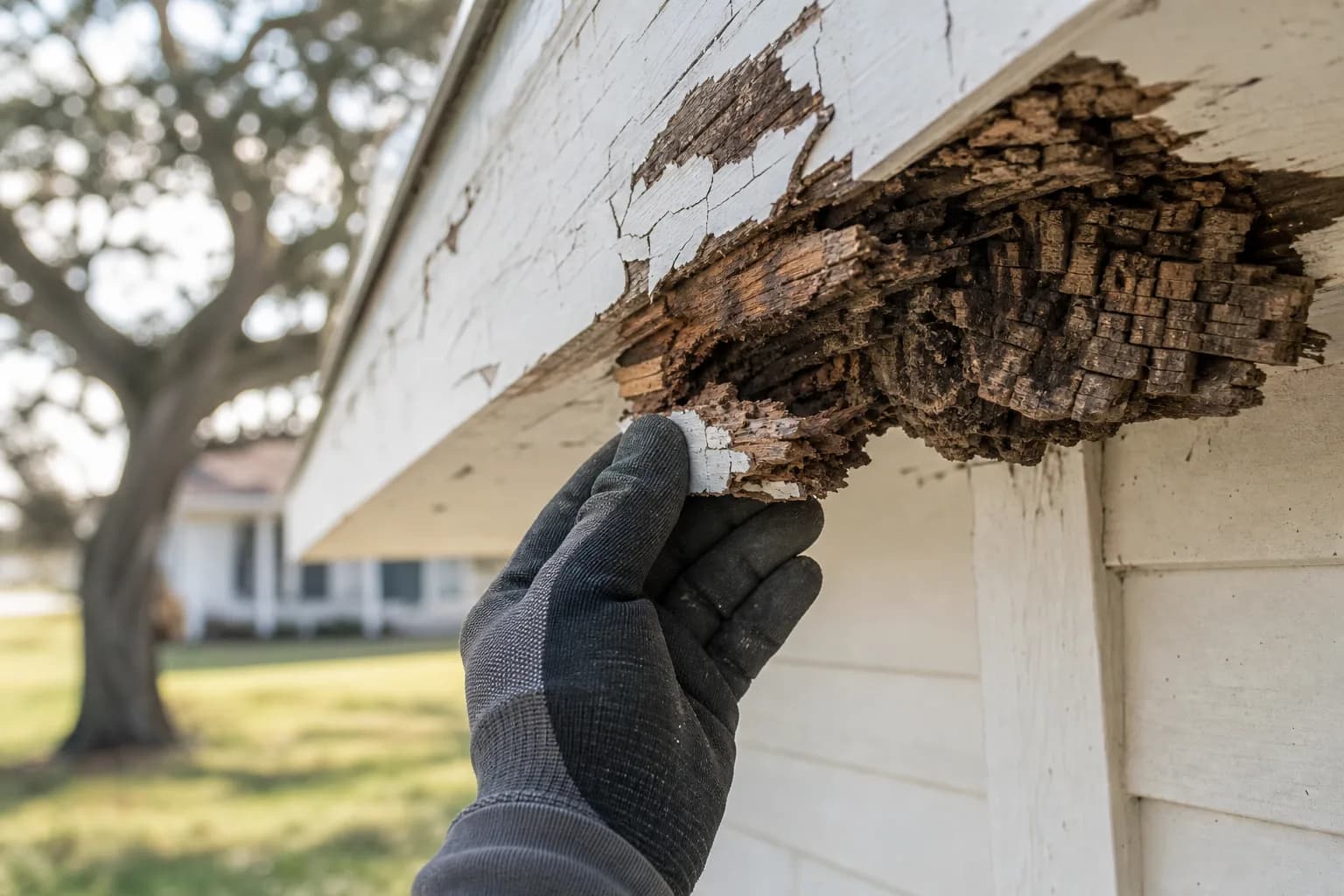
Two soft boards on the same house can be two different problems. One's dark and damp and pulls apart like wet rope. The other's bone-dry and crumbles into little cubes when you press it — and it's three feet from the nearest leak, in wood that looks fine from the curb. People lump it all together as "wood rot," but those are two different fungi behaving in two different ways, and telling them apart changes how far you have to chase the damage before you repaint.
This is a how-to-tell post. Not the repair-or-replace call, not a tour of where rot starts — just dry rot vs wet rot: what each one is, how to read which you've got, and why it matters on a Gulf Coast home where both thrive. Get the identification right and you fix it once. Miss dry rot's reach and you'll be back at the same wall next year.
Dry rot vs wet rot: same cause, different spread
Start with the answer, then the detail. Both dry rot and wet rot are wood-decay fungus, and both need moisture to live — the names mislead almost everyone. The real difference is how far each one travels. Wet rot stays where the water is. It softens the damp wood and stops at the dry edge. Dry rot spreads beyond the wet spot — it's a specific brown-rot fungus that can send strands across masonry and through sound, drier timber to carry moisture to fresh wood, so it reaches boards the leak never touched.
That single difference is why the identification matters. With wet rot, find the wet board, fix the water, replace what's soft, and you're done. With dry rot, the board you can see may be the smallest part of it — the fungus has been creeping behind trim and into framing the whole time. Patch only the obvious spot and you've left the rest of it growing.
How to tell which one you've got
You can usually call it from how the wood looks, breaks, and where it shows up. Press on the suspect board and look closely at the decayed fibers and the area around them.
| What you see | Wet rot | Dry rot |
|---|---|---|
| Moisture | Damp, wet to the touch, right at the leak | Wood ends up dry and brittle even away from water |
| Color | Dark brown to nearly black, sometimes bleached grey | Dull brown, faded, washed-out looking |
| How it breaks | Soft and spongy; fibers pull apart in strings | Crumbles to powder; cracks into small cubes |
| Telltale growth | Usually none — just soft, dark wood | Off-white or grey strands; a flat mushroom-like body |
| Where it shows | Only in wood that's actually wet | Can appear in drier wood away from the leak |
| How far it spreads | Stays in the damp area | Travels through masonry and sound timber |
The fastest tells in the field: cubes versus strings. Dry rot cracks the wood across and along the grain into small brittle cubes that powder when you rub them. Wet rot leaves the wood fibrous and stringy — push a screwdriver in and it sinks into soft, spongy material that holds together in wet strands. And location is the other tell: rot only where the wood is wet points to wet rot; crumbling wood that turns up away from the obvious water source, with thread-like strands running to it, points to dry rot.
Why does the Gulf Coast grow both kinds of rot?
Down here, the climate keeps the door open for either fungus. Wood rot wakes up when moisture content climbs and stays there, and our high humidity, frequent rain, salt air, and long damp stretches keep exterior wood wet far longer than it would be in a dry climate. Shaded north and east walls dry slowest, so trim, sills, and fascia on those sides tend to go first. That's the moisture cycle behind every kind of rot we find around Mobile Bay — and you can read the full version in our guide to what causes wood rot on coastal homes.
People are surprised dry rot shows up in a place this humid, because the name suggests a dry environment. It doesn't work that way. Dry rot still needs water to get established — it just becomes able to spread into drier wood once it's going, using its strands to move moisture. So our wet coast is exactly where it gets the foothold it needs. Knowing that keeps you from underestimating a crumbly spot that seems oddly dry: it may be the leading edge of something that started at a leak across the wall.
What each one means before you repaint
Identification isn't trivia — it sets how far you dig. Both kinds end the same way: the rot has to be cut back to sound wood and repaired or replaced, the wood primed on every face, and the water source that fed it fixed, all before any paint goes on. The difference is the search.
With wet rot, the damage is where the moisture is, so once you've found the wet board and traced the leak, you've found the job. With dry rot, you have to assume it reached farther than it looks — follow the strands, check the framing and trim around the obvious spot, and make sure you've cut back to wood the fungus never touched. Stop short and the brand-new board sits next to live rot that simply spreads back into it.
Whether the next move is a contained patch or pulling boards comes down to how far either rot has gone — and that judgment is its own decision, covered in repair or replace rotted wood before a repaint. If the rot's at a window, window sill and casing rot gets into that spot specifically, and the whole picture of carpentry as paint prep lives in our guide to wood rot, fascia, soffit, and trim. You can also see our carpentry and wood-repair service.
The bottom line: cubes that crumble and spread mean dry rot — chase it farther than it looks. Dark, spongy, stringy wood right at the leak means wet rot — fix the water and replace what's soft. Either way, don't paint over the question. If you've got a board you can't read, that's the call we make every day. Book a free in-home estimate and we'll tell you straight which rot it is and how far it's gone, then email a written quote within 24 hours — family-owned and working Mobile and Baldwin County since 2013, backed by our 3-year workmanship warranty and a 4.8-star rating across hundreds of Google reviews.