
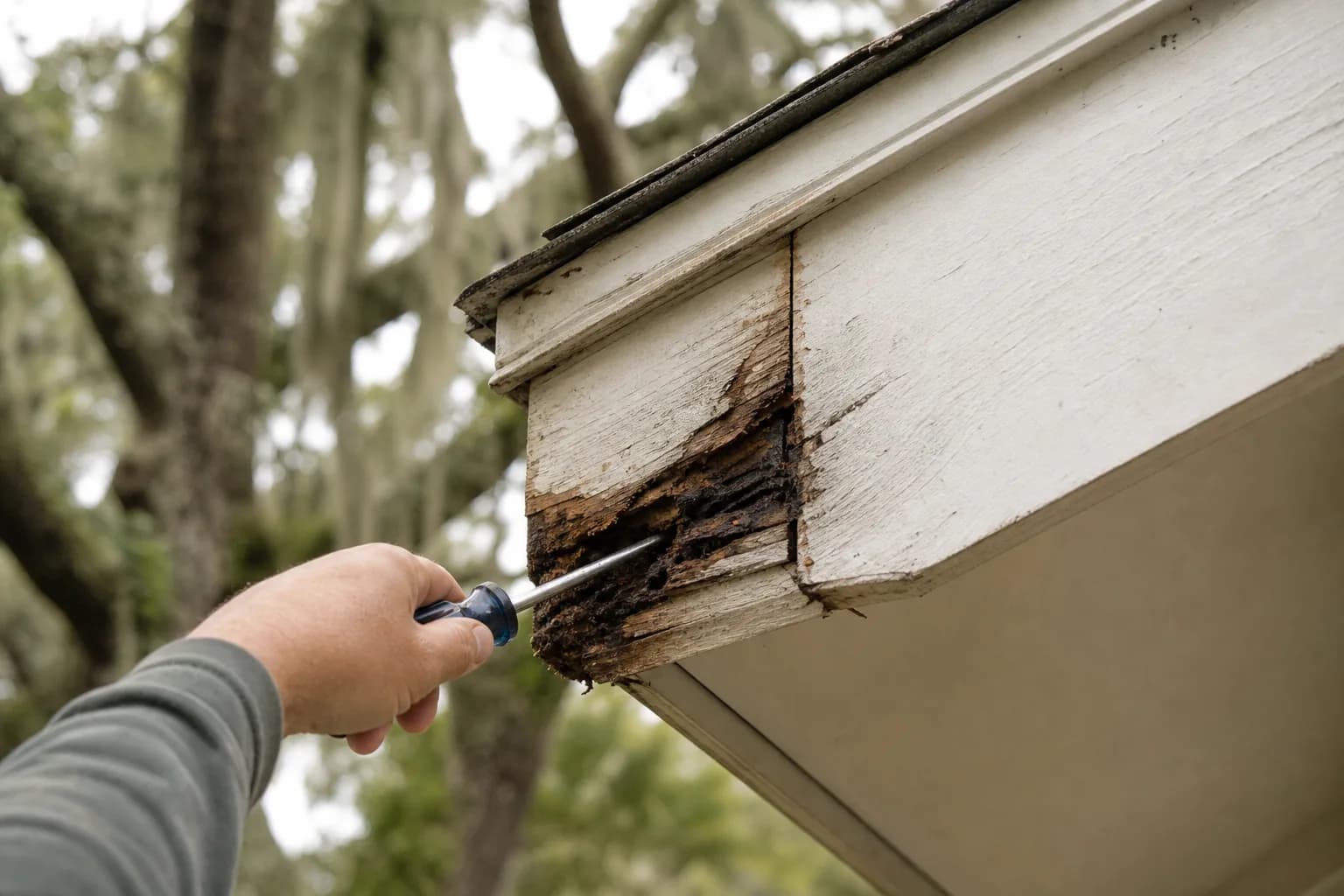
A homeowner in Daphne once pointed me to a fascia board that looked perfectly fine from the driveway. Up on the ladder, I pushed a screwdriver into it and the tip sank in like the wood was a sponge. The paint was holding the shape; the wood behind it was already gone. That's the thing about wood rot on the coast — by the time you can see it, it's usually been working for a while.
If you own a home anywhere near the Gulf, it's worth understanding what causes wood rot in the first place, because the cause is also the cure. Rot isn't bad luck or bad wood. It's a fungus following moisture, and once you know what feeds it, you know exactly how to stop it.
What causes wood rot: moisture, fungus, and four conditions
Here's the simplest version: wood rot is caused by fungus, and that fungus needs four things to grow. Take away any one of them and rot can't happen.
Moisture
Wet wood. This is the one you actually control. Fungus needs the wood damp enough, long enough, to take hold — dry wood is safe from it.Oxygen
Air. Always present around a house, so you can't remove it. Only fully submerged or fully sealed wood lacks it, and that's not your siding or trim.A comfortable temperature
Mild warmth. The fungus thrives in the same range we find pleasant — which on the Gulf Coast is most of the year.Wood to feed on
The wood itself. The fungus digests the fibers for food, which is what softens and weakens it.
Look at that list and one thing jumps out: three of the four are basically guaranteed on a coastal home. There's always oxygen. There's almost always a comfortable temperature. And the wood is, well, your house. The only condition you can actually take away is moisture — which is why every real wood-rot strategy comes down to keeping wood dry. Control the water and the fungus has nothing to start with.
How rot actually starts — and why it hides
Fungal spores are floating in the air all the time. They're harmless until they land on wood that's wet enough to wake them up. Once they do, they start feeding on the fibers, breaking the wood down and softening it from the inside.
It starts small and specific — wherever wood stays damp. A seam that leaks. A spot that never quite dries because it's shaded and the air doesn't move. End grain that wicks up water like a straw. From that first wet foothold, the rot spreads through the connected wood for as long as the moisture lasts, following the grain into trim, fascia, sheathing, and framing.
The reason it sneaks up on people is that it often runs behind intact paint. The finish still looks okay from the ground while the wood underneath turns soft. That's exactly what happened on that Daphne fascia — sound-looking paint over wood that was already spongy. If you want to know where to look before it gets that far, we mapped out the most common spots wood rot starts on a house, and the difference between the two kinds you'll run into in dry rot vs wet rot on Gulf Coast homes.
Why the Gulf Coast is so hard on wood
Every climate has some rot. Ours has a lot of it, and it's not your imagination. The Gulf Coast hands the fungus nearly everything on its wish list.
- Year-round humidity keeps wood from ever fully drying out, so damp spots stay damp.
- Frequent rain and wind-driven storms push water into seams, joints, and any gap a failing finish leaves open.
- Salt air degrades paint and caulk faster, so the very things that should be sealing your wood break down sooner.
- Mild temperatures keep the fungus active for far more of the year than a cold-winter climate would.
Put those together and a small moisture problem that might sit harmlessly for years up north turns into active rot here in a season or two. It's the same reason exterior paint works so hard on the coast — the conditions that peel a finish early are the same ones that rot the wood behind it. We break the climate side down in our exterior painting guide for Mobile and Baldwin County.
How to stop wood rot before it spreads
Because rot is a moisture problem, stopping it is a moisture solution. You don't fight the fungus directly — you take away its water and cut out what it's already eaten.
Find and fix the water source
Track down where the moisture is getting in — a failed seam, a leak, poor drainage, trapped humidity — and fix that first. Skip this and any repair just rots again.Cut back to sound, dry wood
Remove every bit of soft, punky wood and cut back to material that's solid and dry. Rotted wood can't be saved or painted over — it has to come out.Repair, prime, and seal the new wood
Replace what was removed, prime the bare wood on all sides, and seal the seams so water can't get back in. Sealed, dry wood is wood the fungus can't touch.Maintain the finish that protects it
Keep the paint, caulk, and sealant sound over time. An intact finish keeps water out of the wood — a failing one is how the next round of rot starts.
Notice what's not on that list: painting over the problem. You can't seal active rot under fresh paint — that just hides soft wood while it keeps spreading and traps the moisture that's feeding it. The honest fix is always dry it out, cut it out, seal it up. That's carpentry first, paint second.
Can you just paint over wood rot?
No — and it's the most common mistake we get called back to undo. Paint over soft, rotting wood and you've sealed moisture in, not out, so the fungus keeps eating the wood while the surface looks freshly done. Within a season or two the paint bubbles, the wood crumbles behind it, and now you're paying to fix the rot you paid to cover. There's a narrow exception: wood that's only surface-stained or barely starting can sometimes be dried, treated, and consolidated — and on small, sound-enough spots an epoxy wood repair rebuilds the section so it can hold paint again. But genuinely soft, punky wood has to come out. The test is simple: if a screwdriver sinks in, paint isn't the answer — carpentry is.
Keep the water out and the rot stays out
Wood rot on a coastal home isn't mysterious once you see the pattern: fungus follows moisture, and our climate keeps wood wet. Three of the four things rot needs are always here. The one you control is water — so keeping your wood dry, your finish sound, and your repairs sealed is the whole defense.
If you've got soft trim, spongy fascia, or paint that's bubbling over wood you're not sure about, don't wait to see how far it goes. Our carpentry and wood-repair service cuts the rot back to sound wood, fixes what let the water in, and seals it up right — and we follow it with paint that protects the repair. Reach out for a free in-home estimate, and read our full carpentry, prep, and rot-repair guide for the complete picture on keeping Gulf Coast wood sound.