
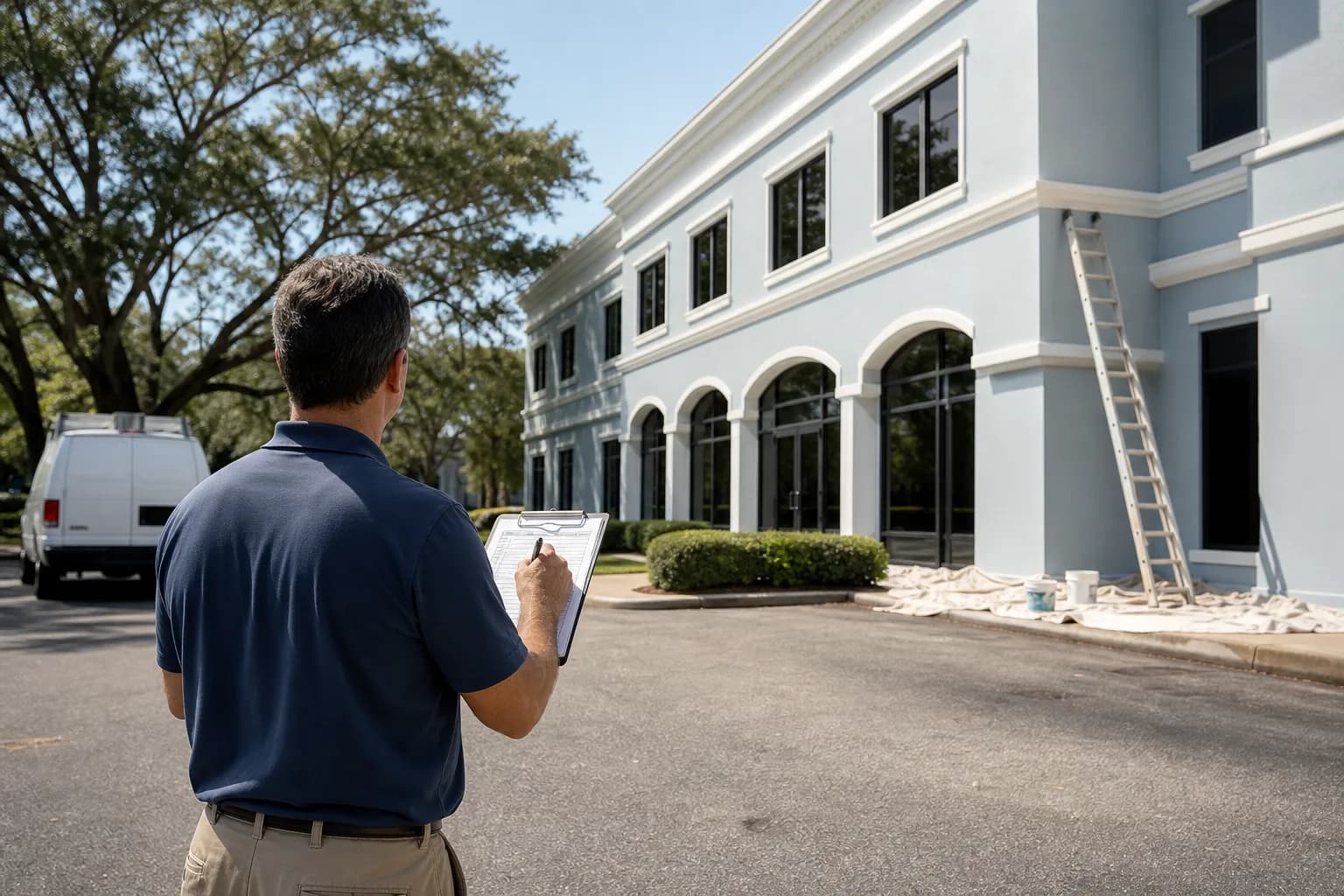
You found three commercial painters, the bids are in, and now you have to pick one without much to go on but a price and a good handshake. Skip the homework and the gaps show up later — a crew on your roofline nobody insured, a "two-week job" stalled at week four, fresh paint peeling off the loading dock by spring. The fix is boring and it works: run every bidder through the same short list before you sign.
This is that list — a scannable, print-it-out pre-hire checklist for a commercial painting contractor. It's built for facility managers, office and retail operators, and property owners who'd rather check boxes than wade through a wall of text. We're not re-explaining why each item matters here; for the reasoning behind every line, read our full guide on how to vet a commercial painting contractor. This page is the quick pass you make against each bidder, side by side.
The pre-hire checklist, item by item
Print this, make a column for each contractor you're considering, and mark every line yes or no. Anything you can't check is a question to ask before you go further — not a thing to assume.
| Checklist item | Cleared when you have… |
|---|---|
| Certificate of insurance | A current COI sent straight from their insurer or agent — active general liability and workers' comp covering your project dates. |
| Three commercial references | Three recent jobs like yours, with working numbers, that you've actually called. |
| Itemized written scope | A quote that breaks out prep, coats, products, areas, and schedule — not one lump sum. |
| Prep spelled out | Wash, scrape, repair, prime — named in writing, not buried under "includes prep." |
| Schedule + site plan | Off-hours or phased work, protected entrances and equipment, daily cleanup. |
| Single point of contact | One named person who runs the job start to finish. |
| Deposit terms | A modest, reasonable deposit — not most or all of the money up front. |
| Written warranty | Workmanship warranty term and what it covers, on paper. |
| Manager sign-off | Confirmation a manager inspects the finished work before final payment. |
The contractor who clears every line without flinching is usually the one you want. The one who stalls on insurance, hands you a single number with no scope, or pushes you to decide today just told you where the trouble will be.
Work the list in five quick passes
You don't have to do this all at once. Break the checklist into five short passes and you can clear most bidders in an afternoon.
Collect proof of insurance
Ask each bidder for a current certificate of insurance sent directly from their insurer or agent — active general liability and workers' comp that covers your project dates.Call three commercial references
Get three recent commercial jobs like yours and actually call them about schedule, cleanup, change orders, and how the finish is holding up a season later.Get the scope and quote in writing
Require an itemized quote covering prep, coats, products, areas, schedule, deposit, and warranty — never a lump sum with no detail behind it.Confirm the schedule and site plan
Pin down off-hours or phased work, how entrances and equipment are protected, daily cleanup, and one named point of contact.Lock down warranty and payment terms
Confirm the written workmanship warranty, the payment schedule, and that a manager signs off on the finished work before final payment.
What should each reference call cover?
A reference is only worth the call if you ask the right things. "Were you happy?" gets you a shrug. Get specific, and keep the questions the same for every reference so you can compare:
- Did the crew finish on the schedule they quoted?
- How were change orders and mid-job surprises handled?
- Did they protect the space and clean up at the end of each day?
- How does the work look now, a season or two out?
- Would you hire them again for a bigger job?
A steady pattern of commercial customers saying the same things — on time, clean, did what they said — beats any single five-star quote on a website. You're checking for consistency.
Red-flag column — auto-fails to weigh
Some answers don't just leave a box unchecked; they belong in a red-flag column. None is an automatic deal-breaker on its own, but stack two or three and keep looking:
- Most or all of the payment demanded up front.
- A verbal-only scope, or "we'll figure out the details later."
- No proof of insurance, or a COI that's expired or comes as a phone photo.
- Pressure to sign today, or a price that's "only good right now."
- A pitch built on trimming prep to hit a lower number.
Prep is the quiet line that decides whether your building still looks painted in three years. A bidder who shaves prep to win on price is selling a finish that fails early — that's exactly the standard we hold ourselves to on every commercial painting project, prep first and in writing. If two bids are far apart, the itemized scope almost always explains it: the cheaper one usually cut prep, coats, or both.
After the checklist: compare and decide
Once every bidder has run the gauntlet, lay the checklists side by side and the right choice usually makes itself obvious. The lowest number isn't the cheapest job if it skipped half the list. For the deeper reasoning on insurance, references, and scope, our commercial painting contractor vetting guide walks through the why behind each item, our questions to ask any commercial painter in Mobile sharpens the conversation, and our commercial painting guide for Mobile and Baldwin County covers the bigger picture.
We built Pro 1 Painters to clear this checklist without breaking a sweat. We're family-owned since 2013, we put an itemized scope in a written quote within 24 hours of a free estimate, and a manager signs off on the finished job before you make final payment — all backed by a 1-year workmanship warranty and a 4.8-star Google rating. If you're vetting painters for a commercial building in Mobile or Baldwin County, schedule a free on-site estimate. Pay by Cash, Check, or Credit Card.