
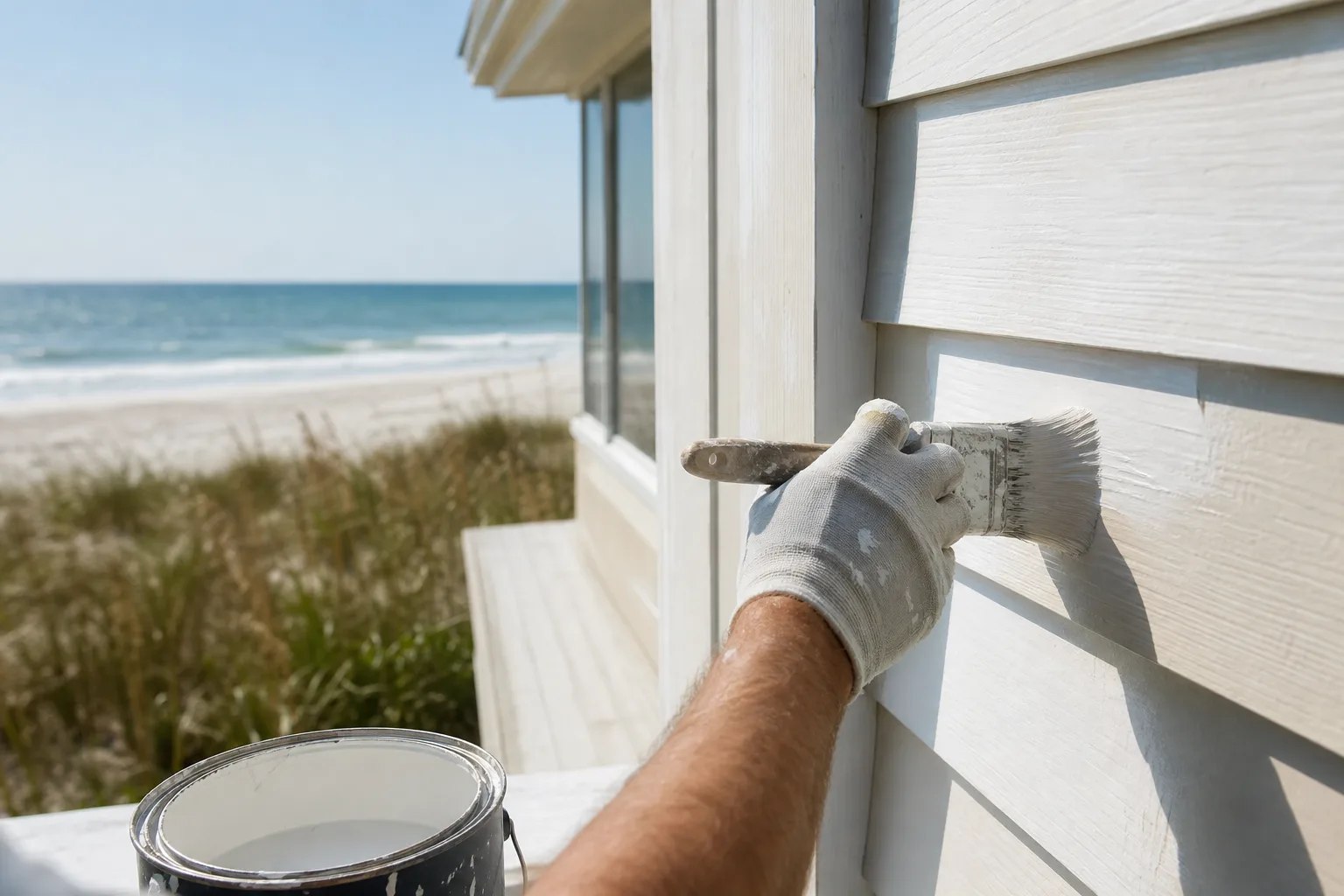
The paint aisle won't help you here. Every can trying to pick a finish for a Gulf Shores beach house promises the same things — durable, weatherproof, lasts for years — but most were never built for the front row. A home on the dune line in Gulf Shores or Orange Beach lives in salt spray, doubled UV, and storm-season humidity that feeds mildew on contact. Choosing the best exterior paint for a Gulf-front beach home isn't about the brand on the label. It's about reading the spec underneath it and matching the product to the harshest exterior environment in the state.
Our Gulf-front coastal painting and salt-air durability guide covers the prep and the systems that make a beachfront job last — and prep is the foundation of all of it. This guide is the companion: a straight look at the product itself. What resin to insist on, what sheen actually performs on the beach, what features to find on the can, how the metal gets its own system, and why color is a durability decision out here, not just a style one.
What the front row demands from a coating
Answer-first: a Gulf-front home needs a premium 100% acrylic exterior with a high resin load, a built-in mildewcide, and a strong UV package — applied in two coats — plus a separate rust-inhibitive primer for every piece of metal. That's the short version. Here's why each piece earns its place, because on the front row a coating has to answer four forces at once and a generic can only answers one or two.
- Salt spray sits on the film constantly and creeps into every fastener and rail. The coating has to shed it and rinse clean, and the metal under it needs its own corrosion barrier.
- Doubled UV — sun plus reflection off the water and white sand — breaks down a paint's binder fast. Without a serious UV package the finish chalks and fades on the Gulf-facing walls years early.
- Storm-driven rain forces water sideways into seams. The film has to stay flexible enough not to crack at the joints where that water tries to get behind it.
- Humidity and mildew. With heavy moisture in the air for much of the year, any coating without a real mildewcide grows the black-and-green speckle that ruins a white beach house.
A builder-grade or mid-tier can might shrug off one of those. The front row throws all four at the wall every day, which is exactly why the product choice is a real decision here and an afterthought three blocks back. We see the toughest exposure on the truly Gulf-facing homes — out on West Beach and along the Fort Morgan peninsula, where there's nothing between the siding and the salt — while a home set back in Craft Farms gets a slightly gentler version of the same forces. The closer you sit to the open Gulf Coast, the less forgiving the wall is, and the more the spec underneath the paint matters.
The best exterior paint for a Gulf-front home starts with resin
The single most important word on the label is acrylic — specifically "100% acrylic," not "vinyl-acrylic" or "acrylic latex blend." Resin is the binder that holds the pigment and grips the wall, and a full acrylic resin is what gives a coastal coating its flexibility and color retention through salt and heat. The premium lines also carry a higher resin load and more pigment than the economy lines, which is most of why they cost more and most of why they last on the beach.
So when people ask which brand is best for a Gulf-front home, the honest answer is that all the major manufacturers make a premium line that clears the bar — and any of their builder-grade lines will fail fast out here. The decision isn't Brand A versus Brand B. It's premium-tier versus mid-tier within whichever brand, and then matching it to your specific siding. We're glad to name specific products at your estimate, but we steer the conversation to the spec, not the badge.
| What to read on the can | Why it matters on the Gulf front | What you want |
|---|---|---|
| Resin / binder type | Acrylic flexes through heat, salt, and movement without cracking at seams | "100% acrylic" — not vinyl-acrylic or a blend |
| Mildew / mold resistance | Stops the black-green speckle humid salt air grows on a white beach house | A stated mildew- or mold-resistant film |
| UV / fade resistance | Counters the doubled UV off water and sand that chalks the Gulf-facing walls | A UV- or fade-resistant claim, and a premium-tier line |
| Coverage spec | Real film thickness is what delivers the durability the can promises | The manufacturer's two-coat exterior spec, not one |
| Metal primer (separate) | Salt corrodes bare railings and fasteners; rust bleeds through any topcoat | A dedicated rust-inhibitive primer before any finish on metal |
What sheen should you use on a beach-house exterior?
Sheen is where a lot of beachfront repaints go sideways, and it's the part the spec sheet won't decide for you. The instinct is to reach for a higher gloss because gloss sounds tougher. On the front row, that backfires on the body of the house. Under hard, reflected coastal light, a high-gloss wall spotlights every lap line, nail head, and bit of surface texture, and any imperfection reads from the street.
The performer for beach-house body siding is a low-luster finish — satin or low-sheen. It still sheds salt and rain and rinses clean in a quick wash, which is exactly what you want when salt film is settling daily, but it hides texture and minor surface variation far better than gloss does. Save the higher sheens for where they earn it: trim, fascia, railings, and the front door, where satin or semi-gloss gives you a crisp line and a harder, more scrubbable, more salt-resistant surface on the parts that take the most hand contact and weather.
The metal is a separate system
This is the piece a paint label will never tell you, and it's where beachfront jobs quietly fail. Salt is brutally corrosive on metal, and a beach house is covered in it — railings, balusters, light fixtures, fasteners, flashing. You cannot just roll exterior paint over bare or rusting metal on the Gulf front and expect it to hold. Within a season the rust works back through and streaks the wall below it.
Metal gets its own treatment: scrape and sand to sound material, then a dedicated rust-inhibitive primer before any finish coat. That primer is the corrosion barrier the body paint isn't designed to be. On the dune line we treat the metal as its own line item and re-check it on a shorter cycle than the siding, because the rails and fasteners face the salt with nothing between them and the air. Skipping this is the difference between a finish that lasts and one that's bleeding rust by next summer — and no premium body paint can make up for the missing primer underneath.
Color is a durability decision out here
On a Gulf-front home, color isn't only style — it's heat. Deep, saturated shades absorb more solar energy and show fading faster on the walls that take the doubled UV, while lighter, higher-LRV colors run cooler and hold their look longer. That's a big part of why the classic coastal palette — bright whites, soft grays, pale blues, weathered sand tones — became the beach-house standard. It reads right against the water, and it's the practical choice on the front row, where a moody charcoal will chalk and shift on the Gulf-facing wall sooner than a coastal white will.
None of which means you can't have a real color — it means choosing it with the exposure in mind, and seeing it before you commit. Our free AI Color Visualizer lets you upload a photo of your own beach house and preview real shades on it, so you're judging the color against your actual siding, roof, and that hard Gulf light instead of a chip in the store. For everything our crews include on a coastal exterior, see the exterior painting service page, and our take on why beachfront paint fails faster in Gulf Shores explains the forces this product spec is built to beat.
The bottom line for the front row
The best exterior paint for a Gulf-front beach home is a premium 100% acrylic with a high resin load, a real mildewcide, and a strong UV package, laid in two coats — in a low-luster body sheen, with the metal on its own rust-inhibitive primer system, in a color chosen for the heat. Match all of that to your specific home and you've given the front row a coating that can actually take it. Put a great can over the wrong sheen, bare metal, and no second coat, and the Gulf wins anyway.
We're a family-owned crew that's painted beach homes across Gulf Shores and the coast since 2013, with a 3-year workmanship warranty and a manager sign-off before any job is called done. If you're weighing paint for a Gulf-front home in Gulf Shores or Orange Beach, call us for a free on-site estimate — we'll look at your siding, trim, and metal, recommend a specific system honestly, and put a written quote in your hands within 24 hours.