
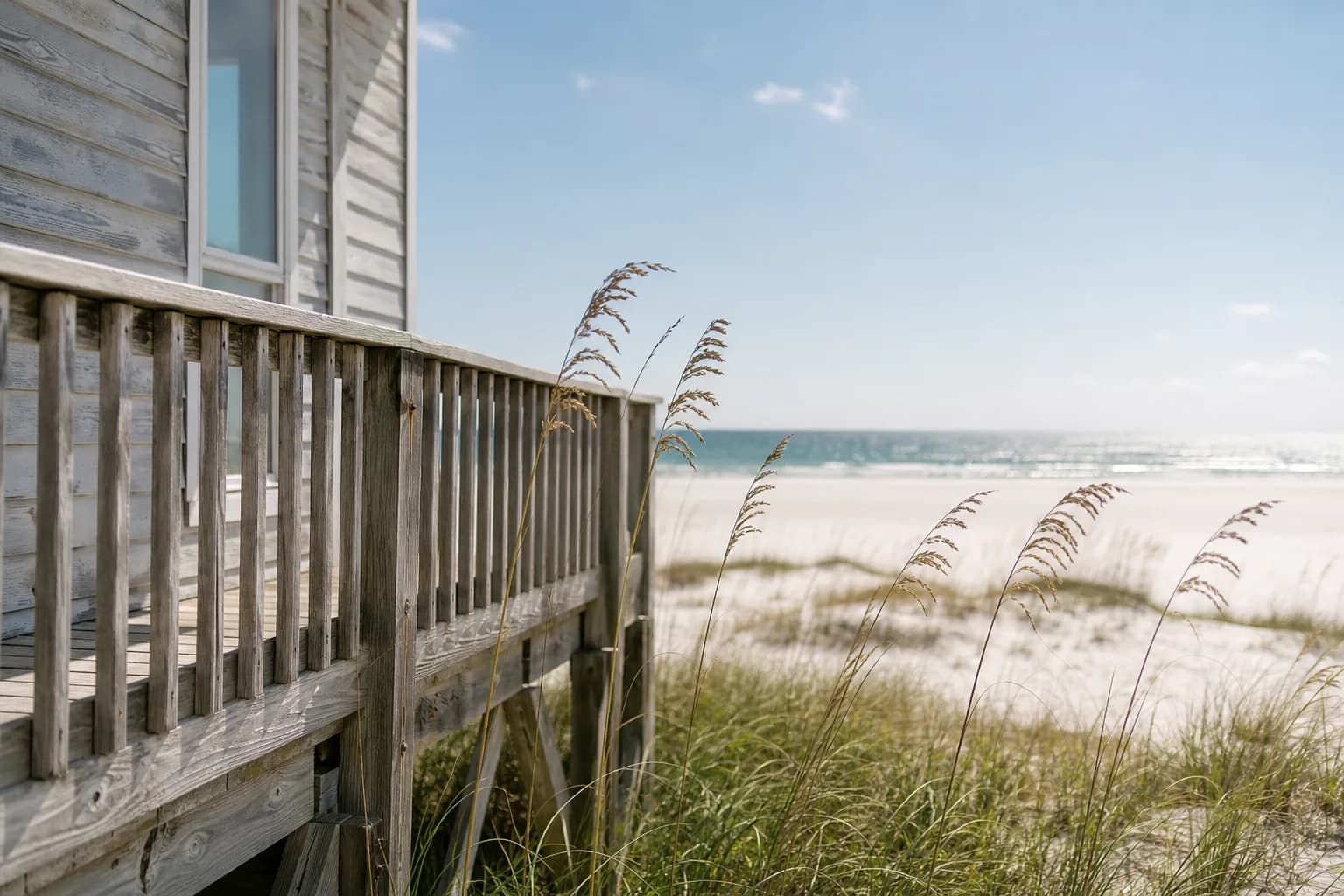
Two homes, painted the same year with the same product, two years apart in how they wear. One sits in the front row at the Gulf Shores dune line. The other is four blocks back. The front-row home is already chalking on its Gulf-facing walls while the inland one still looks fresh. Same product, very different result — and the difference is exposure.
Beachfront paint fails faster in Gulf Shores because a front-row home catches three forces at full strength, all at once: constant salt mist, harsh UV off the water and sand, and wind that carries fine sand against the finish. Move back from the water and all three drop off fast. Understanding that gradient — and those three forces — is the key to why your beachfront finish wears the way it does, and what actually holds up against it.
What are the three forces hitting a beachfront home at once?
Most homes face one paint enemy at a time. A beachfront Gulf Shores home faces three together, every day. That overlap is the whole story.
Salt mist. Surf throws salt into the air, and onshore wind carries it straight onto a front-row home. It settles as a film on every surface, holds moisture against the wall, and works at the bond between paint and substrate from below. The closer to the water, the heavier and more constant the film.
UV off the water and the sand. Direct sun is hard enough on a binder. At the beach, the home also takes sunlight reflected up off the water and bouncing off the bright white sand, so the south- and west-facing walls get hit from more than one direction. That extra reflected UV breaks down the resin holding the paint together faster than the same sun would inland.
Wind-driven abrasion. This is the force most people miss. Steady Gulf wind carries fine sand and salt particles that act like a mild sandblaster against the finish, slowly wearing it and opening tiny paths for moisture. Wind also drives rain sideways into seams and pushes salt deeper onto the walls. It's the quiet third force, and it's why beachfront wear isn't just about salt and sun.
Exposure drops off fast as you leave the water
The reason a few blocks makes such a difference is that all three forces fall off quickly with distance. Salt mist is heaviest right at the surf and thins out as the wind loses it inland. Reflected UV off the water and sand only reaches the front rows. Wind-driven sand is a beach-edge problem. So a home one street back gets meaningfully less of everything, and a home a half-mile in is in a different world entirely.
That's why the same paint job lasts longer the farther you are from the dune line, and why front-row homes are on the shortest repaint cycle in town. We see the heaviest wear on the true Gulf-front rows — the West Beach strip, the houses out along Fort Morgan, and the homes backing the dunes near Gulf State Park — while a place tucked behind Little Lagoon gets a meaningful break from the salt and sand. Gulf Shores housing skews newer — a median build year in the late 1990s, so a median home age around 25 years — but on the beachfront, the finish wears far faster than the structure, and the water-facing walls almost always wear out first. For how that plays out across the rest of the county, see how often to repaint a coastal home in Baldwin County.
What beachfront paint failure actually looks like
Because the forces are uneven across the house, the failure is too. Look for chalking — a powdery film when you rub the wall — as the binder breaks down under UV first. Then dulling and color fade on the Gulf-facing and south-west walls. Then loss of adhesion: the finish starts letting go where salt has held moisture against it. Exposed metal — railings, fasteners, fixtures — rusts and bleeds streaks down the wall. And the water-facing elevations show all of it a cycle ahead of the shaded sides.
The order matters, too. UV usually shows up first as chalk and fade, because the sun goes to work the day the paint cures. Salt-driven adhesion failure comes a little behind it, once moisture has had time to collect under the film and break the bond. Wind abrasion runs underneath both the whole time, thinning the finish and giving salt and water more ways in. By the time a homeowner notices peeling, all three have been at it for a while.
None of this means the paint was bad. It means the exposure was heavy and the system underneath it wasn't built for the front row. A finish applied over salt film, or over wood that wasn't sealed, gives out fastest of all — it never really bonded, so the salt, sun, and wind only have to finish what a skipped prep step started.
What actually holds up at the dune line
You can't turn down the salt, sun, and wind. You can build a system that takes them. On a beachfront home that means a thorough freshwater wash to strip the salt before anything else, repairing and sealing every gap so wind-driven rain can't get behind the finish, priming all bare wood and every piece of exposed metal with a corrosion-resistant primer, and topcoating with a flexible, UV- and moisture-rated coating made for the coast, applied in full coats.
That system — not the brand on the can — is what separates a beachfront paint job that lasts from one that's chalking by the next season. Our exterior painting work is built around it, and the full salt-air playbook lives in our gulf-front coastal painting durability guide. If your home is one of the elevated, piling-built houses on the strip, the structure underneath needs the same treatment — we cover that in West Beach elevated home painting.
Painting the Gulf Shores beachfront
We're a family-owned crew that's painted the Gulf Coast since 2013, based in Spanish Fort about an hour up the road. We build the system to match the exposure, run one accountable crew from the free estimate through the final inspection, and back every job with our 3-year workmanship warranty. You can see our coverage on the Gulf Shores service page.
If your beachfront finish is wearing faster than you'd like, call us for a free in-home estimate. We'll read the exposure on your home and hand you a written quote within 24 hours.