
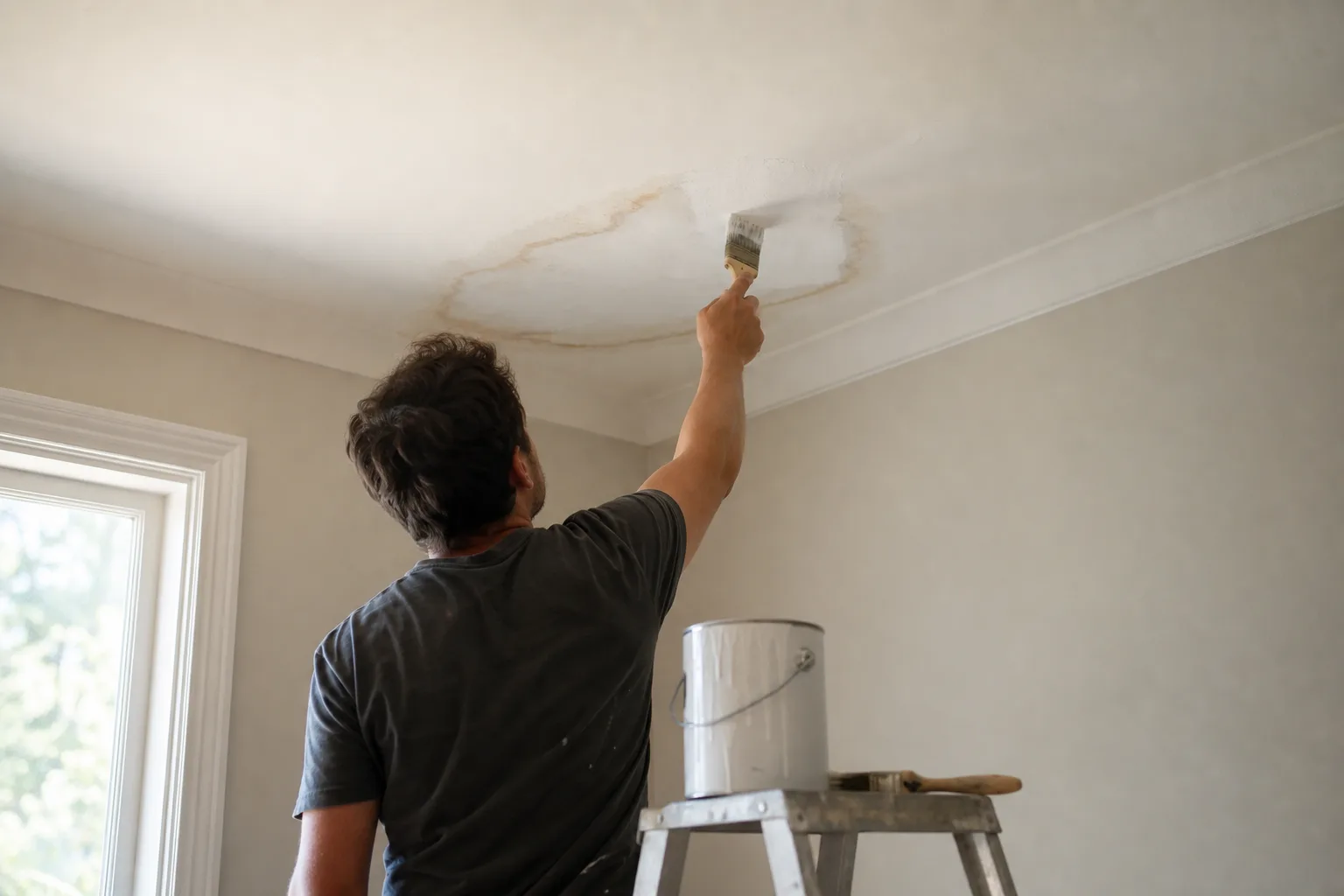
You patched the wall, rolled on two coats of good paint, and the room looked done — until the next morning, when that brown water ring ghosted right back through your fresh white like it was never covered. It's one of the most frustrating things in painting, and it comes down to one thing: the wrong primer, or no primer at all. The best stain-blocking primer isn't a single product. It's the one that matches the stain you're fighting, and picking right is the difference between sealing a mark for good and repainting the same wall twice.
This guide is about choosing the primer — the chemistry, and which type actually stops water rings, smoke, grease, and tannin from bleeding through. If you're still deciding whether your walls need primer at all, start with our guide on when interior walls need primer before painting. Here, we assume you've got a stain and you need it gone for good.
Why can't ordinary paint cover a stain?
Answer first: most wall stains are either water-soluble or oil-based, and ordinary latex paint can't seal either one. When you roll water-based paint over a dried water stain, the moisture in the paint re-wets the stain and it wicks up into the wet film — so the mark reappears as the coat dries. Oily stains like smoke and grease bleed through for a different reason: latex never fully blocks them, so they keep migrating to the surface coat after coat. A stain-blocking primer works because it forms a sealed barrier the stain physically can't cross. That's the whole job of the product, and it's why no amount of extra topcoat does what one coat of the right primer does.
The three stain-blocking primer types
There are three families of stain-blocking primer, and they line up almost perfectly from toughest to most convenient. Knowing what each one is built for is how you stop guessing at the paint store.
| Primer type | Best for | Trade-offs |
|---|---|---|
| Shellac-based | The worst stains and odors — heavy water rings, smoke, soot, nicotine, pet and fire odors, stubborn bleed-through | Strongest blocker and seals odor too; dries fast; needs ammonia or denatured alcohol for cleanup and has a strong smell while wet |
| Oil-based | Most water stains, tannin bleed from wood and knots, marker and grease, everyday problem spots | Excellent all-around stain blocker; slower dry and a stronger odor than water-based; cleans up with mineral spirits |
| Water-based (latex) stain-blocker | Light, dry stains, faint marks, low-odor jobs, and quick spot-priming | Easiest cleanup and lowest odor; good on minor stains but can let the heaviest water and smoke stains bleed through |
Shellac: the heavy hitter for smoke and bad water rings
When the stain is serious — a dark water ring that's soaked the drywall, smoke and soot from a kitchen fire, nicotine film on a former smoker's walls, or any stain that comes with a smell — shellac-based primer is the answer. It's the most aggressive blocker on the shelf, it seals odor as well as the stain, and it usually does it in one or two coats. The trade-offs are real: it has a strong smell while it's wet and you clean up with ammonia or denatured alcohol, not water. But for the stains that defeat everything else, nothing else is as reliable.
Oil-based: the all-around problem-solver
For the everyday problem spots — most water stains, the tannin and knots that bleed through from wood and trim, marker, crayon, and grease — an oil-based stain blocker is the practical workhorse. It seals better than water-based primer and handles a much wider range of stains, without the bite of shellac. It dries slower and smells stronger than latex, and it cleans up with mineral spirits, but it's the primer that quietly handles the majority of stained-wall jobs we see.
Water-based: easy cleanup for light stains
A water-based (latex) stain-blocking primer is the right call when the stain is light and dry — a faint scuff that won't wash off, a small dry mark, minor discoloration — and you want low odor and soap-and-water cleanup. It's convenient and it's fine for minor work. Just know its limit: a heavy water ring or real smoke film can still bleed through it, so it's not the one to reach for when the stain is serious.
Match the primer to the stain
The fastest way to choose is to name the stain and work back to the product. Water rings and ceiling marks from past leaks: oil-based for most, shellac for the dark, deep ones. Smoke, soot, nicotine, and any odor: shellac, no question. Tannin bleed from wood, knots, or cedar trim: oil-based or shellac, because water-based primer lets tannin through. Grease and kitchen film: clean it first, then oil-based. Marker, crayon, and pen: oil-based or shellac. Light, dry, faint marks: a water-based stain blocker is plenty. When in doubt, size up — a primer that's stronger than the stain costs you nothing but a little cleanup, while one that's too weak costs you a whole repaint.
Spot-prime, then paint
For a single stain, you don't need to prime the entire wall. Spot-prime the marked area, feathering the primer a little past the edges of the stain, then paint the whole wall so the sheen stays uniform — a primed patch under a single topcoat can flash if the wall around it got two coats, so carry the finish wall-to-wall. The exception is a wall that's stained all over, like a former smoker's room or a fire-damaged space, where a full coat of shellac or oil-based primer over the whole surface is the right move before color. Stains are also a classic case where good wall prep makes or breaks an interior paint job — sealing the mark is prep, and skipping it is what brings the stain back.
The bottom line on stain-blocking primer
The best primer for stains, smoke, and water marks is the one matched to the stain: shellac for the worst water rings, smoke, and odors; oil-based for the broad middle of water and tannin stains; water-based for light, dry marks. Fix the source first, spot-prime the stain, then paint the full wall — and the mark stays gone instead of ghosting back through your fresh coat.
If a stain has beaten you twice already, or you'd rather have it sealed and the room repainted right, our interior painting crew handles stain-blocking as part of the prep on every job. When the stain comes with damaged drywall, our drywall repair and painting team fixes the surface and seals it in one pass. Book a free in-home estimate and you'll get a written quote within 24 hours, backed by our 3-year workmanship warranty.