
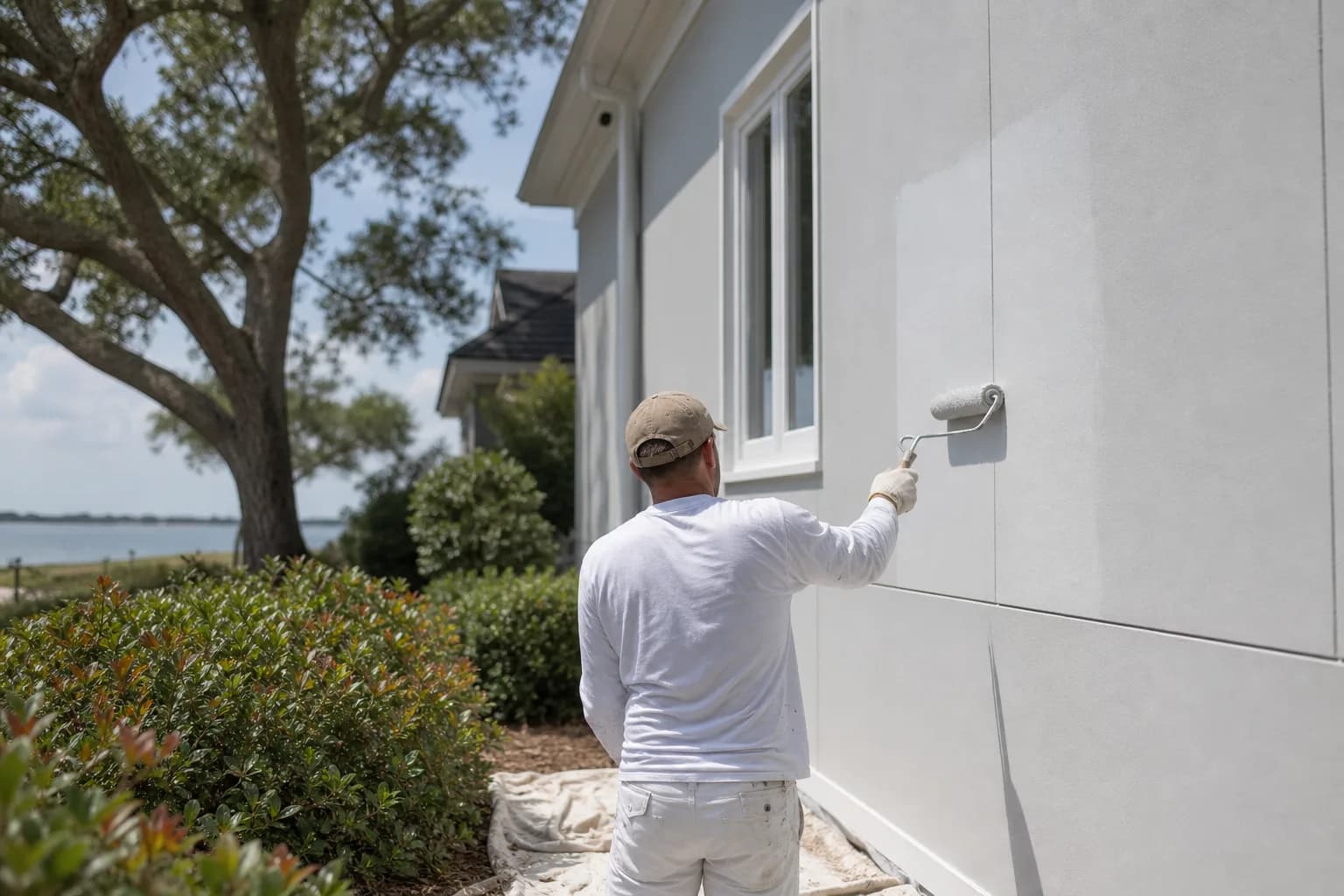
Your house has that smooth, seamless stucco look — no board lines, no brick, just clean walls — and the color has gone tired or dingy. Before you grab a roller, here's the thing nobody at the paint counter tends to mention: that wall is probably EIFS, and EIFS is not the same animal as the rough cement stucco on an older home. Treat it like ordinary masonry and you can do real, expensive damage.
So can you paint EIFS synthetic stucco? Yes — and it repaints beautifully when it's done with the right product and the right prep. But there's one rule that governs everything: the wall has to breathe. Get that wrong and you trap moisture inside a foam-backed wall in the most humid climate in the country. Here's what every Gulf Coast homeowner should understand before repainting synthetic stucco.
Rather have it handled? Our EIFS & stucco painting uses a breathable finish made for synthetic stucco, with the cracks and sealant joints sealed first.
What EIFS actually is — and why it's different
EIFS stands for Exterior Insulation and Finish System. In plain terms, it's a layered wall built over rigid foam insulation: foam board, a reinforced base coat, and a thin acrylic-based finish on the outside that gives it that smooth, monolithic look. It is not the thick, hard, cement-based stucco your grandparents' house had. It's lighter, it's softer, and — this is the part that matters — it sheds water on the outside but does not breathe the way old-school stucco does.
That construction is exactly why painting it is a different conversation. A heavy, sealing product that would be fine on brick can choke an EIFS wall, because any moisture that ever finds its way in — through a crack, a bad sealant joint, a roof-line detail — needs a path back out through the finish. Lock that path and the water stays put against the foam. On the Gulf Coast, where wind-driven rain and humidity are relentless, that's the failure mode you build your whole approach around avoiding.
How to repaint EIFS the right way on the coast
Painting synthetic stucco is mostly about what happens before the finish goes on. The wall itself is fine to recoat; it's the details — the cracks and the penetrations — that decide whether the job protects your home or quietly fails behind it. Here's the sequence we follow.
Inspect for moisture and damage first
Before anything, we check the whole system for soft spots, staining, swelling at windows and the base, and a hollow sound — signs water may already be behind the EIFS. If we find that, it's a remediation issue, not a paint job, and we tell you so.Wash the wall gently
We clean off salt film, mildew, chalk, and dirt with low-pressure washing. EIFS is softer than cement stucco, so we don't blast it — high pressure can gouge the finish and force water into the foam.Seal cracks and penetrations
We fill cracks and re-seal failed joints at windows, doors, trim, and every penetration with the right flexible sealant. This is where water gets in, so this step does more for the wall's life than the paint itself.Spot-prime as needed
Bare, repaired, or patched areas get primed so the finish bonds evenly across the whole wall and nothing flashes or peels early.Apply a breathable acrylic finish
We roll and spray a vapor-permeable 100% acrylic finish rated for stucco-type surfaces, built to shed coastal rain while letting the wall breathe — cured in the right weather window so it sets properly.
Notice that the inspection comes first, not the paint. We're a painting company, and a good repaint can make an EIFS home look new again. But if that wall is hiding water behind it, no finish on earth fixes that — and painting over it just buries the problem. Our crew knows the warning signs, and we'd rather flag them at your free estimate than coat over them. For the cracks-and-sealant side of this, the same discipline we cover in our guide on where to caulk a Gulf Coast exterior applies directly to keeping water out of synthetic stucco.
What finish goes on synthetic stucco?
The product matters as much as the prep here, because most exterior paints are not formulated to breathe the way EIFS needs. The right choice for synthetic stucco is a high-quality, vapor-permeable 100% acrylic finish rated for stucco-type surfaces and for our climate. We use Sherwin-Williams products built to let the wall breathe while standing up to intense coastal sun, salt air, and humidity. The two specs we care about most are permeability — so moisture can leave — and adhesion to a clean, sound surface.
Color is the fun part, and EIFS takes color well once the surface is right. Going lighter helps reflect our heat; going darker is doable but worth a conversation about exposure and heat gain on a foam-backed wall. Because exterior color reads so differently in bright Gulf light than on a chip, our free AI Color Visualizer lets you preview real colors on a photo of your own house before you commit. If you want help landing on a shade and finish that hold up out here, our color consultation is worth the time. And for how our coast treats different surfaces and which products last, our rundown of the best paint brands for Gulf Coast homes covers the same logic that drives the EIFS choice.
When EIFS needs more than paint
This is the honest line we draw. Pro 1 paints EIFS — we'll prep it, seal it, and recoat it with a breathable finish that protects a sound wall for years. What we are not is a remediation or repair specialty for water that's already gotten behind the system. Those are different trades with different tools.
If we open up an estimate and find soft, spongy areas, staining bleeding through, swelling at the base or windows, or a wall that sounds hollow, that points to moisture trapped inside the EIFS — and that needs a specialist to investigate and correct before any paint makes sense. Painting a wet wall doesn't protect it; it just hides the damage and lets it grow. Timing the actual painting also matters, since EIFS needs a dry, mild window to cure cleanly — the same weather logic we lay out in when not to paint if rain is in the forecast. We'd rather give you the straight read than sell you a coat of paint over a problem.
Bottom line
Yes, you can paint EIFS synthetic stucco — and a proper repaint with a vapor-permeable finish brings that smooth, seamless look right back. The rules that matter: let the wall breathe, seal every crack and penetration before the finish goes on, wash gently because the surface is soft, and never paint over signs of moisture trapped behind the system.
We're a family-owned crew that's repainted exteriors across Mobile and Baldwin County since 2013, and we treat synthetic stucco for what it is — a layered, foam-backed wall that has to stay breathable on the coast. See how we approach a coastal repaint on our exterior painting page, then request a free in-home estimate and a written quote within 24 hours, backed by our 3-year workmanship warranty.