
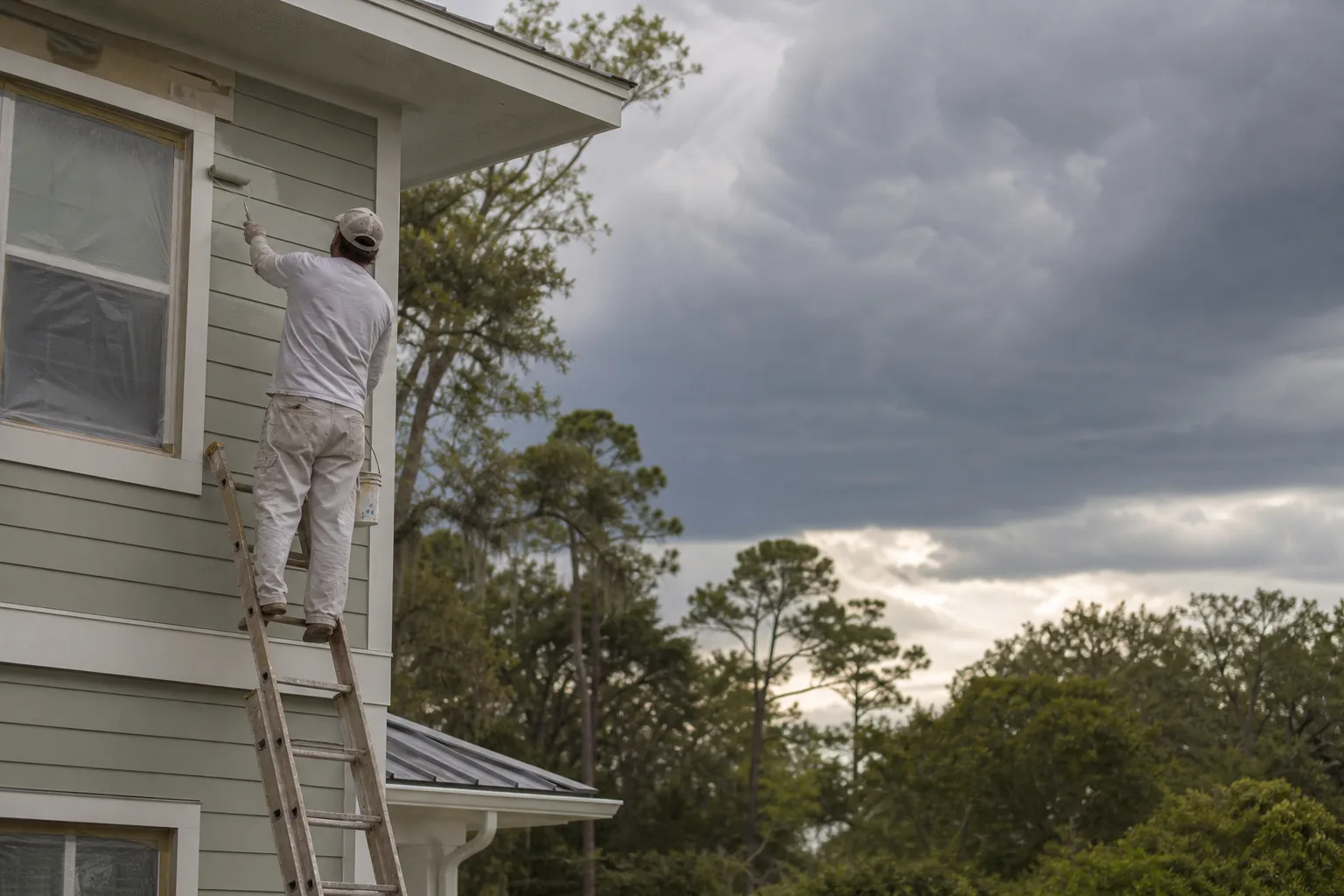
The forecast says "60% chance of rain," the homeowner assumes that kills the day, and the crew that doesn't understand paint either packs up too early or — worse — rolls a coat at three o'clock that a four-o'clock thunderstorm washes off the wall. Can you paint when rain is in the forecast? Usually yes — but the answer lives entirely in the timing. Not whether rain is coming, but when, and whether the paint has time to set before it gets here.
This is one of the most common questions we get on the Gulf Coast, where a "chance of rain" is just the daily weather. Here's the straight answer: how much dry time fresh paint actually needs, the safe window before a storm, and what we reschedule versus push through when coastal Alabama does its usual afternoon pop-up routine.
Can you paint before it rains? It's all about the timing
Answer-first: yes, you can paint before it rains — as long as the fresh coat has enough dry time before the first drop. The percent chance matters far less than the hour the rain shows up.
A "40% chance of rain" tells you almost nothing useful for painting. What matters is the timing: rain expected after dark gives you a full, safe day; a storm two hours out means you don't start a wall you can't finish and let set. So we read the timeline, not just the number — when the rain is due, how fast it's moving, and on the Gulf Coast especially, what the radar shows for the afternoon, because the morning forecast misses the daily pop-up storms entirely.
The rule we run by: never start a coat we can't finish and give a comfortable cushion of dry time before rain is due. A coat that just barely beats the storm isn't safe — it's a gamble with your finish.
How much dry time exterior paint needs before rain
Answer-first: most exterior latex needs at least a couple of hours to dry to the touch and longer before it can safely take rain — and humidity stretches that out, so always follow the can and build in a cushion.
Fresh paint dries in stages. It firms to the touch first, but it isn't truly rain-safe until it's set up further — and the exact times depend on the product, the temperature, and the air. As a working rule, give exterior latex at least a couple of hours of dry time minimum, and more before you'd trust it against rain. The dry and recoat times printed on the can are the real authority for the specific paint and conditions; we go by those, then add margin.
Humidity is the wildcard, and on the Gulf Coast it's always in play. Damp air slows evaporation, so the same coat that would be rain-safe in a few hours in dry weather stays soft and vulnerable longer on a muggy day. High humidity also raises the odds a coat blushes. That's why we don't paint to a fixed clock — we lengthen the cushion when the air is sticky. The full mechanics are in our explainer on how humidity and dew point break a paint job, and the day-to-day timing side is in our piece on painting around Mobile's humidity and dew point.
| When is the rain expected? | Can we paint? |
|---|---|
| Tonight or tomorrow | Yes — a full, safe day to work and let coats set. |
| Late afternoon, several hours out | Usually yes — start early, finish the last coat with dry time to spare. |
| Within about 2 hours | No new coats — the paint can't set in time. |
| Pop-up storm building on the radar now | Stop and protect fresh work; resume when it clears and the surface dries. |
What happens if it rains on fresh paint?
Answer-first: rain on paint that hasn't set can streak it, make it blush or run, wash pigment out, or leave it weak and spotty — and that section may need to be redone once it dries.
This is the whole reason timing matters. Truly fresh exterior paint is still soft, and a downpour can drag pigment down the wall, leave a cloudy blush, or wash a thin spot right off the siding. It often doesn't show its full damage until everything dries, and then it looks like a paint defect when it was really a scheduling one. If a surprise Gulf Coast storm catches genuinely fresh work, we let it dry, assess it, and recoat whatever didn't hold — that's covered under our 3-year workmanship warranty. But the far better outcome is not getting caught, which is what the planning is for.
How a Gulf Coast crew works around the rain
Answer-first: on the coast we plan each day around the rain timing, work the right surfaces for the window we have, and push a day rather than risk the finish.
Coastal Alabama gets near-daily pop-up afternoon storms in the warm months and roughly 52 inches of rain a year, so working around rain isn't the exception here — it's the standard operating routine. Here's the order we run on a day with rain in the forecast.
1. Read the timing of the rain, not just the chance
We check when the rain is expected, not only the percent chance. A storm eight hours out can be fine; one in two hours is a no-go. We watch the radar for Gulf Coast pop-up afternoon storms, not just the morning forecast.2. Give each coat its dry time before the first drop
We plan the last coat so it has a comfortable cushion of dry time before any rain is due — going by the product's dry and recoat times and adding margin when the air is humid.3. Paint the right surfaces for the window we have
On a marginal day we work the sheltered or faster-drying elevations and save big exposed walls for a clear stretch. We never start a coat we can't finish and let set before the weather turns.4. Stop early and protect fresh work if a storm builds
If the radar turns, we quit with dry time to spare rather than race it. Protecting the finish beats redoing a wall, so the patient call wins every time.
A rainy day doesn't have to stall everything, either — if the outside is washed out, it's often the perfect time to knock out interior painting, which the weather never touches.
The short version
Yes, you can paint with rain in the forecast — if the fresh coat gets enough dry time before it arrives, and a careful crew watches the timing and the radar instead of just the daily percentage. The pieces that decide it are dry time, humidity, and honest scheduling. For the seasons that paint best around here, see our guide to the best time to paint a house exterior in coastal Alabama, and for the other half of the warm-season question, can you paint in the summer heat on the Gulf Coast. When you want a crew that takes the weather seriously, all of it lives inside our exterior painting work.
Pro 1 Painters is family-owned, working Mobile and Baldwin County since 2013. We time exterior work to the weather, back it with a 3-year workmanship warranty and our 4.8-star Google rating, and a manager signs off before final payment. Ready to get on the schedule for the next clear stretch? Reach out for a free in-home estimate and a written quote within 24 hours. We accept payment by Cash, Check, or Credit Card.