
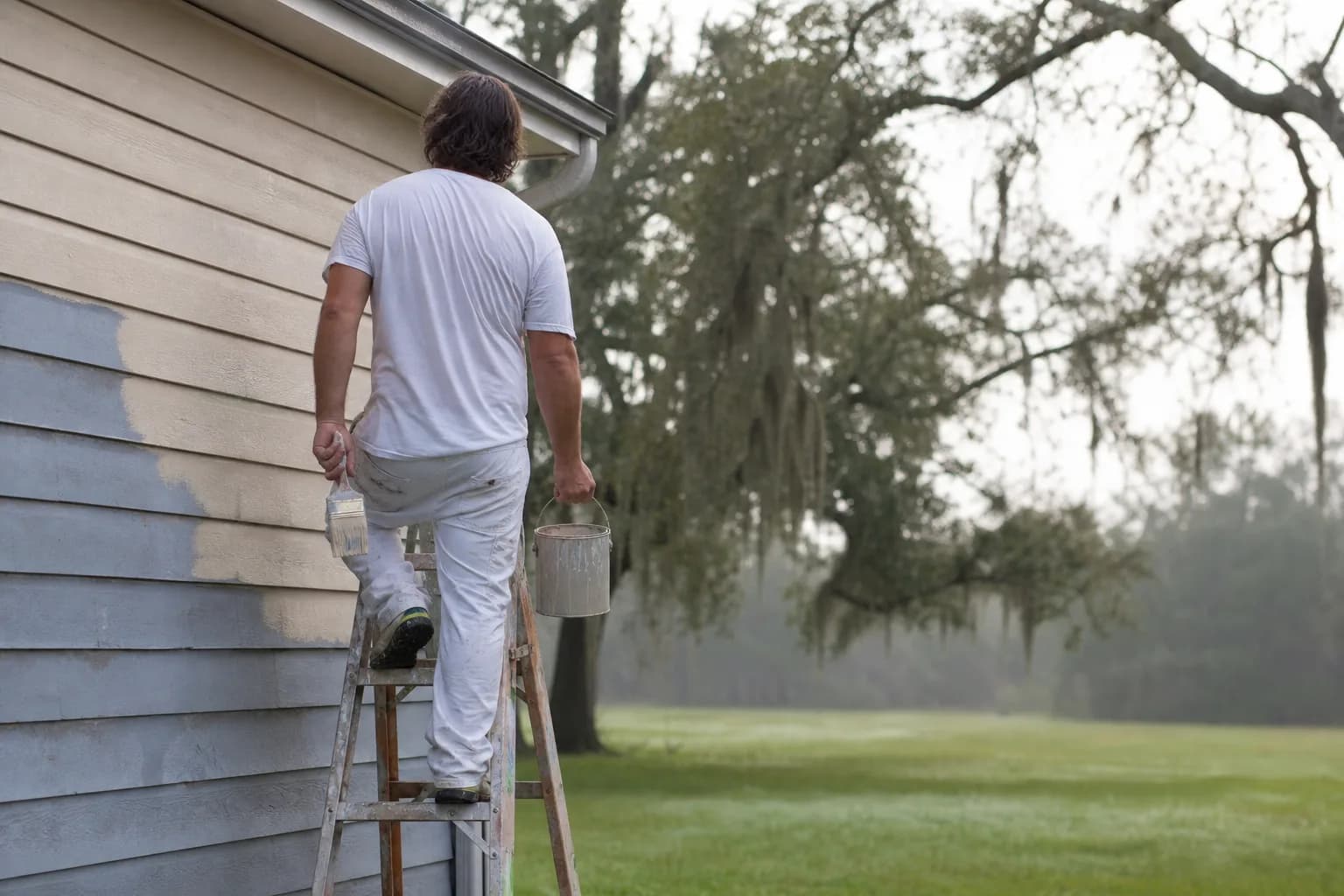
A crew shows up, the siding looks dry, the can says it'll handle the weather — and three months later the paint is peeling in sheets. Nine times out of ten on the Gulf Coast, the paint wasn't the problem. The air was. When it comes to humidity and painting, the moisture in the air and the dew point quietly decide whether a coat bonds for years or starts failing by the next season — and they're two numbers a good painter watches as closely as the color.
This is the part of a paint job nobody puts on the brochure. Here's how humidity affects painting in real terms, what dew point has to do with a finish that lasts, why a careful crew sometimes waits a day, and the conditions that make paint fail early in our climate — so you know what "we're watching the forecast" really means before you ever book a job.
How does humidity affect a paint job?
Start with the simple version: paint has to dry and cure, and humidity controls how fast — or whether — that happens. Most paints, especially water-based ones, release moisture into the air as they cure. When the air is already saturated, that moisture has nowhere to go, so the paint dries slowly, can stay tacky, and bonds poorly to the surface.
Most exterior paints are formulated to go on best below about 70% relative humidity. Push past roughly 85% and you're asking for trouble: streaking, a soft finish that marks easily, and adhesion that won't hold up. On the Gulf Coast, summer afternoons routinely sit in that danger zone, which is exactly why timing matters here more than it does in a dry climate.
Dew point: the number most people miss
Humidity gets the attention, but dew point is the one that catches homeowners off guard. Dew point is the temperature at which water condenses out of the air onto a surface. When your siding cools to within about 5°F of the dew point, a thin film of moisture forms on it — even on a sunny day, even when the surface looks bone dry.
Paint applied over that invisible film can't grip the surface. It blushes, streaks, or peels later, and the homeowner is left wondering why a fresh coat failed. That's why a careful crew compares the surface temperature to the dew point, not just the air temperature on a weather app.
| Surface vs. dew point | What's happening | Paint? |
|---|---|---|
| More than 5°F above dew point | Surface is dry, moisture won't condense | Good to go |
| Within about 5°F of dew point | Invisible moisture film forming on the surface | Wait |
| At or below dew point | Condensation actively on the surface | Do not paint |
This is also why the same wall can be paintable at 11 a.m. and a bad idea at 8 a.m. — the morning surface is still cool and damp from overnight dew, and it has to warm up and dry before anything goes on.
Why this hits the Gulf Coast harder
Our climate stacks the deck. The Eastern Shore and Mobile area see long, humid summers, heavy overnight dew, and roughly 50-plus inches of rain a year. That means more days where the air is saturated, more mornings where dew sits on the siding, and shorter daily windows when conditions are actually right for exterior work.
It's a big reason paint fails early here when a job is rushed. A coat applied to a damp surface, or laid down too late in the day to cure before the evening dew point climbs, can blister or peel within a season or two — and it looks like a paint problem when it's really a timing one. (For the full picture on that kind of failure, see why coastal humidity causes peeling and blistering.) Pair that with our salt-tinged bay air, and the margin for cutting corners gets thin. (Salt and humidity are hard on a finish in their own right — more on that in how salt air and humidity shorten paint life.)
The fix isn't exotic. It's prep plus patience: get the surface genuinely dry and sound, then paint inside the right window.
How a good crew reads the conditions
Here's the routine a careful painter runs before the first coat on a Gulf Coast day. None of it is complicated — it's just the difference between a finish that lasts and one that doesn't.
Check humidity and dew point
Pull the day's relative humidity and dew point. Aim to paint under about 70% humidity with the surface staying well above the dew point through the cure.Measure the gap to the surface
Compare the surface temperature to the dew point. Within about 5°F and moisture is condensing on the wall, even if you can't see it — so hold off.Let the dew burn off
Give the sun time to dry overnight dew off the siding before starting. A damp surface ruins adhesion no matter how good the paint is.Stop early enough to cure
Quit with enough daylight left that the finish sets before the evening dew point climbs. Racing the dark is how a late coat blushes or stays tacky.
What this means when you hire
You don't need to memorize dew-point math. You just want a crew that takes it seriously — one that checks conditions, preps properly, and isn't so rushed that it paints a damp wall to keep a schedule. When you're comparing painters, ask how they handle humidity and weather days. The good ones have a clear answer; the cheap-and-fast ones usually don't.
It also helps to set your own expectations going in. A Gulf Coast exterior repaint isn't a job that always wraps in two perfect back-to-back days, because the weather here doesn't always cooperate. A crew that builds in a little weather margin — and tells you up front that a humid stretch might add a day — is being honest about the climate, not slow. The finish you're paying for is measured in years, so a day's patience at the start is cheap insurance. The same logic is why we won't start a coat we can't finish and cure before the evening damp rolls in: a wall left half-done overnight in our humidity is a wall we'd rather not gamble on.
For more on separating the careful crews from the rest, see our guide on how to hire a painter in Mobile and Baldwin County, and our take on the best time to paint a house exterior in coastal Alabama for the seasonal windows that work here.
When you're ready, we'll give you a free in-home estimate and a written quote within 24 hours — and we'll paint your home when the conditions are right to make it last. Learn more about our exterior painting work, then reach out.