
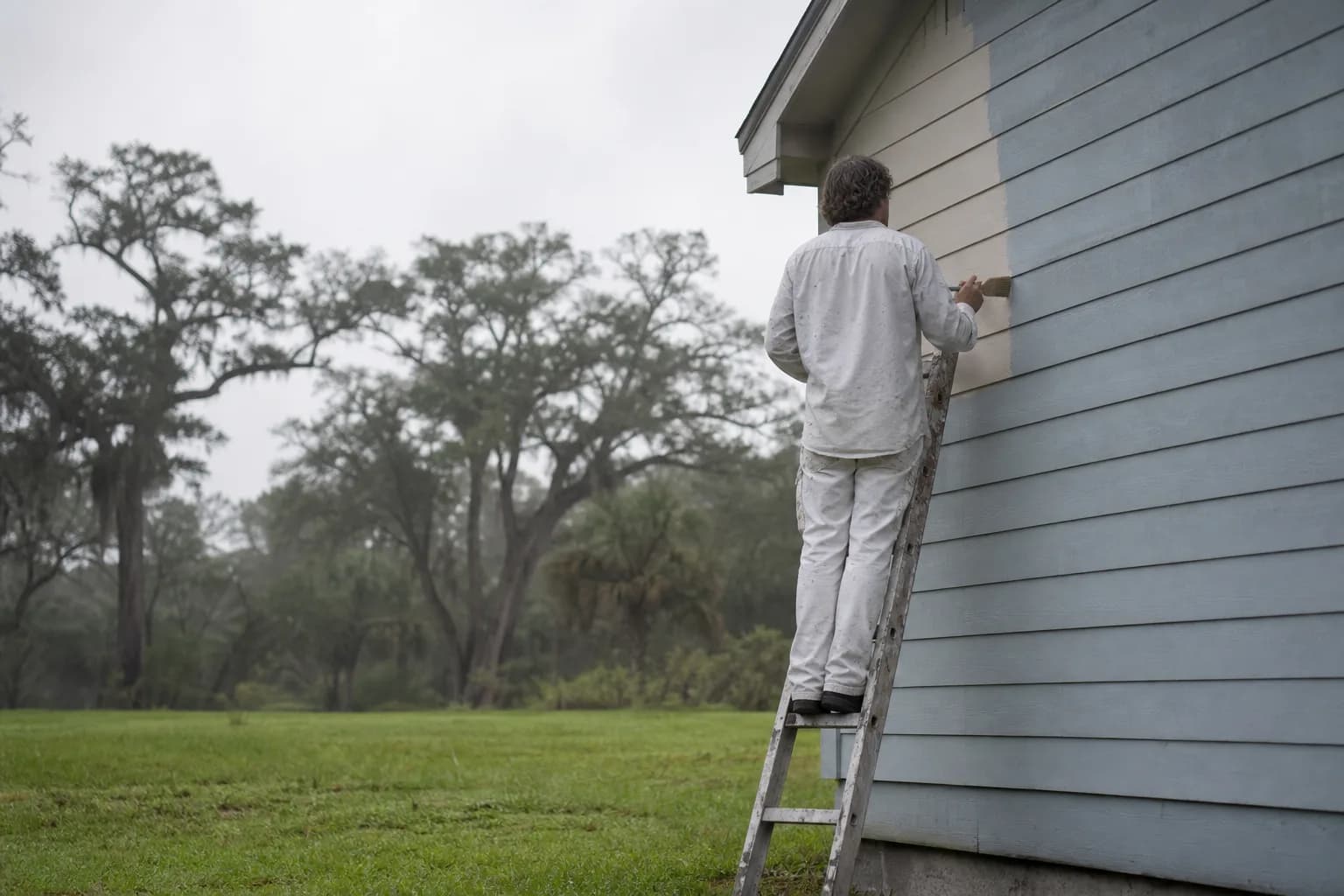
The forecast says clear and 80 degrees, the homeowner is ready, and a less careful crew is already up on the ladder by eight. By noon a thunderhead is building over Mobile Bay, and the wall they coated at nine — still cool and damp from overnight dew when the brush touched it — is the wall that'll be peeling by spring. Painting around Mobile's humidity isn't about avoiding the rain you can see. It's about timing each coat to the two numbers that quietly decide a Mobile paint job: how much moisture is in the air, and the dew point sitting on your siding.
This is the scheduling side of the work — not the science of why moisture wrecks a finish, but the day-to-day rhythm a crew actually runs here. When the dew burns off, why the afternoon matters as much as the morning, and which stretches of the Mobile calendar genuinely paint well. If you want the underlying mechanics first, our explainer on how humidity and dew point break a paint job covers the why; this post is the when.
Painting around humidity: the shape of a Mobile day
A Mobile summer day has a usable middle and two bad ends, and the whole job is finding that middle. Early morning, the siding is wet — overnight dew clings to the walls well past sunrise in our humidity, and a damp surface ruins adhesion no matter how good the paint is. Late afternoon brings the other problem: the evening dew point climbs back up and, through the warm season, a thunderstorm is often building. A coat laid down too late doesn't have time to set before moisture returns.
So the work lives in between. We don't start on a clock — we start on the wall. When the sun has dried the dew off and the surface feels warm and dry to the hand, the window is open; when a storm is on the radar or the light's getting long, it's closing. On a sticky Mobile afternoon, relative humidity routinely pushes past the ~85% line where water-based paint stops curing cleanly, and the honest move is to chase a drier elevation or call it for the day.
Two numbers that run the schedule
Humidity gets the attention, but dew point is the one Mobile homeowners almost never hear about — and it's the one that catches a rushed crew. Dew point is the temperature at which moisture condenses out of the air onto a surface. When your siding cools to within about 5°F of the dew point, an invisible film of moisture forms on it, even on a clear day, and a coat applied over that film can't grip. It blushes, streaks, or peels later, and it looks like a paint defect when it was really a timing one.
That's why the same Mobile wall can be a bad idea at 8 a.m. and perfect at 11 — the morning surface is still cool and damp, and it has to warm and dry before anything goes on. The full go/no-go routine, including the surface-temperature side of it, lives in our temperature and humidity rules for Gulf Coast exteriors. Here's the short field version we run on every Mobile day.
| Time of a Mobile day | What's happening to the wall | Paint? |
|---|---|---|
| Early morning | Overnight dew still on the siding, surface near the dew point | Wait — let it dry |
| Mid-to-late morning | Dew burned off, surface warming and dry | Open window — go |
| Midday | Warm, dry, humidity at its lowest for the day | Best window of the day |
| Mid-afternoon | Heat peaks, storm risk builds, humidity climbing | Watch the radar; finish coats |
| Late afternoon / evening | Dew point rising, moisture returning to the wall | Stop — let the last coat cure |
Which months actually paint well in Mobile?
Mobile gets roughly 52 inches of rain a year, one of the wettest totals in the country, and most of it falls through the humid warm season — so the genuinely paint-friendly stretches are shorter here than inland. The strongest window is mid-fall into early winter: the summer humidity finally lifts, the near-daily storms quit, and walls get the dry, settled days a coat needs to cure and bond. With January lows that only dip into the high 40s on average, Mobile rarely gets cold enough to shut exterior work down the way a northern climate does — the limiter here is moisture, not freeze.
Early spring, before the air turns sticky again, is the next-best run. Summer isn't off the table — plenty of Mobile exteriors get painted in July with afternoon highs near 94°F — but the windows are tighter, so we schedule around the dew and the storms instead of fighting them. The deeper seasonal breakdown is in our guide to the best time to paint a house exterior in Mobile, and if you want a realistic sense of how long your specific job should take given the weather, our free Project Timeline Calculator helps you plan it out.
How we sequence a coat through a Mobile day
None of this is complicated — it's just the routine a careful crew runs so the conditions hold while the paint cures. Here's the order, start to finish, on a Mobile painting day.
Read the day before the crew arrives
We check Mobile's relative humidity, the dew point, and the afternoon storm chance. The aim is under about 70% humidity with the surface staying well above the dew point through the cure, and we watch the radar for the daily storm pattern.Wait for the morning dew to burn off
We don't start on the clock — we start on the wall. We let the sun dry overnight dew off the siding, which on a humid Mobile morning runs into mid-to-late morning, and feel the wall before the first coat goes on.Follow the shade through the day
We work the elevations as they move into and out of sun so no wall bakes or stays cold and damp. The shaded north walls and oak-canopy elevations dry slowest and get the most patience.Stop with daylight and dry air to spare
We quit early enough that the last coat sets before Mobile's evening dew point climbs and the afternoon storm risk hits. Racing the dark or a thunderstorm is how a coat blushes, streaks, or washes out.
What this means when you book a Mobile job
You don't have to track dew points yourself — that's our job. What you want is a crew that takes Mobile's weather seriously: one that waits for the dew to burn off, watches the afternoon radar, and won't start a coat it can't finish and cure before the evening damp rolls in. When you're comparing painters, ask how they handle humidity and weather days. The careful ones have a clear answer; the cheap-and-fast ones change the subject.
This matters more in some Mobile neighborhoods than others. The deep live-oak canopy over Spring Hill, Midtown, and Oakleigh Garden keeps north and east walls cool and damp well into the morning, so those elevations dry slower than a wide-open lot out in West Mobile — and we read each one before we commit a coat.
It also helps to set expectations going in. A Mobile exterior repaint doesn't always wrap in two perfect back-to-back days, because the weather here doesn't always cooperate, and a crew that builds in a little weather margin is being honest about the climate. Reading the conditions is only half a finish that lasts — the other half is prep, which we cover across our exterior painting work and our coastal exterior guide for Mobile and Baldwin County.
When you're ready, we'll give you a free in-home estimate and a written quote within 24 hours, and we'll paint your home in Mobile when the conditions are right to make it last. We're family-owned, here since 2013, and we accept payment by Cash, Check, or Credit Card.