
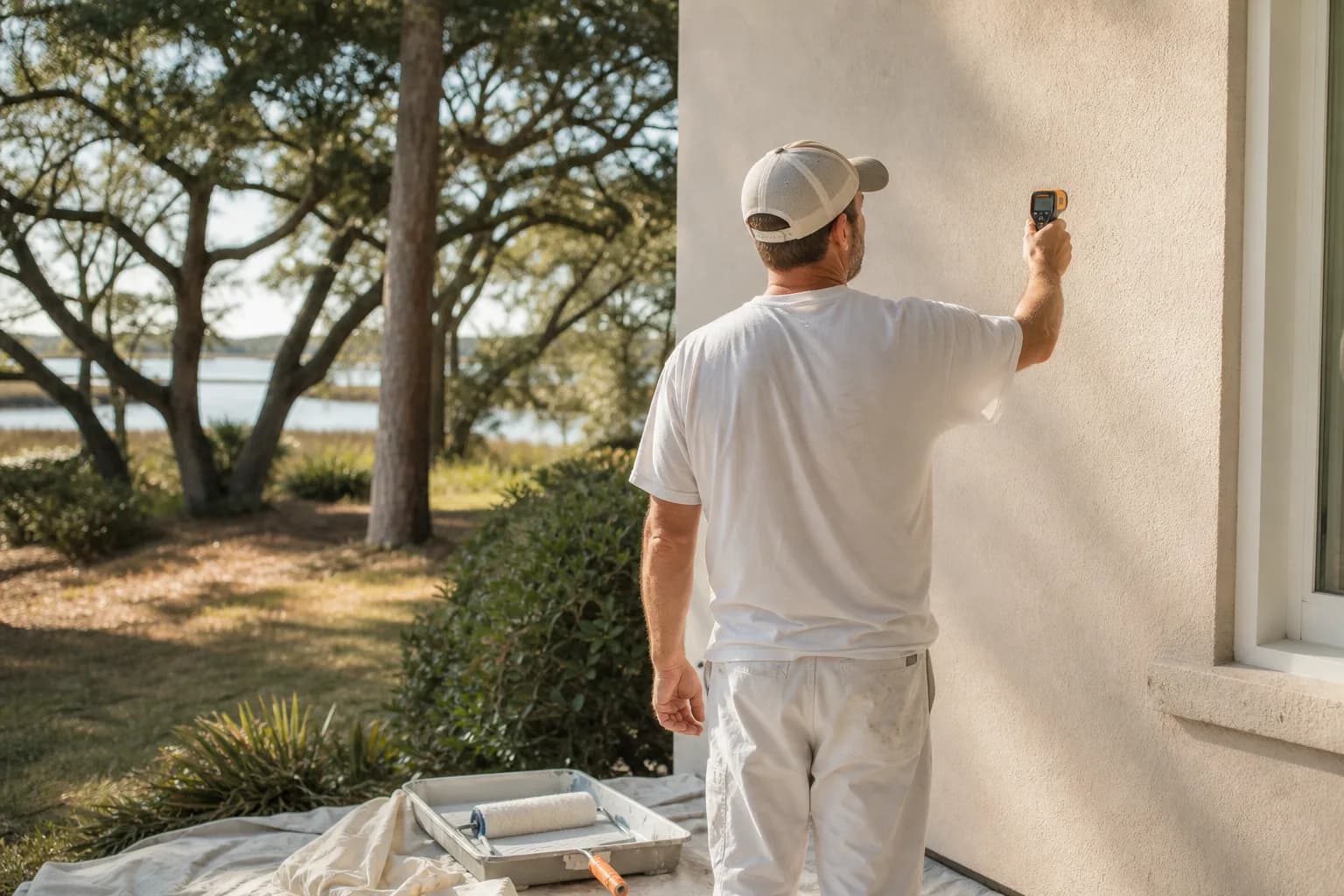
Two crews can use the same paint, the same brushes, and the same color on the same street — and a year later one house looks sharp while the other is peeling. The difference is usually not the paint. It's whether the crew knew the rules for when to put it on. The right temperature to paint exterior surfaces, the humidity ceiling, and the dew-point gap are three numbers that quietly decide whether a coat lasts for years or starts failing by the next wet season.
This is the practical, "can we paint today" version — the go/no-go checklist a careful crew runs before the first coat on a Gulf Coast day. Not the deep science of why moisture wrecks a finish (that's its own subject), just the working rules: how warm the wall has to be, how humid is too humid, and how to time each coat through a coastal day so the conditions hold while the paint cures.
The right temperature to paint exterior surfaces
Start with the number most people get half right. The best temperature to paint an exterior is a surface temperature, not the air temperature on your phone. Most standard exterior paints want the wall and the air somewhere between about 50°F and 85–90°F while the coat goes on and cures. Some products stretch that range — there are low-temp formulas rated near 35°F and others built for heat — but the can always has the final say, and that mid-range is the dependable window here.
Why the surface and not the air? Because paint reacts to whatever it actually touches. A wall in direct Gulf sun can run 20–30°F hotter than the thermometer on your porch — hot enough to flash-dry a coat into lap marks before it can level or bond. The same wall first thing in the morning, still cool from overnight, can sit below the paint's minimum even on a mild day. So we feel the wall or read it with an infrared thermometer instead of trusting the forecast high.
For a deeper look at the heat end of this — surface vs. air on a 95°F day and how crews chase the shade — see our guide on whether you can paint in summer heat on the Gulf Coast. For the cold end, including why the overnight low matters more than the afternoon high, read cold-weather painting and whether you can paint in winter.
The humidity ceiling — and why the coast tests it
Temperature is only half the rule. Humidity for exterior painting matters just as much, because paint has to release moisture as it cures, and saturated air gives that moisture nowhere to go. Most exterior paints are formulated to go on best below about 70% relative humidity. Push past roughly 85% and you invite slow drying, streaking, a soft finish that marks easily, and adhesion that won't hold.
On the Gulf Coast, that ceiling gets tested constantly. Long humid summers, heavy overnight dew, and our heat mean plenty of afternoons sit right in the danger zone — which is exactly why timing here matters more than it does in a dry climate. The honest move on a muggy day is to work a drier window or wait for a better one. A crew that paints a wall in 90% humidity to keep a schedule is buying you a finish that fails early.
| Condition | Rough rule | Call |
|---|---|---|
| Surface temperature | About 50°F to 85–90°F | Inside the range, and not baking in sun |
| Relative humidity | Under ~70% ideal; ~85%+ risky | Lower is better; high humidity means wait |
| Surface vs. dew point | More than ~5°F above dew point | Below that and moisture is condensing — stop |
| Holds through the cure? | Conditions stay in range while it sets | A good noon window can fail by a cold, damp night |
The dew-point gap most people miss
Here's the third number, and it's the one homeowners almost never hear about. Even with the temperature in range and humidity reasonable, a surface that has cooled to within about 5°F of the dew point grows an invisible film of moisture — and paint over that film can't grip. It blushes, streaks, or peels later, and it looks like a paint defect when it was really a timing one.
So a careful crew compares the surface temperature to the dew point, not just the air temperature, before committing a wall. The mechanics of why that film forms — and the full story of how our humidity drives early failure — live in our explainer on humidity, dew point, and how they break a paint job and why coastal humidity causes peeling and blistering. For this checklist, the rule is simple: keep the surface more than 5°F above the dew point, going on and through the cure.
Putting it together: how a crew reads the day
The three numbers don't get checked once and forgotten — they get read together, and they have to hold through the cure, not just at the moment the first coat goes on. A 78°F afternoon at 60% humidity is a great window; the same wall facing a 45°F overnight low is a no-go, because the coat can't finish curing before the temperature drops out from under it. Here's the routine, start to finish.
Check the surface temperature, not the air
We feel the wall or read it with an infrared thermometer and confirm it's inside the paint's rated range — usually about 50°F to 85–90°F — before anything goes on. A sunlit wall reads far hotter than the air; a shaded morning wall, far cooler.Confirm the humidity is in range
We pull the day's relative humidity and aim for under about 70%. Anything past roughly 85% is a wait — water-based paint won't cure cleanly in saturated air, and a humid Gulf afternoon hits that often.Measure the gap to the dew point
We compare the surface temperature to the dew point. Within about 5°F and moisture is condensing on the wall even if you can't see it, so we hold off until the gap opens up.Make sure the window holds through the cure
We check that temperature and humidity will stay in range for the whole cure, not just the start. A good noon window followed by a cold, damp night can still ruin a fresh coat.Time each coat through the day
We start after the dew burns off, follow the shade so no wall bakes in direct sun, and stop with enough daylight and warmth left for the last coat to set before the evening damp returns.
What does this mean when you hire a painter?
You don't need to memorize any of this. You just want a crew that does — one that checks the wall, watches the humidity and the dew point, and isn't so rushed that it paints a damp or baking surface to keep a calendar. When you're comparing painters, ask how they handle temperature and weather days. The careful ones have a clear answer; the cheap-and-fast ones change the subject.
Reading the conditions is only half of a finish that lasts — the other half is prep. For the seasonal windows that work best around here, see our exterior house painting coastal guide and the best time to paint an exterior in Spanish Fort. When you're ready, we'll give you a free in-home estimate and a written quote within 24 hours, and we'll paint your home when the conditions are right to make it last. Learn more about our exterior painting service, then reach out.